
A CASTE CENSUS IS NOT A SILVER BULLET FOR SOCIAL JUSTICE
Why in the News?
- Census data have traditionally served as a crucial foundation for public policymaking in India, informing decisions in areas like health, education, employment, and housing.
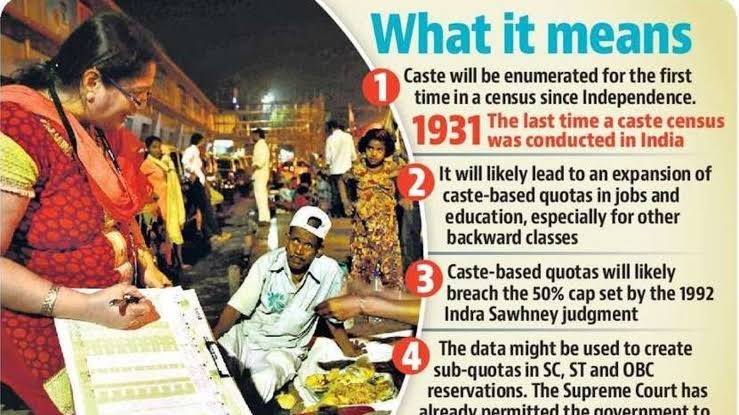
- The Narendra Modi government has recently announced the inclusion of caste enumeration in the upcoming national Census.
- This move has attracted widespread attention due to its potential implications for social justice, resource distribution, and welfare planning.
- It is expected to impact debates on affirmative action, reservations, and social welfare programs.
Concerns Regarding Overemphasis on Caste Census
- Misinterpretation of Census Purpose: Elevating Census data as a prerequisite for achieving social and economic justice or as the central basis for policymaking is a flawed and potentially dangerous misreading of its intended role.
- Perception of Progress: For many, the caste census is seen as a much-needed step toward gathering critical data to better cater to the needs of the Other Backward Classes (OBCs).
- Disproportionate Emphasis: The excessive focus on the caste census raises questions about the true intentions and commitment of the ruling government.
- Policy Deferral Concerns: There is a growing concern that essential welfare policies for marginalised communities have been unnecessarily postponed under the guise of needing more accurate data.
Arguments in Favour of a Caste Census
- Empirical Assessment of Socio-Economic Status: A caste census would provide data-driven insights into the socio-economic conditions of various caste groups, especially Other Backward Classes (OBCs).
- Targeted Affirmative Action: Reliable caste-based data would help design more precise and effective welfare schemes and affirmative action policies.
- Judicial Legitimacy for Welfare Measures: Detailed data could strengthen the legal standing of welfare programmes that courts have previously questioned due to unreliable evidence from surveys and commissions.
- Intra-OBC Inequality Identification: Disaggregated caste data within the OBC category could uncover internal disparities, aiding policy formulation for sub-groups like the Extremely Backward Classes (EBCs).
Limitations and Concerns
- Overstated Expectations: While valuable, a caste census alone cannot resolve all issues of social and economic justice. Over-reliance on it may be misguided.
- Role of the Census: The Census is meant to collect objective, factual data, not to prescribe or shape public policy or political reform.
- Risk of Politicisation: Using Census data as a tool for political agendas may compromise the neutrality and credibility of the Registrar General of India, especially in a politically charged climate.
- Policy Responsibility Lies Elsewhere: It is ultimately the duty of elected leaders and policymakers to design and implement welfare schemes, using various available data sources—not just Census figures.
Empirical Evidence
- Social Justice Policies Don’t Wait for Perfect Data: Historic social justice measures like reservations, land reforms, and the Mandal Commission’s implementation emerged from political struggle, mass mobilisation, and moral commitments—not from perfect statistics.
- Public policy in India is often driven more by electoral considerations, ideology, and public pressure than by detailed data analysis.
- Example of EWS Reservation: The Modi government’s introduction of reservation for the Economically Weaker Sections (EWS) was not based on comprehensive statistical evidence or commission reports, demonstrating the ruling party’s authority in policy execution.
- Existing Data on Caste Inequality: Since Independence, Scheduled Castes (SCs) and Scheduled Tribes (STs) have been included in the decennial Census and complementary national surveys like the National Sample Survey and National Family Health Survey.
- These surveys consistently reveal ongoing educational, economic, and social disadvantages faced by these groups.
- The National Crime Records Bureau documents rising crimes against SC/ST communities, including sexual violence and atrocities under the SC/ST (Prevention of Atrocities) Act.
- Data on OBC Vulnerabilities: The Bihar Caste Survey and the Socio-Economic and Caste Census (SECC) expose economic hardships and heterogeneity within the OBCs.
- A large portion of OBCs remain trapped in informal, insecure, low-income jobs without social security or upward mobility.
- Policy Inaction Despite Data: Despite extensive data availability, the central government has yet to pursue bold or transformative reforms for OBCs at the national level, leaving a policy gap.
- Underrepresentation in Influential Sectors: Research shows SC/STs and OBCs have marginal representation in influential private sectors like corporates, IT, and media, as well as in state-run institutions such as higher education, judiciary, and top bureaucracy.
- No significant measures have been taken to improve their participation in these key areas of power and privilege.
Social Justice Needs Robust Political Will
- Data Alone Does Not Drive Policy: Various surveys, reports, and research confirm that public policy is shaped less by data and more by the intent of the governing class and democratic pressure from the people.
- Caste Census as a Diagnostic Tool, Not a Solution: While a caste census can improve understanding of social issues, it cannot implement solutions. Data acts only as a map and cannot navigate the path on its own.
- Importance of Political and Moral Imagination: Progress toward a just and inclusive society depends primarily on the moral and political vision of those in power.
- Need for Political Will to Activate Evidence: Without strong political will, even the best empirical evidence remains ineffective and unused.
- True Test for the Government: The real measure of the current government’s commitment is not in gathering caste-based data but in courageously implementing effective welfare policies for the most disadvantaged social groups.
Way Forward
- Regular Inclusion of Caste Data in Census: Institutionalize caste enumeration in the Census to maintain updated and neutral socio-economic data without politicising the process.
- Use Multiple Data Sources for Policy Making: Combine Census data with national surveys, academic research, and other reliable reports to get a comprehensive understanding of social inequalities.
- Focus on Political Commitment: Encourage ruling governments to translate available data into bold, inclusive, and transformative social justice policies.
- Address Intra-Group Inequalities: Develop policies that recognize disparities within broad categories like OBCs, targeting Extremely Backward Classes (EBCs) and other vulnerable sub-groups.
- Enhance Representation in Key Sectors: Implement affirmative actions and incentives to increase SC/ST and OBC representation in private sector jobs, higher education, judiciary, and bureaucracy.
- Strengthen Legal and Social Protection Mechanisms: Ensure effective enforcement of laws protecting marginalized groups from discrimination and violence.
- Promote Public Awareness and Mobilization: Foster democratic participation and social movements to pressure governments into acting on empirical evidence for social justice.
- Maintain Census Objectivity and Independence: Protect the neutrality of Census operations to ensure credibility and prevent misuse for political ends.
Source: https://www.thehindu.com/opinion/op-ed/a-caste-census-is-not-a-silver-bullet-for-social-justice/article69590611.ece
Mains question (250 words)
“Discuss the merits and limitations of conducting a caste census in India. How can empirical data shape effective social justice policies for marginalized communities?”