
India’s Reform Express 2025
Syllabus
GS 2: Government Interventions
Why in the News?
Recently, India completed a series of major economic, legal, labour, trade, logistics and energy reforms in 2025, strengthening growth, improving governance, boosting investor confidence, and consolidating its position as the world’s fourth-largest economy.
Introduction
- As 2025 comes to an end, India’s progress is not defined only by headlines, but by continuous, behind-the-scenes reforms.
- Through steady policy action, simplified laws, digital governance, and long-term economic planning, India has strengthened its growth foundation.
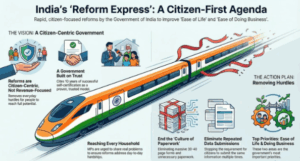
- This cumulative momentum is best described as Reform Express 2025.
Understanding Reform Express 2025
Meaning of Reform Express
- Reform Express 2025 refers to continuous, coordinated, and outcome-oriented governance reforms implemented steadily across sectors.
- These reforms focus on removing bottlenecks, simplifying procedures, reducing compliance burdens, and encouraging long-term private investment.
- The approach emphasises consistency, predictability, and trust between the state, businesses, and citizens.
India’s Strong Economic Performance in 2025
India Becomes the World’s Fourth Largest Economy
- In 2025, India crossed approximately $4.1 trillion in nominal GDP, overtaking Japan.
- This achievement reflects sustained growth rather than temporary economic acceleration.
- Stable political leadership helped ensure policy continuity and reform credibility.
Sovereign Credit Rating Upgrade
- After 18 years, Standard and Poor’s upgraded India’s sovereign rating to BBB.
- This upgrade signalled confidence in India’s fiscal discipline and economic stability.
- Higher ratings reduce borrowing costs and encourage foreign investment inflows.
Governance, Rules, and Investor Confidence
Why Rules Matter
- Transparent and time-bound procedures reduce discretionary decision-making.
- Clean rules improve competition, encourage entrepreneurship, and accelerate job creation.
- Predictable policies convert private caution into private investment.
India’s Expanding Trade Performance
Export Growth in 2024–25
- India’s total exports reached $825.25 billion during 2024–25.
- This represented an annual growth of over 6%, despite global uncertainty.
- Export growth strengthened India’s external sector resilience.
Digital Trade Facilitation Tools
- The Trade Connect ePlatform was launched as a single digital window for exporters.
- The Trade Intelligence and Analytics (TIA) portal provided real-time market insights.
- These tools reduced paperwork and improved market access efficiency.
New Trade Agreements Strengthening Global Integration
India–UK Trade Agreement
- The India–UK Comprehensive Economic and Trade Agreement, signed in July 2025, expanded duty-free access.
- It also created clearer mobility pathways for skilled Indian professionals.
- Services exports gained a stronger institutional framework.
Strategic Agreements with Oman and New Zealand
- In December 2025, India signed a Comprehensive Economic Partnership Agreement with Oman.
- Negotiations for a Free Trade Agreement with New Zealand were successfully concluded.
- These agreements expanded India’s reach into high-value global markets.
India’s Thriving Startup and Innovation Ecosystem
Growth of Startups
- India crossed two lakh government-recognised startups in 2025.
- These startups generated over 21 lakh jobs, supporting youth employment.
- Startup growth reflected improved ease of doing business conditions.
Digital Commerce Platforms
- The Open Network for Digital Commerce (ONDC) processed over 326 million orders.
- Daily transactions averaged more than 5.9 lakh, expanding market access.
- The Government e-Marketplace (GeM) crossed ₹16.41 lakh crore in cumulative transactions.
Improving Ease of Doing Business
Compliance Reduction and Decriminalisation
- Over 47,000 compliances were reduced or simplified across sectors.
- 4,458 legal provisions were decriminalised, lowering fear-driven compliance.
- These reforms encouraged entrepreneurship and formalisation.
Single Window Approvals
- By November 2025, the National Single Window System processed 8.29 lakh approvals.
- Faster approvals reduced project delays and cost overruns.
Infrastructure Planning and Project Monitoring
PM GatiShakti National Master Plan
- The PM GatiShakti platform was opened to private sector participation.
- It enabled integrated infrastructure planning across ministries and states.
- The platform also incorporated environmental clearance processes to streamline project approvals.
Project Monitoring Group (PMG)
- The PMG portal onboarded over 3,000 projects worth ₹76 lakh crore.
- This improved coordination and timely resolution of infrastructure bottlenecks.
- The PMG also facilitated ex post facto environmental clearances for certain projects to ensure compliance with regulations.
Legislative Reforms for Trust-Based Governance
Repealing Obsolete Laws
- Parliament passed the Repealing and Amending Bill, 2025.
- This removed 71 outdated and redundant Acts from the statute book.
- Legal clarity reduced confusion for businesses and citizens.
District-Level Business Reforms
- The District Business Reform Action Plan 2025 strengthened local governance.
- District administrations became more responsive, predictable, and accountable.
- The plan included measures to improve local-level implementation of the Forest Conservation Act and Coastal Regulation Zone norms.
Modern Labour Laws for a New Economy
Implementation of Four Labour Codes
- From November 21, 2025, four labour codes came into force.
- These replaced 29 central labour laws, simplifying compliance.
- The codes cover wages, industrial relations, social security, and workplace safety.
Strengthening Financial and Capital Market Governance
Securities Markets Code Bill
- The Securities Markets Code Bill modernised securities regulation.
- It strengthened SEBI’s investigative and enforcement powers.
- Provisions included specialised market courts and faster grievance redressal.
Logistics and Maritime Reforms
Why Maritime Reforms Matter
- Nearly 95% of India’s trade by volume and 70% by value moves by sea.
- Efficient ports and shipping directly impact trade competitiveness.
Key Maritime Laws of 2025
- The Indian Ports Act, 2025 replaced colonial-era legislation.
- The Merchant Shipping Act, 2025 modernised shipping governance.
- The Carriage of Goods by Sea Act, 2025 updated liability frameworks.
Boosting Shipbuilding and Maritime Industry
Major Financial Package
- The Cabinet approved ₹69,725 crore to strengthen shipbuilding.
- A ₹25,000 crore Maritime Development Fund was established.
- The goal was to reduce dependence and retain freight value domestically.
Energy Reforms for Long-Term Security
Oil and Gas Sector Reforms
- The Oilfields Amendment Act, 2025 improved contractual stability.
- New Petroleum and Natural Gas Rules, 2025 simplified approvals.
- The Open Acreage Licensing Policy Round X offered 25 exploration blocks.
- These reforms incorporated the polluter pays principle and precautionary principle to ensure environmental protection.
Nuclear Energy as a Strategic Pillar
Nuclear Energy Mission
- Budget 2025 launched a ₹20,000 crore Nuclear Energy Mission.
- The target is 100 GW nuclear capacity by 2047.
- Five indigenous Small Modular Reactors are planned by 2033.
- The mission aims to contribute to a pollution free environment through clean energy production.
SHANTI Bill, 2025
- The SHANTI Bill modernised India’s civil nuclear framework.
- It enabled carefully regulated private participation.
- Nuclear energy provides stable, low-carbon base-load power.
- The bill included provisions for rigorous environmental impact assessment and adherence to the EIA notification guidelines.
Strategic Meaning of Reform Express 2025
- Reforms focused on simplifying laws, de-risking investment, and digitising governance.
- Long-cycle sectors like energy, logistics, and infrastructure received policy certainty.
- Productivity gains and private investment form the backbone of future growth.
Conclusion
Reform Express 2025 reflects India’s steady governance approach, combining economic stability, legal clarity, digital efficiency and long-term energy security. These cumulative reforms quietly prepare India for sustained growth, competitiveness, and global leadership in coming decades. The reforms also demonstrate a commitment to balancing development with environmental protection, as evidenced by the integration of environmental clearance processes and the emphasis on sustainable practices across sectors.
Source
The Hindu
Mains Practice Question
Discuss how Reform Express 2025 reflects India’s shift from episodic reforms to continuous governance-led economic transformation.