
Total Solar Eclipse Opens Window Into Sun’s Corona
Total Solar Eclipse Opens Window Into Sun’s Corona
Why in the News ?
A total solar eclipse recently provided European scientists an opportunity to study the Sun’s faint corona from Earth. Such events enable detailed observations of the inner corona, solar magnetic structures and phenomena linked to solar flares and coronal mass ejections.
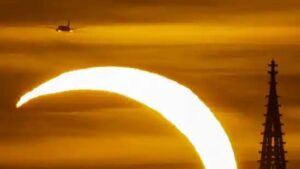
Why Total Solar Eclipses Matter for Science:
- A solar eclipse occurs when the Moon passes between the Sun and Earth, blocking part or all of the Sun’s light.
- During a total solar eclipse, the Moon completely covers the Sun’s bright disc, temporarily revealing its faint outer atmosphere or corona.
- The corona extends millions of kilometres into space and contains important information about the Sun’s magnetic environment.
- Normally, the corona is extremely faint compared with the solar disc, making its detailed observation difficult.
- Scientists use coronagraphs on space missions to artificially block the Sun, but scattered light can obscure parts of the inner corona.
Solar Cycle, Space Weather and Earth
- The Sun experiences an approximately 11-year solar cycle, during which its activity rises and falls.
- The current solar cycle began around 2020 and has already passed its maximum phase, when solar activity is comparatively high.
- During periods of greater activity, scientists can observe more sunspots, solar flares and coronal structures.
- The corona’s magnetic field plays a major role in producing solar flares and coronal mass ejections (CMEs).
- These events can release enormous amounts of energy and charged particles, potentially disrupting GPS, satellite operations and communication systems on Earth.
- Therefore, studying the corona during eclipses contributes to better understanding of space weather, improving the ability to anticipate solar disturbances and protect critical technological infrastructure.
About Solar Eclipse and Solar Activity:
- The path of totality is the narrow region on Earth from which the Moon completely covers the Sun during a total eclipse.
- Totality lasts longest near the centre of this path because of the geometry of the Sun, Moon and Earth.
- The eclipse provides an opportunity for ground-based observations of the solar atmosphere without completely relying on specialised space instruments.
- Researchers from CESSI, IISER-Kolkata, predicted the possibility of observing large-scale streamers—bright, petal-like magnetic structures extending from the solar surface.
- Streamers provide clues about the magnetic-field structure of the corona, which is otherwise difficult to observe directly because the solar disc is overwhelmingly bright.