
SCHOOL DROPOUT RATE FALLS ACROSS KEY STAGES: UDISE+ REPORT 2025–26
SCHOOL DROPOUT RATE FALLS ACROSS KEY STAGES: UDISE+ REPORT 2025–26
Why in the News?
- UDISE+ Report Released: The Ministry of Education released the UDISE+ 2025–26 report, showing a decline in school dropout rates, improved student retention, higher enrolment, and better digital infrastructure in schools.
- Significance: The findings indicate progress towards the objectives of the National Education Policy (NEP) 2020 and Sustainable Development Goal (SDG) 4 on inclusive and equitable quality education.
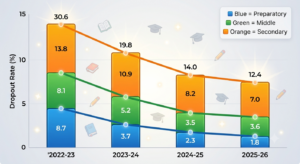
KEY FINDINGS OF UDISE+ 2025–26
- Lower Dropout Rates: The preparatory level (Classes 3–5) dropout rate declined from 2.3% to 1.8%, while the secondary level (Classes 9–12) dropout rate reduced significantly from 8.2% to 7.0%.
- Improved Student Retention: Retention increased at both middle school (83.7%) and secondary school (51.9%), indicating better continuity of education and reduced attrition.
- Higher Enrolment: The Gross Enrolment Ratio (GER) at the secondary level rose from 68.5% to 71.7%, while the transition rate from middle to secondary education improved to 88.3%.
- Teacher Strength: The total number of teachers increased by 8.3% compared to 2022–23, with 54.9% women teachers, reflecting improved gender representation in the teaching workforce.
- Digital Infrastructure: Schools with computer facilities increased to 69.9%, while internet connectivity improved to 67.4%, strengthening digital learning infrastructure.
UDISE+ (UNIFIED DISTRICT INFORMATION SYSTEM FOR EDUCATION PLUS)
- National Database: UDISE+ is India’s integrated digital database for collecting and analysing school education statistics from pre-primary to higher secondary levels.
- Evidence-Based Planning: It provides reliable data for educational planning, resource allocation, monitoring, and policy formulation at national and state levels.
- Comprehensive Coverage: The platform captures information on enrolment, teachers, infrastructure, learning facilities, digital resources, and school management across government and private schools.
- Technology Integration: UDISE+ uses online data collection, GIS mapping, and digital verification to improve the accuracy, transparency, and timeliness of educational statistics.
- Policy Support: The database supports implementation and monitoring of initiatives under the National Education Policy (NEP) 2020, Samagra Shiksha, and other flagship education programmes.
GROSS ENROLMENT RATIO (GER)● Definition: Gross Enrolment Ratio (GER) is the percentage of students enrolled at a particular level of education, irrespective of age, compared to the total population of the official age group corresponding to that level. ● Interpretation: A GER exceeding 100% is possible because it includes over-age and under-age students enrolled in that educational stage. ● Importance: GER is a key indicator of access to education, educational participation, and the capacity of the education system to accommodate learners. ● Policy Relevance: Improving GER is central to achieving the goals of the National Education Policy (NEP) 2020, particularly universal access to school education and increased participation in higher education. ● UPSC Relevance: Important for GS Paper II – Education, Human Resource Development, Social Justice, Governance, NEP 2020, and Sustainable Development Goals (SDG-4). |