






THE WAY FORWARD ON KATCHATHEEVU, PALK STRAIT DISPUTES, AND REGIONAL CONFLICT RESOLUTION
Why in the news?
- India has historically influenced regional and global diplomacy through: ○ Panchsheel principles ○ Non-Aligned Movement (NAM) ○ South Asian Association for Regional Cooperation (SAARC) ○ “Neighbourhood First Policy”
- This approach has generally promoted peace and interdependence in South Asia.
- Challenges remain due to unresolved issues with Sri Lanka, namely Fisheries crisis in the Palk Strait and Sovereignty dispute over Katchatheevu island. These challenges, while distinct, echo some of the complexities seen in other regional issues like the ongoing Manipur conflict.
- During the April 2025 visit to Colombo, Mr. Modi stressed adopting a “humane approach” to the fisheries issue, aiming to balance: ○ Livelihood needs of fishermen ○ Marine conservation imperatives
- The success of this vision depends on India and Sri Lanka addressing Ecological imperatives, Historic grievances & Mutual cooperation. Similar principles could be applied to address the Manipur war and other regional ethnic clashes, such as the violence between Kuki and Meitei communities in Manipur.
Livelihood and Conservation at Odds
Shared Heritage
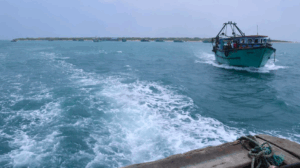
- Fishing communities of Tamil Nadu and Sri Lanka’s Northern Province have shared the Palk Strait for centuries.
- Present disputes stem largely from mechanised bottom trawling by Indian vessels in Sri Lankan waters. This situation bears some resemblance to resource-based conflicts seen in the Manipur riot, where competition over land and resources has fueled tensions between Kuki and Meitei communities in regions like the Imphal Valley and Churachandpur district.
Legal and Global Norms
- UNCLOS: Emphasises equitable use and conservation of marine resources.
- FAO Code of Conduct (1995): Declares destructive practices like bottom trawling unacceptable.
Sri Lanka’s Response
- Banned bottom trawling in 2017.
- Yet, hundreds of Indian trawlers persist, causing: ○ Coral bed damage ○ Shrimp habitat destruction ○ Fish stock depletion
Impact on Tamil Nadu Fishers
- Smaller artisanal fishers, using sustainable traditional methods, also suffer.
- Depleted near-shore resources by trawlers push them into contested waters.
- Conflict is not only territorial, but also intra-community: ○ Trawler operators: Profit-driven, destructive practices ○ Artisanal fishers: Subsistence-based, sustainable traditions
This complex interplay of economic interests and traditional practices mirrors some of the challenges faced in the Manipur unrest, where different communities have conflicting approaches to land use and resource management.
Sustainable Resolution Pathways
- Differentiate between artisanal fishers’ needs and trawler operators’ profits.
- Provide humane accommodation to artisanal fishers who have fished “from time immemorial.”
- Dialogue between Indian & Sri Lankan fisher organisations to negotiate: ○ Quotas ○ Regulated access ○ Limited fishing rights (specific days/seasons) until Indian fish stocks recover
These approaches to conflict resolution and resource sharing could offer insights for addressing the situation in Manipur, where ethnic clashes have been exacerbated by disputes over land and resources, particularly in areas affected by the ongoing Manipur conflict.
Community Sensitisation
- Highlight Sri Lankan Tamil fishers’ hardships during civil war – Lost decades of income due to sea access restrictions.
- Sri Lankan Tamil MPs and Tamil media can shape narratives in Tamil Nadu.
- Stress bonds of fraternity: ○ Tamil Nadu compassionately hosted Tamil refugees during the war. ○ Same empathy should guide current conflict resolution.
Similar community engagement strategies could be valuable in addressing the Manipur riots, where building empathy between Kuki-Zo communities and Meitei groups is crucial for lasting peace. Understanding about Manipur’s diverse ethnic landscape is essential for effective conflict resolution.
Essential Message
- This is a livelihood conflict intertwined with ecological sustainability.
- Preserving Tamil solidarity and ecological balance is crucial for a lasting solution. This principle of balancing community needs with environmental concerns is equally applicable to the situation where Manipur is burning and other regions facing ethnic violence.
Clearing the Misconceptions
Myth vs Reality of Katchatheevu
- Public debate wrongly portrays Katchatheevu as the root of the fisheries dispute.
- Reality: ○ Tiny, barren islet (<0.5 sq. miles) with only St. Anthony’s church. ○ Tamil Nadu fishermen continue to visit the church for annual festival (allowed under 1974 treaty).
- 1974 India–Sri Lanka Maritime Boundary Treaty: ○ Placed Katchatheevu in Sri Lankan waters. ○ Legally binding and sacrosanct under international law (pacta sunt servanda). ○ Cannot be unilaterally revoked without destabilising global order (similar to China’s frontier contestations).
Clarifying Misconceptions
- Claim that “Indira Gandhi gifted Katchatheevu” is inaccurate.
- India’s decision based on sovereignty evidence: ○ Records showed Sri Lankan administrative control since Portuguese & Dutch rule. ○ Even earlier: Tamil kings of Jaffna had authority.
International Precedents
- Minquiers & Ecrehos case (France vs UK, ICJ 1953): Sovereignty awarded to UK for effective jurisdiction.
- Rann of Kutch Arbitration (1968): India–Pakistan dispute settled similarly.
- India conceded Sri Lanka’s stronger claim on same logic. ○ Retrieving Katchatheevu is a matter of political rhetoric, not legal justice. ○ Fishing rights are separate from sovereignty over the islet.
These legal precedents and approaches to territorial disputes could offer valuable lessons for addressing complex issues in other regions, including the ongoing Manipur unrest and the demands for scheduled tribe status by various communities, including groups like Arambai Tenggol and Meitei Leepun.
Historic Waters Context
- Palk Strait & adjacent waters recognised as historic waters under Indian & Sri Lankan law.
- Sovereign rights here stronger than in territorial seas.
- No “innocent passage” or third-state fishing rights without explicit consent.
- Judicial precedent: Annakumaru Pillai vs Muthupayal (1904, Madras High Court) upheld traditional rights in pearl & conch fisheries.
- Hence, India’s 1974 acceptance of the boundary was legally consistent.
International Law & Cooperation
- UNCLOS Article 123: Requires cooperation in semi-enclosed seas (Palk Bay, Gulf of Mannar).
- Examples: Baltic Sea Fisheries Convention (Latvia, Poland, EU share quotas for sustainability).
- India–Sri Lanka must Implement joint frameworks: ○ Equitable fishing quotas (days & catch). ○ Joint research station on Katchatheevu for marine biology & sustainability. ○ Promote deep-sea fishing in India’s EEZ (200 nm) to reduce near-shore pressure & illegal crossings.
These cooperative frameworks could serve as models for addressing resource-sharing and border issues in other regions, including strategies for peace negotiations in Manipur and resolving conflicts between Meitei militants and Kuki-Zo communities. Such approaches could also address issues related to Chin refugees and the impact of counter-insurgency operations.
Toward Good Neighbourhood Policy
India–Sri Lanka Ties
- Rooted in geography, culture, and civilisation.
- Shared maritime boundaries, cultural, religious, and kinship bonds.
Approach to Disputes
- Quiet cooperation, not populist rhetoric.
- Legal recognition of treaties and precedents.
- Shared livelihood security for fishing communities.
This approach to regional diplomacy and conflict resolution could offer insights for addressing the Manipur crisis and other instances of ethnic violence in the region, such as the unrest in Manipur that has led to numerous Manipur victims. It could also inform strategies to address issues like the tribal solidarity march that escalated tensions.
Multi-Level Engagement
- Government-to-Government talks: Build trust, honour treaties.
- State/Provincial engagement: Tamil Nadu & Northern Provincial Council dialogue.
- Community-to-community empathy: Encourage people-to-people contact, counter media distortions.
Similar multi-level engagement strategies could be beneficial in addressing the Manipur situation, involving state government led by N Biren Singh, autonomous district councils, and community leaders in peace negotiations to resolve the crisis in Manipur. This could include discussions on accountability measures and the implementation of sixth schedule provisions.
Fisheries Issue
- Requires fairness to both communities.
- Prioritise: ○ Artisanal livelihoods ○ Ecological sustainability
- Solutions: ○ Collaborative fisheries regime ○ Quotas & regulated access ○ Investment in deep-sea fishing alternatives for Tamil Nadu
These principles of fairness, sustainability, and alternative livelihood development could be adapted to address resource-based conflicts in Manipur and other regions facing similar challenges, particularly in areas affected by the Manipur clashes. They could also help address concerns about police complicity in the conflict.
Katchatheevu Issue
- Legally settled in 1974 treaty.
- Should not cloud the real challenge: resource management.
Way Forward
- Make Katchatheevu & Palk Strait issues symbols of cooperation, not conflict.
- Joint research, sustainable practices, and mutual respect.
- In diplomacy, smaller disputes must not overshadow the larger vision of: ○ Peace ○ Prosperity ○ Mutual respect in South Asia
This approach of prioritizing cooperation and mutual respect over territorial disputes could offer valuable lessons for addressing the Manipur conflict and other instances of ethnic clashes in the region, including the ongoing Manipur protest movements.
As India navigates these complex regional issues, from the Katchatheevu dispute to the conflict in Manipur, it’s crucial to apply consistent principles of dialogue, respect for legal frameworks, and a focus on shared prosperity. By addressing root causes of conflicts, promoting sustainable resource management, and fostering community engagement, India can work towards lasting peace and stability across its diverse regions, including areas affected by insurgency in Manipur and other forms of unrest.
Source: https://www.thehindu.com/opinion/lead/the-way-forward-on-katchatheevu-palk-strait-disputes/article70034563.ece
Mains question
“Discuss the Katchatheevu and Palk Strait issues in the context of India–Sri Lanka relations. How can cooperative frameworks balance sovereignty concerns, livelihood security, and ecological sustainability in South Asia? Draw parallels with other regional challenges like the Manipur conflict.”