







THE GENDER ANGLE TO INDIA’S ECONOMIC VULNERABILITIES
Syllabus:
GS-3: ● Gender Disparity ● Skill Development
Why in the News?
India, valued at $4.19 trillion, is set to become the world’s third-largest economy. However, proposed 50% U.S. tariffs on $40 billion exports threaten GDP growth. These tariffs will disproportionately hit labour-intensive sectors like textiles, gems, leather, and footwear, where women form a significant workforce, exposing India’s gender disparities in economic vulnerability.
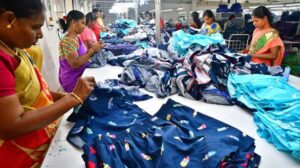
IMPACT OF U.S. TARIFFS ON INDIA
- Export shock: Tariffs targeting $40 billion worth of exports could shave off nearly 1% of GDP, weakening overall economic resilience.
- Sectoral damage: Textiles, gems, footwear, and leather—sectors employing around 50 million people—may see exports decline by 30%-50%, hitting female workers hardest. This “pink tariff” effect disproportionately impacts industries where women work.
- Competitiveness loss: With tariffs, India suffers a 30%-35% cost disadvantage compared to competitors such as Vietnam and Bangladesh, shrinking market share in global value chains.
- China contrast: Unlike China, which cushioned itself with manufacturing scale and diversified exports, India’s reliance on a few goods makes it exposed to trade shocks.
- Women affected: The brunt of this trade disruption will fall on women workers, amplifying unemployment and reducing household incomes, potentially widening the gender wage gap.
LOW FEMALE LABOUR PARTICIPATION CHALLENGES
- Stagnant rates: India’s Female Labour Force Participation Rate (FLFPR) has stagnated between 37% and 41.7%, well below the global average of 47% and China’s 60%.
- Cultural constraints: Patriarchal norms and expectations of unpaid care work remain significant obstacles for women entering and sustaining participation in the workforce.
- Urban stagnation: Women in cities face challenges of workplace safety, poor sanitation, and unreliable transport, which push them away from employment opportunities.
- Rural limits: Rural women’s participation has increased, but mostly in unpaid and low-productivity work, not in sectors with formal wages or upward mobility.
- Growth drag: Persistently low FLFPR risks slowing India’s growth trajectory, similar to Southern European nations where gender gaps curbed long-term productivity.
DEMOGRAPHIC DIVIDEND AND URGENCY
- Narrow window: India’s demographic dividend may close by 2045, leaving just two decades to integrate its large working-age population effectively.
- Global lessons: Countries like China, Japan, and the U.S. leveraged their peak demographic phases through inclusive labour strategies; India risks wasting this chance.
- Now-or-never: Without women’s participation, India risks losing its age advantage, turning demographic potential into a liability.
- Dependency rise: Excluding women will accelerate dependency ratios as the ageing population increases, straining social security systems.
- Strategic liability: Gender exclusion is now a strategic economic weakness, reducing India’s competitiveness in export-oriented production and global supply chains.
LESSONS FROM GLOBAL EXPERIENCES
- U.S. example: Women’s large-scale entry into the workforce during World War II, supported by equal pay and childcare, boosted productivity and economic resilience.
- China reforms: Post-1978 reforms combined with state-supported childcare and education ensured nearly 60% FLFPR, making women central to growth.
- Japan model: Incremental reforms raised women’s participation from 63% to 70%, directly increasing GDP per capita by 4%.
- Dutch innovation: Part-time work with equal benefits suited women’s preferences while keeping them integrated into the labour market.
- Policy commonalities: Successful nations invested in legal rights, care infrastructure, skilling, and flexible work arrangements, areas where India lags significantly.
INDIA’S DOMESTIC INTERVENTIONS
- Karnataka’s Shakti: Free bus travel for women increased ridership by over 40%, expanding access to education, jobs, and entrepreneurship, especially in rural belts.
- Urban Company model: Gig economy platforms onboarded 15,000 women, providing ₹18,000–₹25,000 monthly incomes, insurance, maternity benefits, and skill training.
- Rajasthan scheme: The Indira Gandhi Urban Employment Guarantee Scheme created over four crore person-days of work, with 65% benefiting women.
- Gig potential: Updating labour codes to include gig and part-time jobs with protections can bring millions of women into the formal economy.
- Policy shift: Redirecting funds from populist cash transfers towards digital inclusion, skilling, and entrepreneurship ensures long-term empowerment.
STRUCTURAL BARRIERS LIMITING WOMEN’S PARTICIPATION
- Safety issues: Women face insecurity due to unsafe public spaces and transport, discouraging participation in both education and work.
- Care burden: Women perform over three times more unpaid care work than men, restricting mobility and career advancement.
- Skilling gap: Training remains focused on male-dominated sectors, limiting women’s entry into high-growth areas like technology and green jobs.
- Policy inertia: Delayed reforms in labour codes, maternity protection, and workplace laws slow the pace of inclusivity.
- Urban-rural divide: Policies often ignore rural-specific needs, neglecting women engaged in agriculture and informal work without formal protections.
OPPORTUNITIES FOR EMPOWERMENT AND INCLUSIVE GROWTH
- Labour reforms: Recognising part-time and gig work within formal labour frameworks can expand participation while offering social security benefits.
- Targeted spending: Prioritise mobility infrastructure, digital access, and childcare support rather than blanket welfare schemes.
- Private partnership: Encourage corporates, start-ups, and platforms to adopt women-centric policies, ensuring training, safety, and fair wages.
- Cultural change: Campaigns to challenge stereotypes and showcase women’s contribution to economic growth can shift mindsets.
- Holistic empowerment: Linking women’s empowerment with trade strategies, demographic dividend policies, and growth roadmaps makes gender equality an economic necessity.
CONCLUSION
The looming U.S. tariff shock should not only be viewed as an external challenge but as a signal to fix internal weaknesses. India’s exclusion of women from productive labour is a critical economic vulnerability, threatening demographic dividend utilization, export competitiveness, and long-term prosperity. Empowering women is not merely a social gesture, but a growth imperative. To become a true global power, India must fully integrate women into the workforce. The path of inclusivity leads to resilience and shared prosperity, while neglect leads to fragility and missed opportunities. Addressing the gender gap in work and implementing gender-responsive policies are crucial for sustainable economic development and reducing vulnerable employment for women.
Source:TH
MAINS PRACTICE QUESTION
“India’s economic vulnerabilities are not only external but also internal, rooted in the exclusion of women from the workforce. Discuss in the context of demographic dividend and trade challenges.”