







Somnath and India’s Eternal Civilisational Resilience
Syllabus:
GS-1 : Indian Heritage, History & Culture GS–4 : Ethics, Integrity & Aptitude
Why in the News ?
The year 2026 marks one thousand years since the first destruction of the Somnath temple in 1026 CE, reviving national discussion on India’s civilisational resilience, cultural memory, heritage reconstruction after Independence, and the role of Somnath as a symbol of faith, regeneration, and national continuity.
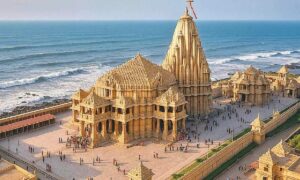
Somnath as a Civilisational and Spiritual Landmark:
● Somnath, situated at Prabhas Patan on the Gujarat coast, occupies a unique position in India’s spiritual geography.
● It is revered as the first among the twelve Jyotirlingas, as mentioned in the Dwadasa Jyotirlinga Stotram, highlighting its pan-Indian sacred significance.
● Beyond ritual importance, Somnath functioned as a civilisational anchor, shaping the cultural consciousness of Bharat over millennia.
● From priests and pilgrims to traders and scholars, Somnath historically attracted people from diverse walks of life, reinforcing India’s integrative civilisational ethos.
● Its coastal location made it a spiritual beacon for seafarers, simultaneously symbolising religious vitality and economic prosperity. Today, this coastal significance is further underscored by the need for adherence to coastal regulation zone guidelines in any development projects near the temple.
Key Cultural Heritage and Constitutional Provisions: |
| ● Dwadasa Jyotirlinga: Twelve sacred Shiva shrines across India. |
| ● Somnath Temple: Located at Prabhas Patan, Gujarat; first Jyotirlinga. |
| ● ASI Act, 1958: Protects monuments of national importance. |
| ● Article 25: Freedom of conscience and religion. |
| ● Article 49: State duty to protect monuments and heritage. |
| ● K.M. Munshi: Author of Somnath: The Shrine Eternal. |
| ● Sardar Patel: Led post-Independence reconstruction. |
The Trauma of 1026 and the Politics of Destruction
● The attack of 1026 CE by Mahmud of Ghazni stands as one of the most traumatic episodes in India’s medieval history.
● Historical records document mass violence, desecration, and plunder, leaving behind collective grief that transcended generations.
● The objective was not merely material loot but symbolic annihilation of faith and civilisational confidence.
● This invasion became a precedent, “inspiring” repeated attacks on Somnath in subsequent centuries.
● Yet, despite the scale of devastation, the destruction failed to erase civilisational memory, which continued to survive through oral traditions, literature, and collective belief.
Regeneration as the Core Indian Response
● The defining feature of Somnath’s history is not destruction but continuous regeneration.
● Each demolition was followed by rebuilding efforts, often initiated by local communities rather than imperial authority.
● This reflects India’s civilisational belief that the eternal is indestructible, echoing the Bhagavad Gita’s idea of the imperishable spirit.
● Thinkers like Swami Vivekananda saw in Somnath the embodiment of India’s national life-current, repeatedly wounded yet never extinguished.
● Somnath thus became a living metaphor for India’s ability to absorb shocks, recover, and move forward with renewed strength.
Intellectual, Cultural and Inter-Sectarian Continuity
● Swami Vivekananda’s 1897 reflections on Somnath emphasised that temples reveal more about history than written texts.
● He observed how these structures bore the marks of “a hundred attacks and a hundred regenerations”, mirroring India’s journey.
● The visit of Hemchandra Acharya, a respected Jain scholar, highlights Somnath’s inter-sectarian appeal.
● His prayer at Somnath symbolised a civilisational culture where faith traditions coexisted rather than competed.
● Literary contributions, especially K.M. Munshi’s “Somnath: The Shrine Eternal”, framed the temple as a symbol of civilisational continuity rather than religious exclusivity.
Post-Independence Reconstruction and Constitutional Debate
● After Independence, the responsibility of rebuilding Somnath fell upon Sardar Vallabhbhai Patel, who viewed it as a moral obligation of a free nation.
● During his Diwali visit in 1947, Patel announced that the temple would be rebuilt at its original site.
● K.M. Munshi, as a key intellectual and administrator, mobilised public support and institutional backing.
● The reconstructed temple was inaugurated on May 1, 1951, by President Rajendra Prasad.
● Jawaharlal Nehru’s discomfort reflected early tensions between constitutional secularism and civilisational self-expression, making Somnath a case study in post-colonial statecraft.
Somnath, National Morale and Economic Memory
● Historically, Somnath strengthened the morale of society, especially during periods of political subjugation.
● Its proximity to the sea symbolised India’s maritime strength, trade networks, and outward-looking civilisation.
● Ancient seafarers carried tales of Somnath’s grandeur across continents, reinforcing India’s soft power.
● The repeated revival of Somnath reassured society that hate and fanaticism may destroy temporarily, but conviction creates eternally.
● Over time, aggressors faded into obscurity, while Somnath remained a radiant marker of continuity.
Contemporary Relevance: Somnath and Viksit Bharat
● Today, Somnath’s narrative resonates with India’s aspiration for Viksit Bharat.
● Just as the temple rose repeatedly from ruins, India has emerged as a global growth engine after centuries of invasions and colonial exploitation.
● India’s youth, innovation ecosystem, culture, Yoga, Ayurveda, and festivals are gaining global recognition.
● Solutions to global challenges — from digital public infrastructure to climate action — increasingly come from India.
● Somnath reminds modern India that development divorced from civilisational wisdom is fragile, while growth rooted in values is sustainable.
Challenges :
● Historical Polarisation: Somnath’s history is often reduced to binaries of victimhood and triumphalism.
● Selective Interpretation: Overemphasis on destruction can overshadow India’s pluralistic traditions.
● Secularism Debate: Cultural reconstruction sometimes clashes with narrow readings of constitutional secularism.
● Heritage Neglect: Many ancient sites lack sustained conservation beyond symbolic attention.
● Academic Gaps: Absence of balanced, multidisciplinary historiography fuels ideological misuse.
● Tourism Stress: Rising pilgrim numbers threaten ecological balance and heritage sustainability, necessitating environmental impact assessments for future development plans.
● Political Instrumentalisation: Civilisational symbols risk being appropriated for short-term politics rather than long-term nation-building.
Way Forward :
● Civilisational Education: Integrate heritage literacy in school and university curricula.
● Balanced Historiography: Encourage evidence-based research free from ideological extremes.
● Sustainable Conservation: Strengthen ASI and state agencies with modern conservation techniques, including adherence to the Forest Conservation Act for surrounding areas.
● Inclusive Narratives: Highlight Somnath’s inter-sectarian and cultural inclusiveness.
● Constitutional Balance: Reconcile cultural confidence with pluralism and secular governance.
● Tourism Management: Adopt carrying-capacity models and eco-sensitive planning, incorporating environmental clearances and ex-post facto assessments where necessary.
● Value-Based Nationalism: Anchor national pride in ethics, resilience, and inclusivity rather than grievance.
Conclusion :
Somnath is not merely a temple but a civilisational testimony to India’s ability to endure, regenerate, and rise. Its thousand-year journey affirms that while violence can destroy structures, it cannot extinguish faith, memory, and national conviction. As we move forward, it’s crucial to balance heritage preservation with environmental concerns, ensuring that our cultural landmarks contribute to both civilizational continuity and environmental sustainability. This approach, rooted in principles like the polluter pays principle and precautionary principle, can help create a harmonious blend of cultural reverence and ecological responsibility.
Source: HT
Mains Practice Question:
“Somnath represents continuity rather than collapse in India’s civilisational journey.” Critically examine the historical and contemporary significance of the Somnath temple in shaping debates on heritage, secularism, and national identity in post-Independence India.