







SHOULD THE METHOD OF COUNTING CASTE CHANGE?
Syllabus:
GS-2 :
● Government policies and interventions
● Vulnerable sections of society.
Why in the News ?
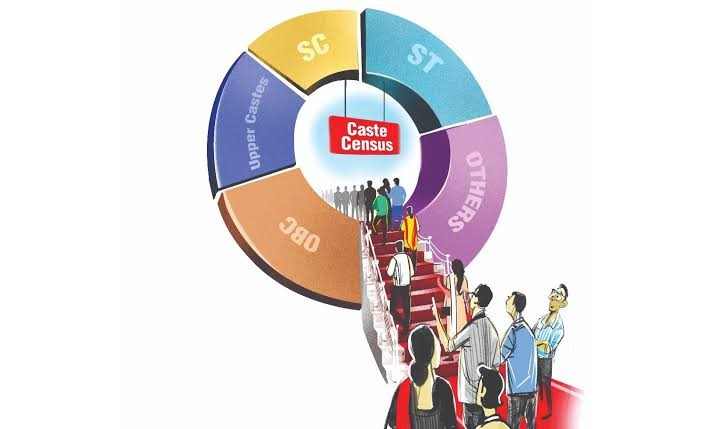
The Union Government has announced that the next Census will be held in 2027 and will include caste enumeration. This is significant as caste data was last effectively recorded in 1931. The move aims to mainstream the marginalised, but experts believe methodological reforms are essential for effective policy outcomes and evidence-based policymaking.
| WHAT IS CENSUS IN INDIA?● Definition: The Population Census is a detailed enumeration of the population, providing data on demographics, economic structure, culture, and human resources at various administrative levels.● Historical Origin: The first census in India was conducted in 1872 during British rule, though it was non-synchronous, meaning it wasn’t carried out at the same time throughout the country.● Synchronous Census: The first synchronous census, i.e., one conducted simultaneously across the nation, was carried out in 1881 under the supervision of W.C. Plowden, the then Census Commissioner of India.● Decadal Exercise: India follows a decadal pattern, where the census is conducted every 10 years to maintain consistency in population data collection and analysis. This decennial census is crucial for tracking changes in living conditions and socio-economic indicators over time.● Administrative Responsibility: The Office of the Registrar General and Census Commissioner of India, under the Ministry of Home Affairs, is tasked with the execution of the decadal census operations.LEGAL AND CONSTITUTIONAL BASIS● Constitutional Provision: Census is mentioned in Entry 69 of the Union List in the Seventh Schedule of the Indian Constitution, making it an exclusive power of the Union Government.● Legislative Framework: The census is conducted under the Census Act, 1948, which provides the legal authority and framework for collecting, processing, and protecting census data. |
UNDERSTANDING THE CENSUS STRUCTURE
● Two phases: The Census occurs in two phases—house listing (2026) and population enumeration (2027)—with the latter phase intended to collect caste data. This structure allows for a comprehensive socio-economic caste census.
● House listing: This phase records household characteristics, dwelling conditions, and amenities to prepare enumeration blocks, ensuring accurate workload distribution for enumerators. It provides crucial data on living conditions across different communities.
● Population enumeration: This includes socio-economic data such as education, marital status, employment, and will now record caste status for all except Scheduled Tribes. This phase is critical for understanding educational disparities and occupational mobility among different caste groups, including OBC communities.
● Data separation: Presently, data collected in the two phases are not linked properly, causing inconsistencies. A more integrated approach could improve data reliability and facilitate better data validation processes.
● Need for precision: The absence of structured caste data affects India’s ability to formulate inclusive policies and target socio-economic upliftment accurately. This underscores the importance of a well-designed socio-economic caste census for human development initiatives.
LIMITATIONS IN EXISTING FORMAT
● Outdated design: The 2021 draft Census format excluded most castes; reforms are essential to ensure comprehensive caste data collection across non-ST groups. This limitation hinders the understanding of caste classification issues.
● Conceptual issues: The unemployment question suffers from ambiguous timeframes, undermining its utility as a reliable socio-economic indicator.
● Inaccurate birth data: Census data on childbirth and survival are inferior to those collected through National Family Health Surveys, reducing their relevance.
● Migration misreporting: Migration trends, key to understanding mobility patterns among castes, are often underreported or misclassified, compromising the quality of insights.
● Limited utility: Only a few data points like education and work participation may be usable for caste-based analysis, making redesign imperative for effective evidence-based policymaking.
SUGGESTED REFORMS IN FORMAT
● Shift questions: Transferring housing, assets and amenities data from the house listing phase to the population enumeration phase would enable linkage with caste, providing a more comprehensive picture of living conditions across different caste groups.
● Urban omissions: Errors due to a six–nine month gap between phases are common in urban areas, reducing the coverage and credibility of outcomes. A digital census approach could help mitigate these issues.
● Improve listing: Enumerators can better focus on identifying dwellings if non-essential questions are removed from the house listing, ensuring comprehensive coverage.
● Enable analysis: Linking housing conditions to caste will allow questions like “What is the literacy rate among those in kutcha houses?” to be meaningfully answered, providing insights into educational disparities and living conditions.
● Tailored insights: Reforms would make it possible to generate caste-wise disaggregated data on amenities, education and employment, aiding inclusive policymaking.
CHALLENGES TO CASTE ENUMERATION
● Identification confusion: Diverse caste names and local variations may confuse enumerators and respondents, leading to classification errors. This highlights the need for a comprehensive drop-down caste directory.
● Self-reporting risks: Without verification protocols, people may misreport caste to gain potential benefits, making the data unreliable for reservation decisions.
● Digital mismatch: The transition to digital enumeration tools must be complemented by training; otherwise, data entry errors and omissions may increase. Proper technology adoption and internet connectivity are crucial for a successful digital census.
● Enumerator burden: Longer and more complex questionnaires can exhaust enumerators, leading to inaccurate data collection and compromised quality.
● Caste politics: The politicisation of caste enumeration may result in resistance or manipulation by vested interests, undermining the objectivity of the exercise.
WHY DATA QUALITY MATTERS
● Program design: Accurate caste-wise data are crucial for designing education, health, and employment programs tailored to marginalised communities, including Dalit Muslims and OBC communities.
● Disparity measurement: Only reliable data can help quantify inter-caste disparities in literacy, access to resources, and employment, guiding equity-focused policies.
● Benchmark tracking: Baseline indicators can be established for tracking progress across various caste groups, particularly those outside Scheduled Caste/Scheduled Tribe categories.
● Benefit targeting: Poor quality data may cause misidentification and exclusion of deserving groups or inclusion of better-off castes, reducing policy efficiency.
● Long-term reforms: A sound caste-based Census could help identify Most Backward Castes (MBCs) and refine the reservation framework and social justice agenda.
MAKING THE CENSUS LEANER
● Drop redundancy: Questions on mobile phone or computer ownership may no longer offer useful differentiation and could be eliminated to ease the burden.
● Bank account data: With financial inclusion expanding under schemes like Jan Dhan Yojana, questions about bank accounts may be dropped as redundant.
● Focus core areas: Concentrating on education, employment, housing, and amenities can yield actionable insights, instead of bloating the Census with non-essential questions.
● Better time allocation: Fewer questions mean more time per household, allowing for deeper probing and more accurate responses, especially in diverse regions.
● Simplify toolkits: A leaner questionnaire enables better training, monitoring, and quality control, improving consistency and inter-state comparability of results.
STRENGTHENING FUTURE POLICY
● Actionable roadmap: Data must inform affirmative action policies, beyond just reservation quotas, influencing education, infrastructure, and employment policies.
● Bridge disparities: With the right disaggregated data, governments can target infrastructure and resource allocation to reduce caste-based development gaps.
● Monitor mobility: The Census can help study whether certain castes are able to move out of poverty traps, or remain structurally disadvantaged.
● Regional focus: Data can identify district or state-level caste vulnerabilities, allowing for region-specific policies rather than blanket central mandates. This approach aligns with principles of cooperative federalism and could be discussed in the Inter-State Council.
● Longitudinal tracking: Repeating such restructured questions every Census cycle will allow long-term tracking of caste-wise socio-economic evolution and policy effectiveness.
CONCLUSION
The inclusion of caste in the 2027 Census is a welcome step but risks being ineffective unless questionnaires are redesigned and methodologies overhauled. Without linking caste with key socio-economic indicators like education, housing, and employment, the objective of mainstreaming the marginalised will remain unmet. A leaner, smarter Census can enable transformative social policy and contribute significantly to human development goals. The implementation of a digital census, coupled with robust data validation processes, can enhance the accuracy and utility of the collected data, paving the way for more effective evidence-based policymaking and addressing persistent issues like untouchability practices.
UPSC MAINS PRACTICE QUESTION
Q. Critically examine the decision to include caste enumeration in the upcoming Census. What reforms are needed in the Census process to make the data useful for inclusive policymaking?