
RAJGHAT ARTEFACTS REVEAL VARANASI’S ANCIENT URBAN EVOLUTION
RAJGHAT ARTEFACTS REVEAL VARANASI’S ANCIENT URBAN EVOLUTION
Why in the News ?
Banaras Hindu University (BHU) has begun systematic documentation of thousands of artefacts excavated from Rajghat, an ancient settlement near Varanasi. The material, including pottery, seals, coins, terracotta objects and human remains, could provide fresh insights into Kashi’s early urban development.
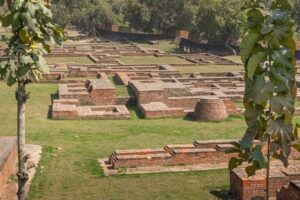
Rajghat Excavations and Archaeological Significance
- Early Discovery: Rajghat attracted archaeological attention in 1940, when remains were reportedly discovered during earth excavation for expansion and remodelling of Kashi Railway Station.
- Major Excavations: Archaeologist A.K. Narain and colleagues from BHU conducted extensive excavations at three mounds in 1957, continuing through several phases until 1969.
- Ancient Settlement: The oldest layer contained pre-Northern Black Polished Ware (pre-NBPW), an Iron Age pottery tradition that helped date the settlement to approximately 800 BCE.
- Rich Artefacts: Excavations produced thousands of objects, including seals and sealings, painted pottery, ivory and iron objects, punch-marked coins and terracotta figurines.
- New Documentation: BHU has undertaken a comprehensive documentation exercise, recording around 4,000 artefacts so far, while the total collection from Rajghat is estimated at nearly 10,000 objects.
New Research Potential from Rajghat Discoveries
- Human Remains: A human skeleton excavated decades ago has recently been examined, offering opportunities to study the age, ancestry and lifestyle of ancient inhabitants.
- DNA Analysis: Modern techniques such as ancient DNA sampling and analysis could generate information that earlier archaeologists could not obtain from the remains.
- Administrative Evidence: Seals and sealings, including some carrying Greek inscriptions and references to administrative units and officials, may provide evidence about governance and external cultural interactions.
- Urban Evolution: The artefacts can help reconstruct the transformation of Rajghat from an early settlement into a major urban centre of the Varanasi region.
- Heritage Preservation: BHU’s documentation initiative aims to systematically preserve archaeological material and make research resources more accessible, strengthening the study of ancient Indian civilisation and urbanisation.
About Kashi, Janapadas and Ancient Urbanisation:
- Kashi Mahajanapada: Kashi was among the 16 Mahajanapadas mentioned in early Buddhist and Jain traditions and was located in the Indo-Gangetic region.
- Janapadas: Janapadas were territorial and political units that developed during the later Vedic period; several evolved into larger Mahajanapadas by the 6th century BCE.
- Urban Centre: Archaeological evidence indicates that Rajghat developed as an important urban centre, while nearby Sarnath acquired prominence as a religious and pilgrimage centre.
- Strategic Location: Ancient Rajghat was situated near the confluence of the Ganga and Varana, offering advantages for settlement, communication and economic activity.
- Historical Continuity: The archaeological sequence spans several periods, including the Kushana and Gupta periods, demonstrating the long-term continuity of settlement in the Varanasi region.