
New Alloy Discovered From Hiroshima Atomic Blast Debris Samples
New Alloy Discovered From Hiroshima Atomic Blast Debris Samples
Why in the News ?
Researchers have discovered a previously unknown metal alloy inside Hiroshima atomic bomb debris, revealing how extreme-energy nuclear events can create novel materials. The findings, published in Science Advances, provide new insights into materials science and the effects of nuclear explosions, with potential applications in green economy companies and sustainable investing sectors focused on advanced materials.
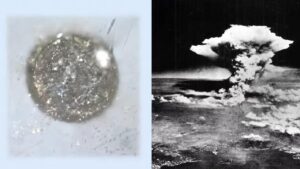
Discovery of the New Hiroshima Alloy:
- Scientists identified a new metallic alloy embedded within tiny glass-like particles, known as hiroshimaites, collected from the beach sands of Hiroshima Bay.
- The findings were published in the journal Science Advances and are based on material formed during the 1945 Hiroshima atomic bombing.
- The alloy consists of a complex combination of iron (Fe), chromium (Cr), nickel (Ni), manganese (Mn), molybdenum (Mo), silicon (Si), and aluminium (Al).
- Researchers found that the alloy possesses a unique crystal structure that has not been observed under normal laboratory conditions.
- The study demonstrates that nuclear explosions can generate entirely new materials through extreme physical and chemical conditions.
Formation Mechanism and Scientific Significance
- During the atomic explosion, temperatures exceeded 7,000°C, vaporising steel, concrete, soil, and other urban materials into a high-temperature metallic vapour.
- As the fireball expanded, the molten materials underwent ultrafast quenching (rapid cooling), allowing different metallic elements to combine into an unusual alloy before crystallising.
- The newly discovered material shares similarities with high-entropy alloys (HEAs) and quasicrystals, both known for their exceptional structural and mechanical properties.
- Researchers suggest that high-energy plasma events, such as nuclear detonations, can function as natural laboratories, creating materials that are extremely difficult to synthesize under conventional laboratory conditions.
- The debris also preserves a high-resolution chemical and physical record of the nuclear explosion, helping scientists better understand the behaviour of matter under extreme conditions.
About High-Entropy Alloys and Quasicrystals:● High-Entropy Alloys (HEAs): ○ Metallic materials composed of five or more principal elements in nearly equal proportions. ○ Known for: ■ High mechanical strength ■ Excellent corrosion resistance ■ Thermal stability ■ Wear resistance ● Quasicrystals: ○ Solid materials with ordered atomic arrangements but without periodic repetition, unlike conventional crystals. ○ Possess unique electrical, thermal, and mechanical properties. ● Ultrafast Quenching: ○ A process involving extremely rapid cooling of molten material, preventing normal crystal formation and enabling the creation of novel microstructures. ● Applications of Advanced Alloys: ○ Aerospace engineering ○ Nuclear technology ○ Defence systems ○ Energy storage ○ High-temperature industrial components |