






Kandla Launches India’s First Port Hydrogen Plant
Why in the News?
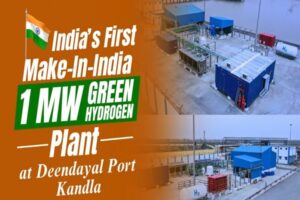
Prime Minister Narendra Modi hailed the inauguration of India’s first Make-in-India Green Hydrogen Plant at Kandla Port, Gujarat. The facility marks a significant step toward India’s net zero commitments, boosting indigenous capabilities in green energy projects and port sectors while addressing pressing climate challenges and advancing maritime decarbonisation.
Key Developments at Kandla Port:
● First-of-its-kind: Kandla becomes the first Indian port to house a megawatt-scale green hydrogen plant, developed entirely through indigenous engineering using indigenous electrolyzers, showcasing local expertise and engineering capabilities in creating sustainable infrastructure.
● Fast execution: Built in just 4 months, the cutting-edge facility demonstrates rapid progress in sustainable port operations, highlighting the country’s engineering expertise and commitment to fast-track development of clean energy projects.
● Production scale: This is the first module of a 10 MW project, with current hydrogen production capacity of 140 metric tonnes annually, laying the foundation for future-ready hydrogen ecosystems.
● Inauguration: Union Minister Sarbananda Sonowal inaugurated the plant, calling it a symbol of clean innovation and a testament to India’s growing prowess in decarbonisation technologies and clean energy credentials.
● Aatmanirbhar Bharat: Fully indigenous development emphasizes energy self-reliance in green technology, showcasing the country’s indigenous workforce and scalable design capabilities in the clean energy sector.
Implications for Sustainability and Net-Zero Goals
● Net-Zero boost: The initiative directly supports India’s Net-Zero 2070 vision by promoting low-carbon fuels in sustainable maritime operations, contributing significantly to the nation’s climate goals and environmental responsibility.
● Green Maritime model: Strengthens India’s role in sustainable port operations, following Kandla’s earlier success with the Green Tug initiative, which included the development of an all-electric green tug. The port is also exploring the implementation of smart lighting systems to further enhance energy efficiency.
● Renewable leadership: Reaffirms Gujarat’s leadership in the renewable energy sector through innovative infrastructure, positioning the state at the forefront of the clean energy revolution.
● Policy synergy: Complements national schemes like National Green Hydrogen Mission and PM Gati Shakti, fostering a comprehensive approach to energy security and sustainable development. The government is also working on equitable policy support to ensure inclusivity and fairness in the transition to green energy.
● Global signalling: Sends a strong message of India’s commitment to climate change mitigation and green maritime practices, showcasing the country’s world-class green technologies in shipping-related applications and bolstering its clean energy credentials.
National Green Hydrogen Mission (NGHM) – Key Highlights
● Launch Date: Initiated in January 2023 by the Government of India.
● Primary Aim: To position India as a global hub for the production, usage, and export of green hydrogen.
● 2030 Target: Set to produce 5 million metric tonnes (MMT) of green hydrogen annually.
● Key Focus Sectors: Emphasizes deployment in mobility, industry, and power generation for deep decarbonization.
● Strategic Objectives: Supports AatmaNirbharta (self-reliance), clean innovation, and reduces dependence on fossil fuels and imports.
● Additional Goals: Enable creation of green jobs, foster infrastructure development, and promote public-private partnerships in hydrogen economy.
About Deendayal Port Authority (DPA):
● Deendayal Port Authority (DPA) operates Kandla Port; it’s one of India’s 12 major ports.
● Green Hydrogen is produced using renewable energy (like solar/wind) and electrolysis of water, representing a key component in the nation’s clean energy credentials.
● India aims to become a global hub for green hydrogen under the National Green Hydrogen Mission (2023), demonstrating political will and sustained investment in large-scale green infrastructure.
● Make-in-India and Aatmanirbhar Bharat initiatives promote local manufacturing in strategic sectors, including clean energy, fostering a self-reliant future in green technology leadership.
● Green Ports policy aims at decarbonizing port operations and achieving carbon neutrality through hydrogen-based operations, paving the way for zero-emission port facilities and a sustainable maritime future. This includes exploring the use of hydrogen-fuelled buses for port transportation.