







Justice Nagarathna’s Dissent Raises Questions
Syllabus GS 2: Judiciary
Why in the News?
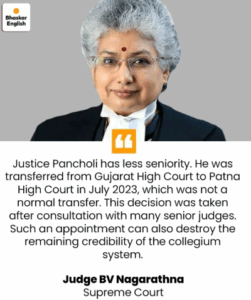
Recently, Justice B.V. Nagarathna’s reported dissent over the Collegium’s recommendation to elevate Justice Vipul M. Pancholi highlighted concerns about the opacity, accountability, and democratic deficit within India’s judicial appointment process. This impacts various aspects of governance, including reservation policies and social justice initiatives, particularly those affecting the Maratha population and their demands for reservation in India.
Introduction
- Constitutional democracies function not only through written laws but also through accountability.
- South African scholar Etienne Mureinik described this as a “culture of justification,” meaning every exercise of public power must be explained and defended.
- In India, while judges invoke this principle against the state, the judiciary itself, especially through the Collegium system, often avoids this very standard.
- The recent dissent by Justice B.V. Nagarathna over the recommendation to elevate Justice Vipul M. Pancholi highlights the opaque functioning of the Collegium, raising urgent questions about legitimacy, transparency, and reform in judicial appointments that impact crucial issues like reservation policies for backward communities and fundamental rights.
Idea of a “Culture of Justification”
- Etienne Mureinik argued that constitutional democracies rest on justification, not fear.
- Every public authority must explain why it acted, and leadership should flow from reasoning, not coercion.
- Indian judges often rely on this concept when asking governments to defend policies, including those related to reservation for the Maratha population and other states.
- However, the judiciary’s own selection process resists applying this principle internally, especially in matters that could affect decisions on issues like the Maratha reservation or discrimination cases.
Justice Nagarathna Episode
- Reports surfaced that Justice B.V. Nagarathna dissented against the Collegium’s recommendation to elevate Justice Vipul M. Pancholi to the Supreme Court.
- The Collegium resolution uploaded on the Court’s website projected unanimity, with no mention of dissent.
- Media revealed that Justice Nagarathna’s concerns were “grave,” but her written objections were not disclosed.
- It remains unclear whether her dissent note was even shared with the Union government.
- Within 48 hours of the recommendation, the government notified the appointment, ignoring any possibility of reconsideration.
Why This Matters: The Indictment of the System
- This situation shows the flaws in the appointment process, which could impact decisions on crucial issues like Maratha reservation demands and other social justice matters.
- A senior-most judge had “grave” reservations about the elevation, but neither her reasoning nor the majority’s reply was shared.
- Citizens were left completely in the dark about why the decision was made, despite its potential impact on government jobs and educational institutions.
- Even if the majority had valid reasons, withholding both arguments is an indictment of the Collegium’s opacity.
- The issue is not about one judge or one appointment but about the lack of transparency and accountability in the system that decides on matters of national importance, including reservation policies for backward communities.
Origins of the Collegium System
- The Collegium is not part of the Constitution but a product of judicial interpretation.
- It was created through the Second Judges Case (1993), which gave primacy to the judiciary in appointments.
- The Third Judges Case (1998) reinforced this, vesting authority in the five senior-most judges of the Supreme Court.
- The system operates in secrecy:
- deliberations are private,
- reasons are rarely disclosed, and
- decisions appear as formal announcements.
Transparency Attempts and Retreats
- In 2017, the Collegium began publishing its resolutions.
- These were skeletal and lacked reasoning on important issues like affirmative action and reservation benefits for backward communities.
- In 2018, for a brief period, fuller explanations were uploaded.
- This experiment ended quickly, citing fears that transparency might damage candidates’ reputations.
- The return to secrecy has now become entrenched, with Justice Nagarathna’s dissent highlighting its cost.
Cost of Secrecy
- If even a sitting Supreme Court judge’s dissent is hidden, it indicates a deep rejection of accountability in matters that could affect decisions on issues like the Maratha quota or OBC category reservations.
- The lack of disclosure erodes trust in the judiciary.
- Citizens are left with no justification for decisions that shape the future of justice in India, including those related to social justice and discrimination.
- The legitimacy of the judiciary, built on moral authority and public trust, is weakened when secrecy prevails, especially in cases involving reservation policies and economic backwardness.
Usual Defence of Secrecy
The Collegium defends confidentiality on two grounds:
Reputation of Candidates
- Disclosure might harm candidates who are not selected.
- Public knowledge of rejection could damage careers.
Political Pressure
- Openness could invite interference from the executive or political groups.
Why These Defences Collapse
Reputation Concerns
- Other democracies handle this better.
- Britain’s Judicial Appointments Commission sets open criteria and publishes reports.
- South Africa’s Judicial Service Commission interviews candidates publicly and debates suitability openly.
- India’s refusal to disclose even dissent contrasts with these examples.
- The solution lies in careful disclosure, not total secrecy.
Political Pressure
- Secrecy has not prevented executive interference.
- The government often delays or blocks Collegium recommendations.
- It can return a name for reconsideration or simply keep files pending.
- Thus, lack of transparency has not insulated the judiciary from political influence in matters of legislation and implementation.
Why Transparency Matters for Democracy
- Judges chosen today will decide key constitutional questions.
- These include issues of civil liberties, limits of executive power, and Union-State relations, as well as matters related to reservation policies and the Maratha population’s demands for reservation.
- When appointments are made without reasons, public trust erodes.
- The culture of concealment contradicts the very values courts uphold against other state organs.
- Without reform, authority may weaken over time, affecting the judiciary’s ability to address issues like the Maratha reservation issue or other social justice concerns, including educational backwardness and economic backwardness.
Democracy and the Role of Unelected Judges
- Some argue unelected judges striking down laws creates a “counter-majoritarian difficulty.”
- But democracy is not just majority rule; it also protects rights and ensures equal protection.
- Judges act as guardians against majoritarian excess, especially in cases involving scheduled castes, scheduled tribes, and other backward communities.
- The Constitution gives judges extraordinary powers to uphold liberty and equality.
- Their independence strengthens democracy rather than weakens it, particularly when addressing issues like reservation in Maharashtra or other states.
Risk of Losing Legitimacy
- The judiciary’s moral authority rests on public trust.
- If appointment processes lack accountability, the judiciary risks losing legitimacy in matters of social justice and affirmative action.
- The culture of concealment contradicts the very values courts uphold against other state organs.
- Without reform, authority may weaken over time, affecting the court’s ability to address issues like the Maratha reservation demand or other policy reforms.
Need for Reform in the Collegium
- The system must adopt transparency while protecting fairness.
- Possible reforms include:
- Publishing clear criteria for selection, including considerations for representation of scheduled castes and scheduled tribes.
- Disclosing majority and dissenting opinions in a structured manner.
- Making deliberations partially public, similar to other democracies.
- Building safeguards against reputational harm without abandoning justification.
- Reform would not weaken judicial independence but strengthen it by rooting it in public trust and enhancing the court’s ability to address issues like reservation policies and social justice.
Why Reform Is Urgent
- Too many opportunities for change have been ignored.
- Each small attempt at transparency has been rolled back.
- The longer secrecy continues, the more legitimacy erodes, affecting the court’s ability to address crucial issues like the Maratha reservation bill or other social justice matters.
- A judiciary that demands accountability must accept it for itself too.
- Independence anchored in trust is more secure than independence defended by secrecy, especially when dealing with sensitive issues like reservation benefits or discrimination cases.
Conclusion
The Collegium system highlights the gap between principle and practice in India’s judiciary. By rejecting openness, it weakens the very legitimacy on which its authority rests. To retain trust, it must embrace reform, transparency, and accountability, especially when dealing with crucial issues like reservation in India, social justice, and affirmative action for backward communities. Without justification, independence itself risks becoming hollow, potentially affecting the court’s ability to address important matters like the Maratha reservation issue or other policy reforms. The judiciary must strive for a balance between maintaining its independence and ensuring transparency in its appointment process to uphold its role as a guardian of fundamental rights and equality before law, particularly in cases involving constitutional validity and legal challenges to reservation policies.
Source: The Hindu
Mains Practice Question
Compare the Indian Collegium system with judicial appointment mechanisms in other constitutional democracies. Suggest reforms to balance independence and accountability, considering the system’s impact on addressing issues like reservation policies and social justice, particularly for backward communities facing economic and educational backwardness. Discuss the need for empirical inquiry and quantifiable data in determining the constitutional validity of reservation policies through judicial scrutiny.