







INDIA’S PROGRESS ON CLIMATE TARGETS
Syllabus:
GS-3: ● Environment and ecology ● Conservation
Why in the News?
Recent debates on environmental governance and the need for robust environmental clearances have revived attention on India’s climate commitments under the Paris Agreement. While India has met key emissions-intensity and non-fossil capacity targets, questions persist regarding absolute emissions reduction, renewable integration, forest quality, and long-term credibility of its 2070 net-zero pledge. The ongoing discussions also highlight the importance of environmental impact assessments and the role of ex post facto clearances in shaping India’s environmental jurisprudence.
INDIA AND THE PARIS AGREEMENT |
| ● CBDR Principle: India’s commitments rest on common but differentiated responsibilities, reflecting historical emissions inequity. |
| ● Original Pledges: Targets included emissions-intensity reduction, renewable capacity expansion, and forest carbon sinks. |
| ● Updated Ambitions: India raised its goal to 50% non-fossil capacity by 2030, strengthening global credibility. |
| ● Implementation Focus: Success now depends on delivery quality, not ambition escalation. |
| ● Global Position: India outperforms many G-20 peers on intensity decline but lags on absolute mitigation. |
INCOMPLETE DECOUPLING OF GROWTH
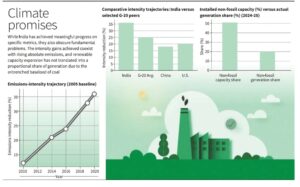
- Early Achievement: India reduced GDP emissions intensity by nearly 36% by 2020, meeting its 2030 Paris target a decade early through structural and policy shifts, including improved environmental clearance processes.
- Energy Shift: Rapid expansion of non-fossil electricity capacity, especially solar and wind, lowered average carbon intensity of power generation significantly.
- Economic Transition: Growth of services and digital sectors reduced emissions per unit GDP, aiding intensity decline without structural industrial decarbonisation.
- Efficiency Programs: Schemes like PAT and UJALA curtailed energy demand growth, generating measurable electricity savings and avoided emissions.
- Absolute Reality: Despite intensity gains, absolute emissions remain high, reflecting partial decoupling where GDP growth continues to outpace emissions reductions.
ABSOLUTE EMISSIONS CONSTRAINT
- High Emissions: India emitted nearly 2,959 MtCO₂e in 2020, remaining among the world’s largest absolute emitters despite improved efficiency.
- Sectoral Divergence: Emissions from cement, steel, and transport continue rising, even as power-sector emissions growth moderates.
- Coal Dependence: Large coal capacity sustains high per-kWh emissions, limiting translation of efficiency gains into absolute reductions.
- Net-Zero Challenge: Without coal phase-down schedules and industrial decarbonisation, India’s 2070 net-zero pledge risks credibility. This challenge underscores the need for stringent environmental clearances and adherence to the polluter pays principle.
- Masked Trends: National averages conceal regional and sectoral emissions disparities, complicating targeted mitigation strategies.
GENERATION–CAPACITY MISMATCH
- Capacity Growth: Non-fossil capacity crossed 51% of installed capacity by mid-2025, fulfilling headline Paris commitments.
- Generation Gap: Renewables produced only about 22% of electricity in 2024-25 due to intermittency and low capacity factors.
- Coal Baseload: Coal-based capacity of around 253 GW continues supplying over 70% of electricity, anchoring system reliability.
- Missed Targets: India missed its 175 GW renewable target for 2022, highlighting execution and integration challenges.
- Policy Illusion: Installed capacity success masks failure in actual emissions displacement, weakening climate mitigation outcomes.
STORAGE AND GRID BOTTLENECKS
- Critical Deficit: Energy storage demand is projected at 336 GWh by 2030, while operational capacity remains negligible.
- Integration Failure: Lack of storage prevents renewables from replacing fossil baseload during non-generation hours.
- Transmission Delays: Grid connectivity constraints and land acquisition issues delay renewable evacuation and utilisation.
- State Bottlenecks: Regulatory fragmentation across States slows wind expansion and renewable deployment.
- Systemic Need: Storage, transmission upgrades, and demand response are essential for reliable renewable dominance.
FOREST SINK: NUMBERS VS NATURE
- Target Nearing: India has achieved 2.29 billion tonnes of additional carbon sequestration, nearing its 2.53-billion-tonne target.
- Elastic Definitions: Official forest cover includes plantations and monocultures, overstating ecological restoration.
- Minimal Expansion: Forest cover increased by only 156 sq km between 2021–23, reflecting stagnation.
- Implementation Gaps: ₹95,000 crore under CAMPA remains under-utilised due to weak State capacity.
- Climate Stress: Warming and water stress undermine actual carbon assimilation, despite satellite-observed “greening”.
The implementation of the Forest Conservation Act and proper environmental impact assessments are crucial for addressing these challenges and ensuring a pollution-free environment.
THE ROAD AHEAD
- Coal Transition: India must develop a transparent coal phase-down roadmap aligned with employment and energy security.
- Storage Scale-Up: Rapid deployment of battery and pumped-storage systems is indispensable for renewable dominance.
- Forest Governance: Climate policy must prioritise biodiversity-rich regeneration, not plantation-centric accounting.
- Data Transparency: Improved sectoral and regional emissions data is essential for credible monitoring.
- Coordination Need: Climate success now depends on institutional coherence, not technology alone.
To achieve these goals, India must strengthen its environmental democracy and continue to evolve its environmental jurisprudence, including addressing issues related to ex post facto and retrospective environmental clearances.
CONCLUSION
India has broadly met its headline Paris commitments, particularly on emissions intensity and renewable capacity. Yet, rising absolute emissions, coal dependence, storage deficits, and plantation-centric forestry expose structural weaknesses. The coming five years are decisive in converting symbolic success into real climate mitigation through systemic reforms and coordinated governance. This transition will require a careful balance between development needs and environmental protection, guided by principles such as the precautionary principle and robust environmental impact assessments.
MAINS PRACTICE QUESTION
India has met several quantified Paris Agreement targets but continues to face challenges in achieving absolute emissions reduction. Analyse the reasons and suggest a way forward, considering the role of environmental clearances and impact assessments in this process.