







INDIA’S DIPLOMATIC GAINS IN WEST ASIA
Syllabus:
GS-3: ● Indian economy and issues associated ● Growth and Development
Why in the News?
India’s signing of a landmark Comprehensive Economic Partnership Agreement (CEPA) with Oman in December 2025 highlights the transformation of India’s West Asia diplomacy. Once viewed through the prism of Pakistan, key Gulf countries now see India as a strategic, economic, and security partner, reflecting dramatic diplomatic gains since 2014. This shift can be likened to an environmental clearance process, where India’s regional standing has undergone a thorough assessment and emerged stronger.
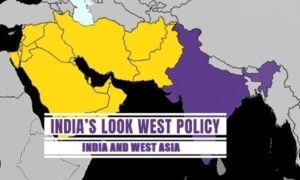
| INDIA’S “THINK WEST” POLICY |
| ● Policy Origin: The Think West Policy, articulated after 2014, aimed to deepen engagement with West Asia beyond energy-centric ties. |
| ● Core Pillars: It integrates economic diplomacy, security cooperation, diaspora welfare, and political outreach. |
| ● Strategic Scope: The policy aligns West Asia with India’s Indo-Pacific and extended neighbourhood strategy. |
| ● Diplomatic Tools: Emphasises leader-level diplomacy, defence cooperation, and civilisational narratives. |
| ● Outcomes: Think West has transformed India from a transactional partner to a strategic stakeholder in the region. |
SHIFT FROM PAST FOREIGN POLICY
● Policy Reorientation: India’s West Asia engagement moved from episodic outreach to a coherent “Think West” strategy, integrating diplomacy with trade, security, and diaspora interests. This shift resembles an ex post facto environmental clearance, retroactively validating India’s regional approach.
● Breaking Hyphenation: India successfully de-hyphenated itself from Pakistan in Gulf diplomacy, ensuring bilateral relations are no longer influenced by subcontinental rivalries. This process mirrors the precautionary principle in environmental jurisprudence, proactively addressing potential diplomatic challenges.
● Civilisational Connect: Diplomatic engagement was framed within India’s historical, cultural, and people-to-people ties, deepening trust beyond transactional diplomacy. This approach aligns with the concept of environmental democracy, emphasizing inclusive and participatory relationships.
● Strategic Clarity: New Delhi projected itself as a confident rising power, aligning economic growth with geopolitical relevance across the Middle East. This clarity in vision is akin to a comprehensive environmental impact assessment of India’s regional role.
● Sustained Engagement: Unlike earlier ad-hoc interactions, India maintained continuous high-level political engagement, signalling long-term commitment to the region. This consistency echoes the principles of sustainable development in environmental jurisprudence.
ECONOMIC DIPLOMACY AND TRADE EXPANSION
● Trade Growth: India’s share in GCC trade rose from 3% in 1992 to 11% by 2012, accelerating significantly in the past decade. This growth trajectory resembles the gradual implementation of retrospective environmental clearances, validating past economic engagements.
● Oman Agreement: The CEPA with Oman grants zero-duty access on 98% tariff lines, marking Oman’s first bilateral trade pact since 2006. This agreement serves as an environmental clearance for enhanced economic cooperation.
● Trade Volume: India–GCC trade reached $184 billion in 2023–24, underscoring deep economic interdependence. This volume reflects the success of India’s ex-post diplomatic strategy in the region.
● Investment Flows: FDI from Gulf countries crossed $20 billion, reflecting confidence in India’s economic stability and policy environment. These investments align with the polluter pays principle, ensuring mutual benefits and responsibilities.
● Energy Security: Strong ties ensure reliable access to oil, gas, and strategic reserves, reinforcing India’s energy security architecture. This approach mirrors the coastal regulation zone management, balancing resource utilization with strategic interests.
EXPANDED REGIONAL OUTREACH
● Beyond GCC: India expanded engagement beyond the six GCC states to Egypt, Jordan, Morocco, Tunisia, and African Muslim-majority nations. This expansion is comparable to broadening the scope of an environmental impact assessment.
● Africa Linkages: Outreach to Nigeria, Ghana, and Ethiopia aligned West Asia diplomacy with India’s broader Africa strategy, creating a comprehensive diplomatic ecosystem.
● Geographic Integration: West Asia was repositioned as part of India’s extended neighbourhood, not a distant diplomatic theatre. This integration reflects the holistic approach of the Forest Conservation Act in preserving interconnected ecosystems.
● Political Signalling: Engagement with North Africa signalled India’s intent to be a pan-regional partner, not confined to the Gulf. This approach embodies the principles of environmental democracy, fostering inclusive regional partnerships.
● Economic Corridors: These ties support emerging connectivity corridors, linking South Asia, West Asia, and Africa, similar to creating sustainable ecological corridors.
SECURITY AND STRATEGIC REALISM
● China Factor: India openly acknowledged concerns over China’s naval and port footprint across the Indian Ocean and West Asia. This acknowledgment aligns with the precautionary principle in strategic planning.
● Net Security Provider: India positioned itself as a net security provider, safeguarding sea lanes from piracy and missile threats. This role mirrors environmental protection measures in maritime zones.
● Naval Presence: Regular deployment of Indian naval assets enhanced maritime security cooperation with Gulf partners, akin to monitoring and enforcing coastal regulation zone guidelines.
● Military Exercises: Joint exercises with UAE, Saudi Arabia, and Egypt strengthened defence interoperability and trust, reflecting collaborative approaches in environmental jurisprudence.
● Strategic Balance: India offered a non-intrusive, rules-based security partnership, distinct from coercive great-power approaches. This balance echoes the principles of sustainable development in international relations.
PERSONAL DIPLOMACY AND LEADERSHIP
● Leader-Level Focus: Prime Minister Modi made nine visits to West Asian countries, more than his four predecessors combined. These visits served as diplomatic environmental impact assessments, evaluating and strengthening bilateral ties.
● Trust Building: Personal rapport with regional leaders translated into political goodwill and strategic confidence, similar to building stakeholder trust in environmental governance.
● Crisis Diplomacy: High-level engagement enabled sensitive outcomes, including the release of Indian naval veterans from Qatar. This success demonstrates the effectiveness of India’s ex post facto diplomatic approach.
● Narrative Shift: Modi’s diplomacy reshaped perceptions of India as a decisive and dependable partner, akin to establishing a new environmental jurisprudence in regional relations.
● Political Capital: Sustained leadership investment ensured continuity across political transitions in the region, reflecting the long-term vision of sustainable development policies.
DIASPORA-CENTRIC DIPLOMACY
● Human Dimension: Protection of the Indian diaspora’s safety, dignity, and welfare became central to West Asia policy, embodying the principles of environmental democracy in human-centric diplomacy.
● Labour Cooperation: Strong ties improved cooperation on labour rights, working conditions, and legal protections, aligning with the polluter pays principle in ensuring responsible employment practices.
● Remittance Security: Stable Gulf relations safeguarded remittance flows, vital for India’s domestic economy, similar to protecting critical environmental resources.
● Mutual Dependence: The Gulf’s reliance on Indian labour reinforced reciprocal interdependence, reflecting the interconnected nature of ecosystems in environmental management.
● Soft Power: Diaspora engagement enhanced India’s soft power and societal influence across the region, comparable to the far-reaching impact of environmental awareness campaigns.
POLITICAL DE-HYPHENATION FROM PAKISTAN
● Perception Shift: Saudi Arabia and the UAE no longer view India through the Pakistan-centric lens, marking a significant ex post facto correction in regional diplomacy.
● Kashmir Stance: Post-2019, key Gulf states treated Jammu and Kashmir as India’s internal matter, reflecting an environmental clearance for India’s sovereign decisions.
● Investment Continuity: Gulf investments continued despite geopolitical sensitivities, signalling strategic recalibration and adherence to the polluter pays principle in economic partnerships.
● Diplomatic Autonomy: India gained greater political space to pursue independent regional interests, akin to establishing protected areas in environmental conservation.
● Regional Respect: India emerged as a trusted political actor, not a balancing variable in South Asian rivalries, embodying the principles of environmental jurisprudence in regional politics.
BROADER GEOPOLITICAL IMPLICATIONS
● Multipolar Region: India’s rise fits West Asia’s shift towards multi-alignment and strategic diversification, reflecting the diversity principle in ecosystem management.
● Global Standing: Strong West Asia ties elevate India’s profile in global energy, trade, and security forums, similar to gaining international recognition for environmental stewardship.
● Connectivity Projects: Partnerships support trans-regional initiatives linking Europe, Middle East, and Asia, comparable to creating ecological corridors across diverse landscapes.
● Strategic Autonomy: India balances relations with the U.S., Iran, Israel, and Arab states without entanglement, mirroring the delicate balance in managing complex ecosystems.
● Long-Term Influence: These gains anchor India firmly within West Asia’s evolving power architecture, establishing a sustainable diplomatic ecosystem for the future.
CONCLUSION
India’s West Asia diplomacy has undergone a remarkable transformation, driven by strategic clarity, economic engagement, and personal leadership. By de-hyphenating itself from Pakistan, deepening security ties, and prioritising diaspora welfare, India has emerged as a trusted strategic partner. This diplomatic evolution mirrors the comprehensive process of obtaining environmental clearances, where each aspect of engagement is carefully assessed and optimized. The Vanashakti judgment principle of balancing development with conservation finds its diplomatic parallel in India’s nuanced approach to regional relationships. Few diplomatic theatres reflect such rapid and consequential gains, showcasing India’s ability to navigate complex geopolitical landscapes while fostering a pollution-free environment for constructive international relations.
MAINS PRACTICE QUESTION
“India’s West Asia policy has shifted from transactional engagement to strategic partnership.” Analyse the factors behind this transformation and its implications for India’s foreign policy.