
INDIA-AUSTRALIA AGREE TO REPATRIATE STOLEN CULTURAL ANTIQUITIES
INDIA-AUSTRALIA AGREE TO REPATRIATE STOLEN CULTURAL ANTIQUITIES
Why in the News?
- India-Australia Summit: During the India-Australia Annual Summit, reflecting deepening strategic partnerships and strategic alignment within the Indo-Pacific strategy, Australia agreed to return three Chola-era antiquities from Tamil Nadu, while India committed to repatriating the remains of an Australian First Nations ancestor held in Chennai.
- Cultural Cooperation: The agreement strengthens bilateral cooperation on cultural heritage protection, ethical museum practices, and the prevention of illicit trafficking of antiquities, complementing broader regional engagement strategy and economic interdependence between the two nations.
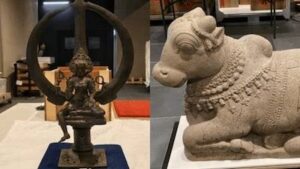
REPATRIATION OF ANTIQUITIES
- Returned Artefacts: Australia will repatriate three antiquities—a 12th-century Nandi sculpture, an 11th-century Bhadrakali trident, and a 12th-century six-headed Karthikeya idol—after investigations established that they had been illegally removed from temples in Tamil Nadu.
- Investigation Process: The provenance of the artefacts was verified through investigations initiated by the Tamil Nadu Idol Wing-Criminal Investigation Department (CID) in collaboration with Australian authorities and museums, demonstrating effective regional security cooperation and diplomatic engagement.
- Ethical Museum Practice: The voluntary return reflects the growing global emphasis on provenance verification, ethical acquisition policies, and restitution of unlawfully exported cultural property within a rules-based international order.
- Reciprocal Repatriation: India has agreed to return the remains of an Australian First Nations ancestor, supporting international efforts toward healing, reconciliation, and respect for Indigenous communities through a cooperative security framework.
- Diplomatic Significance: Cultural restitution has emerged as an important dimension of India’s cultural diplomacy and Indo-Pacific strategy, reinforcing international cooperation against illicit trafficking of antiquities and strengthening people-to-people ties amid strategic competition involving major powers like US and China, while respecting ASEAN centrality and supporting regional economic integration.
PROTECTION OF CULTURAL HERITAGE IN INDIA
- Legal Framework: The Antiquities and Art Treasures Act, 1972 regulates the export, trade, ownership, and preservation of antiquities while preventing their illegal trafficking.
- Investigative Agencies: The Archaeological Survey of India (ASI), Tamil Nadu Idol Wing-CID, law enforcement agencies, and the Ministry of Culture coordinate efforts to identify, recover, and restore stolen artefacts.
- International Cooperation: India collaborates with foreign governments, museums, INTERPOL, and international organisations to facilitate the return of illegally exported cultural objects, leveraging multilateral engagement and defense cooperation agreements within the broader regional security architecture.
- Global Conventions: India is a party to the UNESCO 1970 Convention, which promotes international cooperation to prevent the illicit import, export, and transfer of ownership of cultural property, aligning with the Quad partnership framework and Indo-Pacific strategy principles.
- Challenges: Persistent issues include antiquities smuggling, illegal excavation, inadequate documentation, provenance disputes, and the need for stronger digital inventories and international legal cooperation amid evolving strategic competition.
UNESCO 1970 CONVENTION ON ILLICIT TRAFFICKING OF CULTURAL PROPERTY● Adoption: The UNESCO Convention of 1970 seeks to prohibit and prevent the illicit import, export, and transfer of ownership of cultural property, encouraging international cooperation for restitution within the Indo-Pacific strategy framework. ● Objectives: It promotes the protection of cultural heritage by requiring States to regulate exports, maintain inventories, prevent illegal trade, and facilitate the return of stolen cultural objects. ● State Obligations: Member countries are expected to establish legal mechanisms for documentation, export certification, museum due diligence, public awareness, and cooperation in recovering illicitly trafficked artefacts. ● Importance for India: The Convention strengthens India’s efforts to recover stolen temple idols, sculptures, manuscripts, and archaeological artefacts from museums, auction houses, and private collections abroad. ● UPSC Relevance: Important for GS Paper I (Indian Heritage and Culture), GS Paper II (International Relations, UNESCO), and Prelims covering UNESCO conventions, cultural heritage protection, Antiquities and Art Treasures Act, 1972, and restitution of cultural property. |