







HOW NEW TECHNOLOGY CAN HELP INDIA CLOSE IN ON TB
Why in the news?
● The rapid development of COVID-19 vaccines showcased the power of global collaboration and robust public investment.
● It demonstrated that scientific innovation can be accelerated when resources, data, and expertise are shared across countries and sectors.
● This success has renewed calls to apply a similar model to tuberculosis (TB) vaccine development, which has lagged despite TB being a leading infectious disease killer.
● Experts and public health advocates emphasize that replicating the COVID-19 response strategy could finally help deliver an effective TB vaccine, especially for pulmonary tuberculosis cases caused by Mycobacterium tuberculosis.
Review of National Tuberculosis Elimination Programme (NTEP) by PM Modi
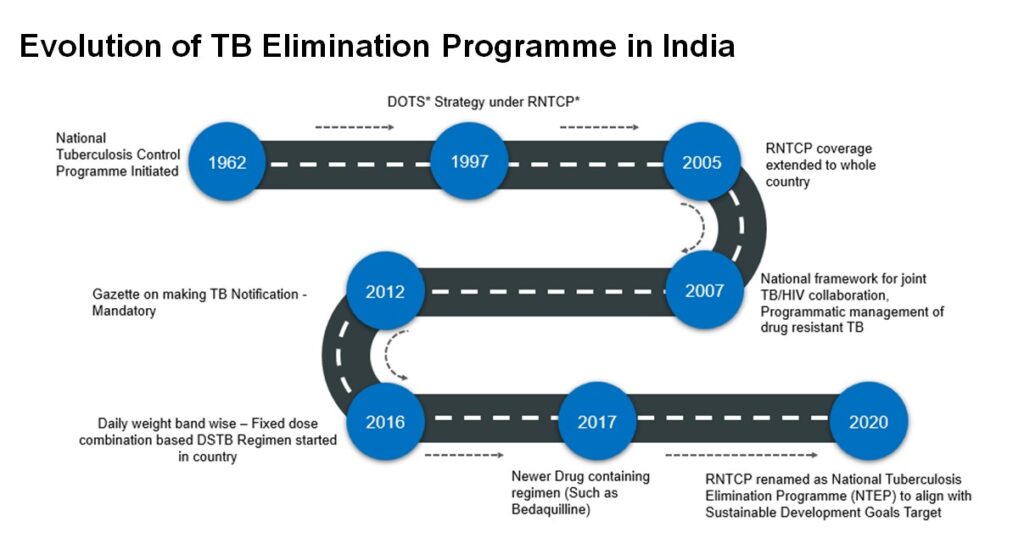
● Prime Minister Narendra Modi recently reviewed the progress of the National Tuberculosis Elimination Programme (NTEP).
● He emphasized public participation and the need to scale up successful and innovative strategies.
● The review comes at a critical juncture, with new opportunities emerging due to advancements in: ○ Diagnostics, including computer-aided detection and GeneXpert testing ○ Digital health tools and mobile health technologies ○ Vaccine development and potential drug repurposing strategies
Encouraging Trends in TB Elimination
As per the WHO Global TB Report 2024:
● Global TB incidence declined by 8.3% between 2015 and 2023.
● India outperformed the global average with a 17.7% reduction during the same period, showcasing progress even in resource-constrained settings.
India’s Strong Progress Under NTEP
● These improvements underscore the effectiveness and focused implementation of NTEP.
● Reflects strong political will, sustained commitment, and community engagement.
● Demonstrates India’s leadership and momentum in the global fight against TB, particularly in addressing health equity concerns through cost-effectiveness analysis of interventions.
Closing the Diagnostic Gap: The Most Critical Weak Link
● An estimated 2.7 million TB cases globally in 2023 were undiagnosed or unnotified.
● Lack of diagnosis prevents timely treatment and enables continued transmission of Mycobacterium tuberculosis.
● Subclinical TB (asymptomatic phase) may account for ~50% of TB cases in high-burden countries like India.
● This asymptomatic reservoir is likely a key driver of ongoing transmission, highlighting the need for improved diagnostic accuracy and sensitivity and specificity in screening methods.
Lessons from the 100-Day TB-Mukt Bharat Abhiyaan
● Focused on intensified screening, especially in vulnerable, asymptomatic populations.
● Out of 7.19 lakh TB cases diagnosed, 2.85 lakh were asymptomatic — potentially missed by conventional screening methods like sputum smear microscopy.
● Use of portable chest X-rays and AI-assisted interpretation, including convolutional neural networks and support vector machines, enabled early and accurate tuberculosis diagnosis.
● The planned national scale-up of this tech-driven model could become a global benchmark for community-based screening, especially in low-income countries, with emphasis on quality assurance and external validation.
Transforming Diagnosis Through Innovation
New point-of-care diagnostics are improving access and affordability:
● Non-invasive sampling (e.g., tongue or nasal swabs) are child- and elderly-friendly.
● Open PCR platforms reduce testing costs and expand access to molecular diagnostics like nucleic acid amplification.
● These innovations are being piloted in India, with the Indian Council of Medical Research (ICMR) facilitating integration into routine care, while considering ethical considerations and data governance.
● Advanced machine learning techniques, such as gradient boosting and principal component analysis, are being explored for feature extraction from diagnostic data to enhance accuracy.
Enhancing Supportive Care and Reducing Mortality
● India has doubled nutritional support under Nikshay Poshan Yojana to address undernutrition — a leading TB risk factor.
● Introduction of differentiated TB care models: ○ Risk-based stratification of patients using meta-analysis of clinical data. ○ Timely referrals to higher facilities. ○ Intensive inpatient care for severe cases, including those requiring drug susceptibility testing and resistance prediction.
● These steps aim to bring TB mortality close to zero, including for drug-resistant tuberculosis cases, while ensuring cost-effectiveness through real-world performance evaluation.
The Long-Term Goal: TB Vaccine Development
● An effective TB vaccine remains the ultimate solution.
● The Covid-19 vaccine experience highlights the potential of: ○ Global collaboration ○ Fast-track regulation ○ Public investment
● India is well-positioned with: ○ Strong scientific & manufacturing infrastructure ○ Ongoing clinical trials, including mRNA vaccine candidates and virtual screening for TB drug discovery using vision transformer models.
India’s Global Leadership in TB Elimination
● PM Modi’s leadership has kept TB elimination at the forefront of the national health agenda.
● India is inspiring the global south with: ○ Ambitious targets ○ Innovative approaches, including smartphone-based imaging and ultra-portable digital x-ray systems ○ Data-driven policy frameworks leveraging machine learning for adherence tracking
● With sustained political will and cutting-edge innovation, India can lead the global fight to end TB, fostering international collaboration.
Way Forward for TB Elimination in India
● Close the Diagnostic Gap ○ Expand community-based active case finding, especially targeting asymptomatic individuals. ○ Use AI-assisted chest X-ray analysis with computer-aided detection and non-invasive sample methods (tongue/nasal swabs) for faster and broader screening.
● Scale Up Innovations ○ Roll out portable diagnostic tools and open PCR platforms across public and private health sectors. ○ Ensure last-mile connectivity of tech-enabled diagnostics in rural and underserved areas, leveraging mobile health technologies and addressing infrastructure requirements.
● Strengthen Subclinical TB Detection ○ Integrate subclinical TB detection into national screening protocols. ○ Train frontline health workers in identifying early and atypical TB cases using advanced diagnostic techniques and machine learning algorithms.
● Ensure Nutritional and Social Support ○ Further enhance and universalize Nikshay Poshan Yojana benefits. ○ Link TB care with other social welfare schemes (e.g. PDS, livelihood programs) to address health equity concerns.
● Implement Differentiated TB Care Models ○ Develop risk-stratified care pathways based on severity and co-morbidities. ○ Ensure timely referrals, specialist intervention, and inpatient care where required, with a focus on treatment monitoring and resistance prediction.
● Accelerate TB Vaccine Development ○ Invest in next-gen vaccine R&D, including mRNA-based candidates. ○ Create fast-track regulatory pathways, leveraging the COVID-19 vaccine model and international collaboration.
● Promote Public Participation and Behaviour Change ○ Launch sustained IEC (Information, Education, Communication) campaigns to reduce stigma. ○ Encourage community surveillance and peer-led support systems, incorporating digital adherence technologies.
● Strengthen Data Systems and Real-time Monitoring ○ Use digital platforms like Nikshay to track outcomes and plug gaps. ○ Enable predictive analytics for outbreak forecasting and resource planning, ensuring proper data governance and leveraging training datasets for continuous improvement.
● Foster Global Collaboration ○ Share India’s learnings globally, especially with other high-burden nations. ○ Leverage partnerships with WHO, Stop TB Partnership, and research institutions for knowledge exchange and resource optimization.
● Ensure Sustained Political Commitment ○ Keep TB elimination high on the national policy agenda. ○ Ensure adequate and predictable funding for diagnostics, treatment, and R&D, including support for anti-TB medications and innovative technologies.
Source: https://indianexpress.com/article/opinion/columns/closing-in-on-tb-10104959/
Mains Question (250 words):
“Despite progress under the National Tuberculosis Elimination Programme, diagnostic gaps and subclinical cases pose major challenges. Discuss the role of innovation and policy in accelerating India’s TB elimination goals, considering the potential of computer-aided detection and ethical considerations in implementation.”