






GST 2.0: Towards a Simpler, Stronger and Inclusive Tax Regime
Syllabus:
GS 3
● GST Reform
● Taxation reforms, Fiscal policy
Why in the News?
The GST 2.0 reform marks India’s most significant indirect tax reform since GST’s launch in 2017. Prioritising simplification over short-term revenue gains, it collapses tax slabs, introduces a clear sin tax structure, eases compliance, and strengthens institutions like the GST Appellate Tribunal. Its success depends on smooth execution, voluntary compliance, and alignment with India’s growth and formalisation goals.
 Introduction: Why GST 2.0 Matters
● GST launched in 2017 was hailed as India’s biggest tax reform, unifying the fragmented indirect tax system.
● Despite its achievements, challenges persisted: ○ Multiple GST slabs created complexity and disputes. ○ Compliance burdens discouraged smaller businesses. ○ Tax gaps (difference between actual and potential revenue) remained high, averaging around 70% efficiency.
● GST 2.0, launched after eight years, is the most ambitious attempt to fix these issues.
● Core aim: long-term structural stability over short-term collection spikes.
The Rationale Behind GST 2.0
● Economic logic – “Laffer Curve” principle: ○ Lower tax rates → broader compliance → higher long-term GST collections. ○ High rates discourage compliance, increase evasion, and suppress demand.
● Need for simplification: ○ Four-slab GST structure was confusing for businesses and administrators alike. ○ Led to classification disputes, especially between 12% and 18% slabs. ● Global evidence: OECD and IMF studies show that tax simplification → boosts compliance → leads to sustained revenue growth.
● Indian context: ○ Revenue foregone in the short term is acceptable if it brings more businesses into the formal tax net. ○ GST 2.0 is also aligned with India’s goal of becoming a $5 trillion economy.
Key Structural Reforms in GST 2.0
(a) Collapsing the Four-Slab System
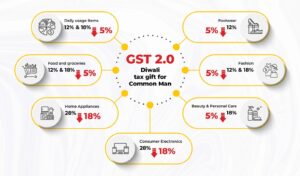
● Previous structure: 5%, 12%, 18%, and 28% + cess.
● New structure: ○ 5% (essentials, mass consumption goods).
○ 18 percent GST (majority of standard goods & services). ○ 0.25% and 3% (special categories like gems, gold). ○ 40% sin/luxury tax (new bracket for select items).
● Implications: ○ Greater clarity and predictability. ○ Reduces disputes on classification. ○ Makes India’s system closer to global best practices.
(b) Introduction of 40% “Sin and Luxury” Tax Slab
● Replaces earlier 28% + cess.
● Applies to goods like: ○ Tobacco, aerated drinks, soft drinks. ○ Luxury goods, high-end consumer products
. ● Advantages: ○ Transparency – clear highest GST rate for luxury items. ○ Public health benefits – discourages harmful consumption. ○ Revenue stability – demand for these goods is relatively inelastic.
(c) Exemptions and Relief Measures
● Out of 850 goods reviewed: ○ 90% saw reductions in tax rates. ○ 52 items completely exempted – mostly essential goods.
● Small businesses: ○ Output below ₹25 lakh/month gets relief. ○ Encourages marginal enterprises to join formal tax net.
(d) Removal of Compensation Cess on Coal and Lignite
● Relief to the struggling power sector.
● Helps reduce input costs for electricity generation, with positive spillovers across the economy.
Demand-Side and Supply-Side Impacts
(a) Demand-Side Considerations
● Price transmission: Businesses must pass reduced tax burden to consumers.
● Consumer demand sensitivity: ○ For inelastic products (tobacco, soft drinks) – consumption remains stable. ○ For elastic products (processed food, online services) – higher tax may reduce consumption.
● Targeted taxation of youth consumption patterns: ○ Higher taxes on processed food, social media services, online gaming – labelled the “deadly troika” by the CEA. ○ Encourages healthier consumption patterns.
(b) Supply-Side Impacts
● Simplification reduces compliance burden for businesses.
● Refund reforms: ○ Faster processing of Input Tax Credit (ITC) claims. ○ Removal of threshold limits on low-value exports → major boost for small exporters.
● Institutional reform with GSTAT reduces litigation backlog and offers clarity to businesses.
Bridging India’s Tax Gap
● Persistent issue: only ~70% of potential tax revenue realised for over a decade.
● Causes: ○ Evasion due to complex structures. ○ High compliance costs → discouraging smaller businesses.
● GST 2.0 strategies: ○ Simplified slabs → reduces incentive to misclassify goods. ○ Targeted relief → brings more marginal businesses into the fold. ○ Better refund systems → improves liquidity and compliance willingness.
Fiscal Concerns and Market Reactions
● Short-term dip in effective tax rate: ○ From 11.64% to 11.43%. ○ A “temporary revenue sacrifice”. ● Fiscal deficit worries: ○ Lower collections + higher spending to support exporters = short-term deficit risks. ○ Markets reacted negatively at first.
● Stabilisation factors: ○ Recent sovereign credit rating upgrade. ○ Government’s commitment to fiscal consolidation.
● Long-term: GST 2.0 expected to increase tax buoyancy and strengthen fiscal health.
Global Lessons for India
● Malaysia’s GST rollback (2018): ○ Poor implementation → business disruptions → repeal of GST. ○ Lesson: Execution is as important as design.
● OECD experience: Countries with simplified GST/VAT see stronger compliance and higher sustained revenues.
● India’s challenge: Avoid glitches in IT systems, refunds, and enforcement.
Institutional Strengthening: GSTAT
● Long-standing demand: Businesses needed a dedicated appellate forum.
● GST 2.0 introduces the Goods and Services Tax Appellate Tribunal (GSTAT).
● Benefits: ○ Reduces litigation backlog in High Courts. ○ Provides specialised tax adjudication. ○ Enhances trust in tax governance.
Challenges in Implementation
● Coordination challenge: Requires cooperation across Centre, States, tax officials, and businesses.
● Training requirements: ○ State-level officials need robust training. ○ Businesses require clear guidance to adjust billing systems.
● Risk of disputes: ○ Classification issues may continue, especially with sin tax items.
● Technology readiness: ○ Need for glitch-free GSTN (Goods and Services Tax Network). ○ Smooth processing of refunds and ITC critical.
Long-Term Strategic Benefits
● For government: ○ Higher voluntary compliance → more stable revenues. ○ Simplification → less administrative cost.
● For businesses: ○ Predictability in tax rates → easier financial planning. ○ Faster refunds → improved liquidity. ● For consumers: ○ Lower taxes on essentials → more affordable living. ○ Clarity in pricing → less hidden tax burden.
● For economy: ○ Formalisation of small businesses → higher productivity. ○ Encourages Make in India and exports.
Way Forward
● Short-term focus: ○ Ensure smooth September 22 rollout. ○ Avoid disruptions in supply chains.
● Medium-term focus: ○ Strengthen GSTAT functioning. ○ Monitor effectiveness of 40% sin tax.
● Long-term focus: ○ Explore single-rate GST system for maximum simplicity. ○ Integrate GST with digital payments and AI-based compliance monitoring. ○ Gradually expand GST to include excluded sectors (like petroleum, electricity, alcohol).
Conclusion
● GST 2.0 is not just a tax reform but a strategic investment in India’s future.
● By prioritising simplification, compliance, and inclusivity, it aligns with the vision of a modern, formalised, and growth-driven economy.
● Success depends on seamless implementation, taxpayer trust, and cooperative federalism.
● If executed well, GST 2.0 could emerge as a landmark reform powering India’s next growth phase.
MAINS PRACTICE QUESTION
Q. “GST 2.0 represents a shift from revenue maximisation to structural simplification. Critically analyse how the reform addresses India’s tax gap, compliance challenges, and fiscal stability, while also highlighting potential risks in its implementation.”