







Faster Is Not Fairer: Rethinking POCSO Case Clearance in India
Syllabus:
GS 2 ● Free Trade Agreement ● India – EU relations
Why in the News
The India–EU FTA serves as a catalyst for domestic reforms, regulatory modernisation, and geopolitical diversification. By reducing tariffs, aligning standards, and integrating supply chains, India moves beyond protectionism toward competitiveness while hedging strategic risks. The agreement is a stepping stone to deeper global integration rather than the culmination of trade policy.
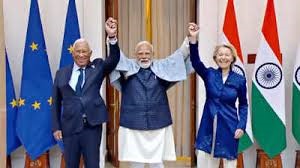
Introduction: Beyond a Conventional Trade Deal
● In January 2026, India and the European Union concluded a long-awaited comprehensive Free Trade Agreement (FTA) after nearly nineteen years of negotiations.
● The announcement was widely celebrated as a diplomatic breakthrough and described as the “mother of all trade deals“. Yet, to view the agreement merely as a trade pact that lowers tariffs would be to underestimate its true significance.
● The India–EU FTA is not simply about increasing exports or improving market access; it is fundamentally about reshaping India’s domestic economy, modernising regulatory institutions, enhancing competitiveness, and repositioning the country strategically in an increasingly uncertain global order.
● In this sense, the agreement marks not an endpoint but the beginning of a deeper reform trajectory, including areas like environmental clearances and impact assessments.
Historical Context: Why the Timing Matters
● When negotiations between India and the European Union began in 2007, the global environment was very different.
● Globalisation appeared irreversible, multilateral institutions such as the World Trade Organization commanded legitimacy, and supply chains were stable and expanding.
● India was experiencing rapid growth, the services sector was booming, and geopolitical rivalries were relatively muted.
● Few would have imagined that two decades later the world would be grappling with a pandemic, supply chain disruptions, trade wars, sanctions, and an increasingly fragmented geopolitical landscape.
● The COVID-19 crisis exposed the vulnerability of global production networks. The U.S.–China trade conflict accelerated economic decoupling.
● The Russia–Ukraine war led to sanctions and the weaponisation of energy and finance. Nations began prioritising strategic resilience over pure efficiency.
● In such an environment, trade agreements are no longer merely instruments of commerce; they have become tools of economic security and geopolitical strategy.
● The India–EU FTA must therefore be understood as a rational response to this transformed world order, including considerations for environmental jurisprudence and sustainable development.
Changing Nature of Trade Agreements
Traditional trade agreements focused largely on reducing customs duties and quotas. Their primary objective was to make goods cheaper across borders. Modern trade agreements, however, are much more comprehensive. They extend into regulatory frameworks, technical standards, digital trade, intellectual property rights, investment protection, labour norms, environmental compliance, and dispute resolution mechanisms. In effect, they shape how economies function internally as much as how they trade externally.
The India–EU FTA belongs firmly to this new generation of agreements. It compels India to modernise its regulatory systems, improve quality standards, enhance transparency, and upgrade institutional capacity. Thus, the agreement acts as an external anchor for domestic reform. By aligning with advanced economies such as those in the European Union, India pushes itself toward higher standards of governance and production, including areas like environmental impact assessments and ex post facto clearances.
Economic Importance of the European Union for India
● The European Union is among India’s most important trading partners.
● It represents one of the largest consumer markets in the world with high purchasing power and strong demand for quality goods and services.
● India already exports tens of billions of dollars’ worth of goods such as textiles, engineering products, pharmaceuticals, and chemicals, along with a substantial volume of services including information technology, consulting, and professional services.
● However, India’s competitiveness in Europe had weakened after the withdrawal of tariff concessions under the Generalised System of Preferences (GSP).
● Sectors such as textiles, garments, leather, and gems and jewellery faced higher duties, making Indian products less attractive compared to competitors like Vietnam or Bangladesh.
● The FTA restores preferential access and improves price competitiveness, enabling Indian exporters to regain lost market share.
Tariff Liberalisation and Competitive Discipline
● A major feature of the agreement is India’s commitment to gradually reduce tariffs across several sectors.
● High duties that once protected domestic industries will now be rationalised. For instance, tariffs on imported automobiles, which had reached levels above one hundred percent, will be reduced progressively.
● Similar reductions apply to wines, spirits, and various industrial goods.
● While such liberalisation may initially raise concerns among domestic producers, it is expected to generate long-term benefits.
● Exposure to global competition encourages firms to innovate, adopt better technology, reduce inefficiencies, and improve productivity.
● Consumers benefit from lower prices and higher quality. Economies that rely excessively on protectionism often become complacent and inefficient, whereas competition fosters dynamism.
● In this way, tariff cuts act as a mechanism for competitive discipline, potentially leading to a more pollution-free environment through improved production practices.
Sectoral Opportunities and Gains
● The manufacturing sector stands to benefit from deeper integration with European supply chains.
● Access to cheaper intermediate goods and advanced technologies can reduce production costs and enhance quality.
● Firms that upgrade successfully will find new export opportunities and expand scale.
● The services sector, which is a strength of the Indian economy, is likely to experience significant gains.
● Better access for IT professionals, consultants, financial service providers, and digital businesses can expand India’s footprint in Europe.
● Mutual recognition of qualifications and easier mobility provisions can further support professional exchanges.
● Pharmaceuticals, engineering goods, and specialty chemicals may also gain from regulatory harmonisation, which simplifies compliance procedures. Indian brands in alcoholic beverages and processed foods can explore premium markets.
● Even small and medium enterprises, if supported with certification and branding assistance, can participate in niche export segments.
Agriculture: From Protection to Standards-Based Competitiveness
● Agriculture has traditionally been treated as a sensitive sector in trade negotiations, and the India–EU FTA is no exception.
● Many vulnerable farm products remain protected to safeguard farmers’ livelihoods.
● However, the key challenge facing Indian agricultural exports to Europe is not high tariffs but strict standards.
● European markets demand stringent sanitary and phytosanitary measures, traceability systems, and sustainability compliance.
● Thus, the real opportunity lies in upgrading quality rather than seeking protection.
● Investment in testing laboratories, certification processes, cold chains, and food safety systems can enable Indian producers to meet these requirements.
● Once standards improve, Indian agricultural exports can grow substantially. Therefore, the agreement incentivises capacity building rather than mere tariff concessions.
Regulatory Modernisation: The Hidden Dividend
● Perhaps the most important benefit of the FTA lies in regulatory reform. Aligning with European norms requires India to strengthen food safety mechanisms, environmental safeguards, product standards, and digital governance systems.
● These improvements generate positive spillovers across the domestic economy.
● Consumers receive safer and higher-quality products, industries operate with clearer rules, and investors gain confidence in regulatory predictability.
● Such reforms often face resistance when pursued internally. External commitments through trade agreements create credible pressure for implementation.
● In this way, the FTA serves as a catalyst for institutional modernisation, potentially including reforms to environmental clearance processes and the implementation of the Forest Conservation Act.
Geopolitical Significance: India’s Strategic Balancing Act
● The agreement also has profound strategic implications. India today operates in a complex geopolitical environment.
● It seeks closer ties with the United States for technology and security cooperation while maintaining defence and energy relations with Russia.
● At the same time, it wishes to preserve strategic autonomy. However, it is difficult to fully maximise all these objectives simultaneously.
● The India–EU FTA helps diversify India’s partnerships and reduce dependence on any single power.
● Stronger economic integration with Europe provides resilience against geopolitical shocks and trade disruptions.
● It signals that India is aligning with like-minded democratic economies while maintaining flexibility.
● Thus, the deal functions as a strategic hedge in an uncertain world, potentially influencing environmental democracy and jurisprudence.
Why the European Union Needs India
● The partnership is mutually beneficial. Europe faces its own structural challenges, including ageing populations, slow growth, and heavy reliance on China for manufacturing.
● India, with its young workforce, expanding market, and rapid growth, represents an attractive alternative.
● Closer economic ties allow Europe to diversify supply chains while tapping into India’s dynamism.
● This convergence of interests explains why both sides were willing to compromise and conclude the agreement.
Gateway to Broader Economic Integration
● The FTA also positions India for participation in larger plurilateral trade groupings such as the Comprehensive and Progressive Agreement for Trans-Pacific Partnership (CPTPP).
● Membership in such blocs requires adherence to high regulatory standards. By aligning with the European Union first, India prepares itself institutionally for deeper integration into global value chains.
● Hence, the current agreement can be seen as a stepping stone rather than a final destination, potentially influencing areas like the Coastal Regulation Zone and environmental impact assessments.
Challenges and Concerns
● Despite its potential benefits, the agreement is not without risks.
● Domestic industries that are unprepared for competition may suffer short-term losses. Small enterprises could face high compliance costs.
● Workers in inefficient sectors may experience job displacement.
● Geopolitical adjustments could strain certain traditional partnerships.
● These challenges underscore the need for careful transition management.
● Targeted support measures, including skill development, financial assistance for MSMEs, and infrastructure improvements, are essential to ensure that gains are widely shared.
● Without such policies, the benefits of the FTA may remain uneven, potentially impacting environmental standards and the implementation of principles like “polluter pays” and the precautionary principle.
Way Forward: Translating Opportunity into Outcomes
● For the agreement to succeed, India must focus on implementation. Strengthening logistics, ports, and digital systems will reduce trade costs.
● Upgrading standards infrastructure and testing facilities will help exporters meet compliance requirements.
● Encouraging innovation and research will enhance competitiveness.
● Most importantly, policymakers must sustain reform momentum rather than treating the FTA as an isolated achievement.
Conclusion: Not an Endpoint but a Beginning
● The India–EU Free Trade Agreement represents far more than a reduction of tariffs.
● It is a comprehensive framework that promotes domestic reform, regulatory modernisation, competitiveness, and geopolitical diversification.
● By opening markets and aligning standards, India signals a decisive shift away from protectionism toward integration with the global economy.
● The true value of the agreement will depend not on the signing ceremony but on the reforms it inspires, including potential improvements in environmental clearances and impact assessments.
● In this sense, the FTA is not the culmination of India’s trade policy but the foundation for its next strategic move towards a more competitive and environmentally conscious economy.
UPSC Mains Practice Question
Q:”Free Trade Agreements today act as instruments of domestic reform and strategic realignment rather than mere tariff reduction mechanisms.” Discuss in the context of the India–EU Free Trade Agreement.” (15 marks)