
DIGITAL RUPEE-BASED DBT UNDER PMGKAY: A NEW MODEL OF WELFARE DELIVERY
DIGITAL RUPEE-BASED DBT UNDER PMGKAY: A NEW MODEL OF WELFARE DELIVERY
Why in the News?
Chandigarh is set to become the first Union Territory to undertake a full-fledged rollout of Central Bank Digital Currency (CBDC)-based Direct Benefit Transfer (DBT) for food subsidy under the Pradhan Mantri Garib Kalyan Anna Yojana (PMGKAY). The initiative represents a shift from physical foodgrain distribution towards purpose-bound digital welfare delivery through the Digital Rupee.
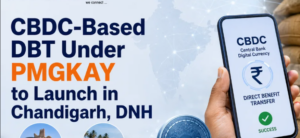
CBDC-BASED DBT AND ITS KEY FEATURES
- Digital Transition: The initiative represents an evolution from subsidised foodgrain distribution to DBT and subsequently towards purpose-bound welfare transfers using Central Bank Digital Currency.
- Chandigarh Pilot: Chandigarh will become the first Union Territory to undertake a full-fledged CBDC-based DBT mechanism for food subsidy under PMGKAY.
- Purpose Bound: Digital Rupee-based transfers can potentially enable targeted utilisation of welfare benefits, ensuring that transferred funds remain aligned with their intended purpose.
- Wider Rollout: The initiative will also be virtually launched for Dadra and Nagar Haveli, indicating potential expansion of CBDC-enabled welfare mechanisms across other Union Territories.
- Delivery Efficiency: Digital delivery can potentially improve transparency, traceability and efficiency while reducing leakages and intermediaries in welfare-transfer mechanisms.
SIGNIFICANCE AND CHALLENGES OF CBDC-BASED WELFARE DELIVERY
- Financial Inclusion: CBDC-based DBT could strengthen digital financial inclusion by enabling beneficiaries to receive government assistance directly through digital payment infrastructure.
- Leakage Reduction: Greater transaction traceability could help minimise diversion, duplication and fraudulent claims, strengthening accountability in welfare expenditure.
- Programmable Benefits: Purpose-bound digital currency can potentially introduce programmability, allowing welfare payments to be designed around specific objectives or permissible uses.
- Digital Risks: Successful implementation will depend upon digital literacy, smartphone and connectivity access, cybersecurity, privacy protection and reliable payment infrastructure.
- Exclusion Concerns: Excessive dependence on digital systems may create exclusion risks for beneficiaries lacking devices, connectivity, digital skills or adequate access to banking and payment infrastructure.
CENTRAL BANK DIGITAL CURRENCY (CBDC)
- Definition: A CBDC is a digital form of sovereign currency issued by a country’s central bank, representing a direct liability of the central bank unlike privately issued digital payment instruments.
- Indian CBDC: The Digital Rupee (e₹) is India’s CBDC, issued by the Reserve Bank of India (RBI) and available in both retail and wholesale forms.
- Retail CBDC: e₹-R is designed for use by individuals and businesses for retail transactions, potentially offering an alternative digital form of cash.
- Wholesale CBDC: e₹-W is intended primarily for financial institutions and can facilitate transactions such as government securities settlement and interbank transfers.
- UPSC Relevance: CBDC is important for GS Paper III topics including digital economy, financial inclusion, monetary policy, payment systems, cybersecurity, privacy and welfare-delivery reforms.