






Constitutional Bill Seeks Cleaner Politics
Syllabus
GS 2: Constitutional Amendments
Why in the News?
Recently, the Constitution (130th Amendment) Bill, 2025, introduced in Lok Sabha, proposes automatic removal of Ministers detained beyond 30 days, sparking debate over constitutional morality, presumption of innocence, and political accountability. This move comes amidst growing concerns about corrupt leaders and power without integrity in Indian politics, as exemplified by high-profile cases like the Arvind Kejriwal bail controversy and V. Senthil Balaji’s detention.
Introduction
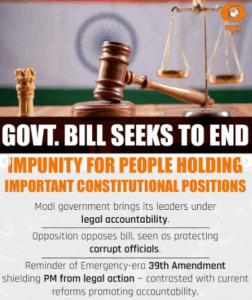
The Constitution (One Hundred and Thirtieth Amendment) Bill, 2025, seeks to address criminalisation in politics and strengthen the integrity of the Indian constitution.
It mandates resignation or removal of Ministers, Chief Ministers, and even the Prime Minister if they remain in custody for more than 30 consecutive days in cases involving serious criminal allegations.
The bill has prompted discussions about the need for a joint parliamentary committee to review its implications and potential impact on governance.
Context of Criminalisation in Politics
A Longstanding Problem
India has witnessed the steady rise of leaders with criminal backgrounds holding high offices, often facing charges like money laundering.
The public demands integrity and moral responsibility from leaders, yet criminality persists across parties, including the Bharatiya Janata Party and opposition groups.
Statistics Reflecting the Crisis
In the 2024 general elections, 46% of elected Members of Parliament (251 MPs out of 543) declared criminal cases.
This marks a sharp rise from 43% in 2019, 34% in 2014, and 30% in 2009.
The trend shows a 55% increase in criminalisation over 15 years, highlighting the urgency of reform and the need for stronger involvement of law enforcement agencies in vetting political candidates.
Objective of the Bill
To prevent leaders in custody for serious crimes from holding executive power, as seen in cases like the ongoing Arvind Kejriwal case.
Aimed at restoring people’s trust in governance by ensuring accountability and integrity without fairness being compromised.
Constitutional Basis of the Bill
Articles Involved
Article 75: Deals with appointment and tenure of Union Ministers.
Article 164: Governs State Ministers.
Article 239AA: Applies to the governance of Delhi.
Pleasure of the President or Governor
Ministers hold office at the pleasure of the President (Union) or Governor (State).
However, this “pleasure” is subject to constitutional morality and legal propriety as clarified by the judiciary.
Judicial Interpretations
Shamsher Singh vs State of Punjab (1974): Clarified that executive power must follow constitutional morality.
Nabam Rebia vs Deputy Speaker (2016): Reinforced limits on arbitrary dismissal.
S.R. Bommai vs Union of India (1994): Emphasised constitutional morality as a guiding principle in governance.
Manoj Narula vs Union of India (2014): Warned against appointing Ministers with serious criminal charges, although it did not mandate automatic removal.
Key Provisions of the 130th Amendment Bill
Resignation or Removal Rule
Ministers, Chief Ministers, or the Prime Minister must resign or be removed if in custody for more than 30 consecutive days.
Applies to offences carrying a maximum punishment of five years or more, including serious criminal allegations like money laundering charges.
Mechanism of Removal
Discretionary removal: On advice of Prime Minister/Chief Minister.
Automatic removal: If advice is withheld and custody extends beyond 30 days.
Scope
Covers Union Ministers, State Ministers, and Delhi Ministers, making it uniformly applicable across India.
Constitutional and Legal Quandaries
Presumption of Innocence
Article 21 guarantees the right to life and liberty, including the principle that a person is innocent until proven guilty.
This Bill equates arrest/detention with guilt, even before trial or conviction, raising concerns about fairness and the potential for tactical legal manoeuvres to influence political outcomes.
Inconsistency with Representation of the People Act (RPA), 1951
Section 8(3) of RPA disqualifies a legislator only upon conviction for certain offences.
Lily Thomas vs Union of India (2013): Supreme Court struck down the three-month appeal window, ensuring immediate disqualification after conviction.
Under this Bill:
Legislators continue until conviction.
Ministers must resign after 30 days of detention.
This creates unequal standards, making ministerial office riskier than legislative office.
Politicisation of Executive
The bill’s provisions could potentially be misused by law enforcement agencies to target political opponents.
There are calls for an independent review mechanism to ensure the bill’s implementation doesn’t compromise the integrity without fairness principle in governance.
The Constitution (130th Amendment) Bill, 2025, while aiming to cleanse politics of criminal elements, raises important questions about the balance between political accountability and individual rights. As the debate continues, it remains to be seen how this constitutional amendment will shape the future of Indian democracy and its leaders.