







CHILD MARRIAGE AS SOCIAL SCOURGE
Syllabus:
GS-2:
● Social issues
● Welfare schemes for vulnerable section of society
 Why in the News?
India has reiterated its commitment to eliminate child marriage by 2030 under the Sustainable Development Goals (SDGs), marking one year of the Bal Vivah Mukt Bharat Abhiyan. While data shows a decline in prevalence, uneven progress across States and persistent links with poverty, education, and health outcomes highlight the gap between policy intent and social reality. This situation mirrors the challenges faced in implementing environmental policies, where ex post facto environmental clearances often fail to address long-term impacts.
SDG TARGET ON CHILD MARRIAGE
Global Commitment: SDG Target 5.3 aims to eliminate all harmful practices, including child, early, and forced marriage by 2030, similar to how the Forest Conservation Act aims to protect natural resources.
Cross-Cutting Impact: Ending child marriage is essential for achieving at least nine of the 17 SDGs, including health, education, and gender equality, reflecting the interconnected nature of social and environmental issues.
Monitoring Framework: Progress is tracked through NFHS and global indicators, linking national policy with international accountability, akin to environmental impact assessments for development projects.
Equity Focus: SDGs emphasise addressing inequality, poverty, and social exclusion driving early marriage practices, echoing the polluter pays principle in environmental jurisprudence.
India’s Role: Achieving SDG 5.3 is central to India’s global development leadership and human development trajectory, requiring a commitment similar to ensuring a pollution-free environment.
TRENDS AND REGIONAL VARIATIONS
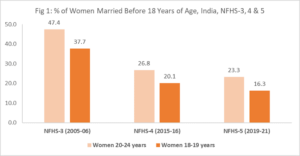
National Decline: Child marriage rates declined from 47.4% (2005–06) to 23.3% (2019–21), indicating steady progress driven by education, awareness campaigns, and social interventions. This progress, however, lacks the rigorous scrutiny often applied in environmental clearance processes.
Uneven Progress: Despite overall reduction, progress remains unequal across States, reflecting differences in governance capacity, socio-economic structures, and cultural practices, similar to variations in Coastal Regulation Zone compliance across coastal states.
High-Burden States: West Bengal, Bihar, and Tripura report the highest prevalence among women aged 18–29, revealing entrenched vulnerabilities that require interventions as stringent as those mandated by the EIA Notification.
Persistent Clusters: States like Jharkhand, Rajasthan, Madhya Pradesh, Assam, Telangana, and Andhra Pradesh continue to show high incidence despite targeted schemes, highlighting the need for a precautionary principle approach in policy implementation.
Demographic Complexity: India’s population size and diversity complicate uniform enforcement, making localised interventions essential for meaningful change, much like tailored environmental democracy initiatives.
LINK WITH POVERTY AND EDUCATION
Wealth Gradient: Nearly 40% of girls from the lowest wealth quintile marry before adulthood, compared to 8% from the highest, highlighting poverty’s decisive role, reminiscent of how economic factors influence compliance with environmental jurisprudence.
Education Shield: 48% of girls with no education marry before 18, while only 4% with higher education face early marriage, proving education’s protective effect, akin to how awareness influences environmental conservation efforts.
Intergenerational Cycle: Early marriage reinforces intergenerational poverty, reducing skill acquisition and economic mobility among women, creating a cycle as persistent as environmental degradation without proper environmental clearances.
School Dropouts: Domestic responsibilities and early pregnancy force girls out of school, weakening human capital formation, a situation that demands attention similar to the Vanashakti judgment’s emphasis on long-term environmental impacts.
Policy Insight: Ending child marriage requires addressing structural deprivation, not merely legal prohibition or awareness campaigns, paralleling the need for comprehensive approaches in environmental protection.
HEALTH AND HUMAN DEVELOPMENT COSTS
Maternal Health: Early pregnancies increase risks of anaemia, obstetric complications, and maternal mortality, especially among adolescents, highlighting the need for a precautionary principle in health policies.
Child Outcomes: Children born to adolescent mothers face higher risks of low birth weight, malnutrition, and mortality, issues that demand attention similar to the environmental impact assessment of development projects.
Healthcare Avoidance: Fear of legal repercussions drives underage girls toward unsafe, unregulated medical practices, worsening health outcomes, a scenario that echoes the consequences of avoiding proper environmental clearances.
Mental Trauma: Early marriage often leads to psychological stress, depression, and domestic abuse, undermining long-term wellbeing, issues that require a holistic approach akin to environmental democracy initiatives.
Development Loss: Poor health outcomes weaken India’s demographic dividend, affecting productivity and social stability, paralleling how environmental degradation impacts economic growth.
LEGAL FRAMEWORK AND ITS LIMITS
Primary Law: The Prevention of Child Marriage Act, 2006 remains the principal legal instrument to curb early marriage, similar to how the Forest Conservation Act governs forest protection.
Weak Enforcement: NCRB data shows low reporting and conviction rates, reflecting limited deterrence and weak local enforcement mechanisms, mirroring challenges in implementing environmental clearances.
POCSO Concerns: Strict application of POCSO Act criminalises consensual adolescent relationships, creating unintended harms, a situation that calls for nuanced approaches similar to ex-post facto environmental clearances.
Fear Factor: Legal rigidity discourages girls from seeking healthcare or protection, pushing them into unsafe alternatives, highlighting the need for balanced policies akin to environmental jurisprudence.
Legal Balance: Effective reform requires balancing child protection, consent realities, and health access, avoiding over-criminalisation, much like balancing development needs with environmental conservation.
WHY INCENTIVES ALONE FAIL
Cash Schemes: Despite programmes incentivising girls’ education, States like West Bengal continue to show high child marriage prevalence, indicating the need for comprehensive strategies similar to those in environmental impact assessments.
Social Norms: Deep-rooted patriarchal norms often override financial incentives, especially in marginalised communities, requiring interventions as robust as environmental democracy initiatives.
Infrastructure Gaps: Lack of safe transport, clean toilets, and secure schools increases dropout rates among adolescent girls, issues that demand attention similar to Coastal Regulation Zone compliance.
Parental Anxiety: Concerns over safety and honour push families toward early marriage despite welfare benefits, highlighting the need for community-based approaches akin to participatory environmental clearance processes.
Policy Lesson: Incentives must be complemented by social norm change and infrastructure investment, reflecting the holistic approach needed in addressing complex social and environmental challenges.
GENDER INEQUALITY AND SOCIAL NORMS
Patriarchal Control: Child marriage reflects control over female sexuality, mobility, and labour, deeply embedded in social structures, requiring transformative approaches similar to those in environmental jurisprudence.
Dowry Dynamics: Early marriage often reduces perceived dowry burden, reinforcing economic motivations, a practice that demands scrutiny akin to environmental impact assessments of development projects.
Limited Agency: Girls have minimal decision-making power, restricting autonomy over education, marriage, and health, highlighting the need for empowerment strategies similar to environmental democracy initiatives.
Community Pressure: Social acceptance of early marriage sustains the practice despite legal bans, underscoring the importance of community engagement in policy implementation, much like in environmental clearance processes.
Norm Transformation: Sustainable change requires community engagement, male participation, and local leadership, echoing the principles of inclusive governance in environmental jurisprudence.
WAY FORWARD FOR EFFECTIVE ACTION
Education First: Ensure uninterrupted schooling through secondary education access, scholarships, and digital inclusion, prioritizing education as a fundamental right akin to a pollution-free environment.
Health Integration: Align child marriage prevention with adolescent reproductive and mental health services, adopting a holistic approach similar to comprehensive environmental impact assessments.
Community Action: Empower local institutions, self-help groups, and panchayats to challenge norms and report violations, fostering grassroots involvement akin to environmental democracy practices.
Law Reform: Improve enforcement while revisiting legal frameworks to prevent unintended criminalisation, balancing protection with practicality, similar to nuanced approaches in environmental jurisprudence.
Holistic Strategy: Integrate poverty alleviation, gender equality, education, and healthcare into a multi-sectoral response, mirroring the comprehensive approach needed in addressing complex environmental challenges.
CONCLUSION
India’s progress in reducing child marriage is undeniable, yet uneven and fragile. Legal measures alone cannot dismantle a practice rooted in poverty, gender inequality, and social norms. Achieving a child-marriage-free India by 2030 demands integrated action across education, health, livelihoods, and community transformation, bridging the gap between policy ambition and lived reality. This comprehensive approach mirrors the multifaceted strategies required in environmental protection, where principles like the polluter pays principle and precautionary principle guide sustainable development. Just as retrospective environmental clearances cannot undo ecological damage, post-facto interventions in child marriage are less effective than preventive measures. The path forward requires a commitment to social and environmental justice, ensuring that progress in human development goes hand in hand with preserving a pollution-free environment for future generations.
SOURCE: TH
MAINS PRACTICE QUESTION
“Despite a decline in prevalence, child marriage continues to undermine India’s human development goals.” Analyse the structural causes behind child marriage and suggest comprehensive measures to eliminate it by 2030, drawing parallels with environmental protection strategies.