






Atmanirbharta Imperative Amid Weaponisation of Global Interdependence
Syllabus:
GS Paper – 2 Effect of Policies & Politics of Countries on India’s Interests Bilateral Groupings & Agreements
GS Paper – 3 Mobilization of Resources Employment
Why in the News ?
Growing geopolitical tensions in West Asia, the weaponisation of trade, finance, and energy by major powers, and uncertainty surrounding U.S. foreign policy under Donald Trump have revived debates on India’s strategic autonomy and atma nirbhar bharat. The issue highlights how excessive external dependence can constrain India’s national security and foreign policy choices, making the vision of a self-reliant india more critical than ever.
Concept of Atmanirbharta in Strategic Context
● Strategic autonomy: Aatmanirbhar does not imply economic isolation but aims to reduce critical external dependencies in sectors like energy, defence systems, food, and defence technology that affect national security and defence sovereignty.
● Policy revival: Prime Minister Narendra Modi has increasingly emphasised the aatma nirbhar bharat vision, echoing earlier ideas promoted during the Nehruvian economic strategy focused on import substitution.
● External vulnerability: Globalisation has created deep interdependence, but this interdependence can also be weaponised by powerful states to influence smaller economies, particularly in defence production and critical technologies.
● Policy flexibility: Strategic self-reliance through nirbhar bharat allows India to maintain an independent foreign policy rather than being pressured by powerful nations during crises.
● Security dimension: National security managers must evaluate economic dependencies not merely as trade relations but as potential geopolitical leverage points, especially in defence industry and defence capabilities.
Historical Lessons from India’s External Dependencies :
● Four early vulnerabilities: At independence, India faced dependence on food imports, foreign exchange, defence equipment from ordnance factories abroad, and energy supplies.
● Foreign exchange crisis (1957–58): This crisis exposed India’s limited export base and external financial vulnerability, forcing policy adjustments toward import substitution.
● 1962 Sino-Indian War: The war revealed India’s defence equipment shortages and weak defence industrial base, prompting Prime Minister Jawaharlal Nehru to seek military assistance from the United States while establishing DRDO for indigenous defence technology development.
● Food crisis (1965–67): Severe droughts forced reliance on U.S. PL-480 food aid, showing how external dependence could influence foreign policy decisions.
● 1990 Gulf War crisis: Rising oil prices triggered a balance-of-payments crisis, eventually leading to the 1991 economic reforms under P.V. Narasimha Rao.
Weaponisation of Global Economic Interdependence :
● Energy leverage: Major powers increasingly use energy exports and oil supply chains as instruments of geopolitical influence.
● Financial sanctions: After the Russia–Ukraine conflict, G7 countries weaponised financial systems, including sanctions and restrictions on banking transactions.
● Trade restrictions: Economic policies such as tariffs, defence supply chain restrictions, and export controls have become tools of strategic competition.
● Technology control: Advanced technologies, including semiconductors and critical defence technology, are now restricted through strategic alliances and trade rules.
● Implication for India: These trends demonstrate that economic dependence can quickly translate into political pressure during international conflicts, affecting defence projects and national security.
India-U.S. Relations and Strategic Uncertainty :
● TRUST framework: India and the U.S. previously agreed on cooperation under the “TRUST” (Transforming the Relationship Utilising Strategic Technology) initiative, including defence platforms and technology sharing.
● Energy partnership: Both countries committed to an Energy Security Partnership covering oil, gas, and civil nuclear cooperation.
● Policy reversal concerns: The Trump administration’s “America First” policies have created uncertainty regarding long-term energy and trade commitments, affecting defence exports and collaboration.
● Strategic caution: India may need to avoid entering new major agreements until U.S. policy direction becomes more predictable.
● Diplomatic balance: India must maintain relations with the U.S., Russia, and China without becoming excessively dependent on any single power for defence systems or technology.
Emerging Vulnerabilities: Diaspora, Elite Networks, and Influence :
● Diaspora exposure: India traditionally views its global diaspora as a source of soft power and foreign exchange through remittances.
● Policy vulnerability: However, events like anti-immigration policies in developed countries reveal how diaspora dependence can become a strategic risk.
● Elite influence networks: A globalised Indian professional and business elite may sometimes be influenced by geopolitical narratives of other countries.
● Information influence: External actors increasingly use media, policy forums, and influencers to shape domestic debates in India.
● Cold War parallels: Similar external influence attempts were seen during the Cold War, when India’s domestic politics became a theatre for competing global powers.
Geopolitical Risks from West Asian Conflicts :
● Energy dependence: India relies heavily on West Asia for crude oil imports, making regional instability a major concern.
● Economic stakes: India has large trade, investment, and diaspora interests in the Gulf region, including millions of Indian workers.
● War repercussions: Escalating conflicts involving Israel and Iran could disrupt energy supply routes and global oil markets.
● Strategic betrayal concerns: Some analysts argue that escalating military actions in the region undermine previously established trust and stability in energy markets.
● Foreign policy test: India must balance relations with Israel, Iran, and Gulf countries while protecting its energy and economic interests.
Leadership and Strategic Autonomy in Foreign Policy :
● Historical precedent: Leaders such as Indira Gandhi demonstrated the ability to resist external pressure, particularly during international crises.
● Policy continuity: India’s long-standing commitment to strategic autonomy and non-alignment remains relevant even today.
● Balancing major powers: The current global order is increasingly shaped by U.S.–China–Russia rivalry, requiring careful diplomatic management.
● National interest priority: India must ensure that external powers cannot exploit strategic dependencies to influence domestic or foreign policy.
● Atmanirbharta as strategy: True self-reliance must be earned through economic strength, technological capability, and strategic foresight, not merely political rhetoric.
Challenges :
● High energy dependence: India imports nearly 85% of its crude oil, making it vulnerable to global oil price shocks and geopolitical conflicts.
● Defence imports: Despite progress in indigenisation, India remains one of the largest defence importers globally.
● Technological dependence: Advanced sectors such as semiconductors, AI, and critical technologies rely heavily on foreign suppliers.
● Global supply chain disruptions: Events like wars, pandemics, and sanctions can disrupt global supply chains, affecting India’s economy.
● Diaspora vulnerability: Dependence on remittances and migrant labour opportunities abroad exposes India to external immigration policies.
● Strategic pressure: Major powers increasingly use economic tools—sanctions, tariffs, and export controls—to influence foreign policy decisions.
● Regional instability: Conflicts in West Asia, India’s primary energy source region, threaten both energy security and diaspora safety.
● Information warfare: Foreign actors may influence domestic debates through media, think tanks, and digital platforms.
● Limited domestic manufacturing capacity: Some sectors still lack robust domestic industrial ecosystems.
● Policy coordination gaps: Achieving true self-reliance requires coordination between economic, technological, and security policies, which can be challenging.
Way Forward :
● Energy diversification: Expand renewable energy, nuclear power, and strategic petroleum reserves to reduce dependence on imported oil.
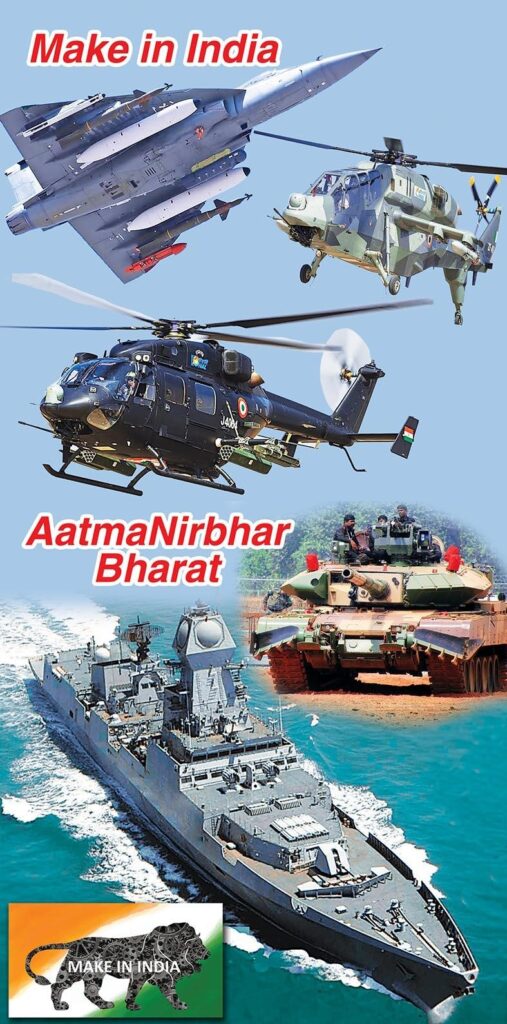
● Defence indigenisation: Accelerate programmes like Make in India in Defence and increase investment in domestic R&D and private sector participation.
● Technological self-reliance: Invest in semiconductor manufacturing, AI, and advanced technologies through public-private partnerships.
● Strategic diplomacy: Maintain balanced relations with all major powers to avoid excessive reliance on any one country.
● Strengthen supply chains: Develop resilient domestic manufacturing ecosystems and diversify import sources.
● Diaspora protection: Create policies to support overseas Indian workers and diversify employment opportunities.
● Energy diplomacy: Deepen engagement with West Asian countries, Africa, and Central Asia for stable energy supplies.
● Economic reforms: Encourage export competitiveness and industrial growth to reduce foreign exchange vulnerability.
● Strategic communication: Counter external influence through strong domestic institutions and transparent policy communication.
● Institutional coordination: Integrate economic policy, foreign policy, and national security planning to achieve comprehensive self-reliance.
Conclusion :
In an era where trade, finance, technology, and energy are increasingly weaponised, India must strengthen Atmanirbharta to safeguard its strategic autonomy. Building domestic capabilities while maintaining balanced global partnerships will enable India to manage great-power rivalries and pursue an independent foreign policy rooted firmly in national interests.
Source : Mint
Mains Practice Question :
Q. In an era of growing geopolitical rivalry and economic weaponisation, discuss the importance of Atmanirbharta (self-reliance) in safeguarding India’s strategic autonomy. Examine the historical lessons of external dependence and suggest measures to reduce vulnerabilities in critical sectors such as energy, defence, and technology.