







Artificial Intelligence Can Transform Agriculture for Women Farmers
Syllabus:
GS-2: Government Policies & Interventions
GS-3: E-Technology in the Aid of Farmers, IT & Computers
Why in the News ?
As the world observes International Women’s Day on 8 March, states like Maharashtra are adopting Artificial Intelligence (AI) strategies for agriculture, with several public–private partnerships piloting AI-based advisories, pest diagnostics, and climate prediction tools. These innovations, aligned with the spirit of women’s day celebrations, can particularly benefit women farmers, who constitute a large share of India’s agricultural workforce but face persistent structural and digital barriers.
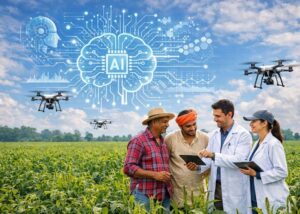
Rising Role of Artificial Intelligence in Agriculture:
- Technological transformation: Artificial Intelligence (AI) is increasingly reshaping agriculture through data-driven decision-making and predictive analytics, helping farmers improve productivity and reduce risks.
- Emergence of AI-based solutions: Technologies such as satellite-based remote sensing, computer vision systems, and machine learning models now identify crop stress, pest infestations, and soil nutrient deficiencies.
- Climate-smart agriculture: AI models integrating Indian Meteorological Department (IMD) weather data, soil health cards, and cropping histories are enabling better yield predictions and adaptive farming practices.
- Digital advisory platforms: AI-powered multilingual chatbots and mobile advisories are providing farmers with real-time information on crop management, pest control, and weather conditions.
- State-level initiatives: States like Maharashtra have introduced dedicated AI strategies for agriculture, piloting digital advisory platforms to reach millions of farmers.
Understanding Women in Agriculture & AI Policies in India:Key Facts ● Women constitute about 43% of India’s agricultural labour force. ● Agriculture contributes roughly 15–18% of India’s GDP. ● Over 40% of India’s workforce depends on agriculture. ● Women own only 13–14% of operational landholdings in India. Important Government Initiatives ● Digital Agriculture Mission (2021–2025): Promotes use of AI, Big Data, remote sensing, and blockchain in |
Women’s Central Role in India’s Agricultural Economy
- Large workforce participation: Women constitute nearly 43% of India’s agricultural labour force, making them essential contributors to the rural economy.
- Contribution to crop production: Women are estimated to contribute nearly half of India’s crop production activities, including sowing, harvesting, and post-harvest management.
- Dominance in livestock sector: More than 70% of livestock-related work—including dairy farming and animal care—is performed by women.
- Major rural employer: Agriculture remains the largest source of employment for women in rural India, accounting for 55–60% of female employment.
- Critical role in food security: Women’s agricultural work directly influences household nutrition, food security, and rural livelihoods.
AI as an Opportunity for Women Farmers
- Improving productivity: AI-driven advisory systems can help women farmers make better decisions regarding crop choice, irrigation, pest control, and fertiliser use.
- Reducing workload: Automation and digital advisories reduce manual monitoring and trial-and-error practices, saving time and effort.
- Climate risk management: AI-powered early warning systems for weather variability and extreme events help small farmers adapt to climate change.
- Enhancing income: Productivity improvements of 5–10% through AI-enabled optimisation could significantly increase rural household incomes.
- Boosting dairy sector: India’s $150-billion dairy industry, heavily dependent on women’s labour, could see major gains through AI-enabled veterinary alerts and livestock monitoring systems.
Structural Barriers Faced by Women Farmers
- Limited land ownership: Women own only about 13–14% of operational landholdings, restricting their access to credit, subsidies, and agricultural schemes.
- Limited institutional credit: Due to lack of land titles and financial inclusion, women often face difficulty accessing formal credit systems.
- Digital gender gap: Women are 15–20% less likely than men to own smartphones and significantly less likely to access mobile internet services.
- Limited participation in decision-making: Agricultural policies and extension services often do not adequately consider women farmers’ needs.
- Technology access challenges: Without targeted digital inclusion measures, women farmers may remain excluded from AI-driven agricultural innovations.
Data Bias and Agricultural Digitisation Challenges
- Male-centric data bias: Much of the existing agricultural data focuses on major commercial crops like wheat and rice, which are traditionally male-dominated sectors.
- Neglect of diversified agriculture: Crops such as millets, pulses, horticulture, and small livestock farming, where women play a greater role, are underrepresented in digital datasets.
- Algorithmic bias risks: If AI models are trained on biased or incomplete datasets, advisory systems may inadvertently favour male-dominated farming activities.
- Incomplete agricultural modelling: Lack of digitised data for women-led agricultural activities may reduce the effectiveness of AI solutions.
- Need for inclusive data ecosystems: Balanced data collection is necessary to ensure fair and representative AI models.
Potential Economic and Social Gains from Inclusive AI
- Higher agricultural productivity: Agriculture contributes about 15–18% of India’s GDP while employing over 40% of the workforce. Even small productivity gains can significantly boost economic output.
- Income enhancement: AI-driven productivity improvements can increase rural incomes and economic resilience.
- Household welfare gains: Women’s increased income has positive spillover effects on nutrition, education, and healthcare within households.
- Local enterprise development: Digitally empowered women farmers can develop rural enterprises, cooperatives, and agribusiness ventures.
- Multiplier effects: Empowering women farmers with AI tools could lead to inclusive and sustainable rural development.
Policy and Institutional Measures for Inclusive AI Agriculture
- Gender-sensitive AI strategies: Agricultural AI initiatives must incorporate gender-aware design and inclusive data practices.
- Participatory data collection: Governments should involve women’s self-help groups (SHGs), Farmer Producer Organisations (FPOs), and rural communities in building data systems.
- Digital infrastructure investments: Expanding internet connectivity and smartphone access in rural areas is essential.
- Multilingual AI systems: AI advisory tools must be developed in local languages and dialects to ensure accessibility.
- Public–private collaboration: Partnerships between governments, research institutions, and technology companies can accelerate inclusive AI adoption.
Challenges:
- Digital gender divide: Women farmers are less likely to own smartphones or access the internet, limiting their ability to use AI-based agricultural services.
- Limited land ownership: With only 13–14% land ownership, women often lack eligibility for government schemes, credit facilities, and subsidies.
- Data bias in AI systems: Agricultural datasets are heavily focused on major cereals, neglecting crops and activities where women dominate.
- Low digital literacy: Many rural women lack digital skills and technical training, making technology adoption difficult.
- Infrastructure gaps: Poor internet connectivity and digital infrastructure in rural areas restrict access to AI services.
- Institutional neglect: Agricultural extension services often fail to specifically target women farmers.
- Financial constraints: Women farmers frequently face credit shortages and limited access to formal financial institutions.
- Risk of technological exclusion: Without inclusive design, AI innovations may widen existing gender inequalities in agriculture.
Way Forward :
- Promote digital inclusion: Governments should invest in affordable smartphones, rural broadband connectivity, and digital literacy programmes for women farmers.
- Gender-sensitive AI development: Technology developers must design AI platforms that address the specific needs of women farmers.
- Expand agricultural data coverage: Data systems should include diversified crops, livestock activities, and women-led agricultural practices.
- Strengthen women’s institutions: Self-help groups (SHGs), cooperatives, and Farmer Producer Organisations (FPOs) can serve as digital data partners and technology disseminators.
- Capacity building programmes: Training initiatives should focus on digital skills, AI literacy, and modern agricultural techniques for women.
- Policy integration: Government programmes such as Digital Agriculture Mission and National e-Governance Plan in Agriculture (NeGPA) should explicitly include gender-based objectives.
- Encourage public-private partnerships: Collaboration with agri-tech startups and research institutions can accelerate innovation.
- Monitoring and evaluation: Establish gender-disaggregated metrics to measure the impact of AI adoption on women farmers.
Conclusion :
Artificial Intelligence has the potential to transform Indian agriculture by enhancing productivity, improving climate resilience, and empowering farmers. For women farmers, AI represents an unprecedented opportunity to overcome structural disadvantages. However, inclusive policies addressing digital access, data bias, and gender inequality are essential to ensure equitable agricultural transformation.
Source: IE
Mains Practice Question :
- Artificial Intelligence is increasingly transforming agricultural systems worldwide. Discuss how AI-based technologies can empower women farmers in India. Examine the structural challenges faced by women in agriculture and suggest policy measures to ensure inclusive and gender-sensitive adoption of digital technologies in the agricultural sector.