







AI India: Strategy Must Precede Mission
Syllabus:
GS-3: ● Science and Technology ● Artificial Intelligence
Why in the News?
India a aspiring global leader in AI governance faces challenges in its current approach, which lacks a comprehensive national strategy. While the IndiaAI Mission is operational, it bypasses key democratic and institutional processes. Experts warn that without a clear roadmap, India’s strategic autonomy and global credibility in AI governance may be compromised. The development of AI in India requires a more structured approach to ensure its success and impact.
NEED FOR A NATIONAL STRATEGY
● Mission-Led Model: The IndiaAI Mission, under a Section 8 company, lacks democratic accountability and should follow, not precede, a national strategy.
● Unanswered Questions: India has yet to determine its national AI priorities, guiding values, or institutional frameworks, which are essential before mission execution.
● Democratic Anchoring: Governance of AI must involve parliamentary oversight, citizen consultation, and inclusion of diverse voices to ensure legitimacy.
● Global Leadership: Without internal coherence and a transparent AI framework, India cannot effectively influence global AI governance norms.
● Risk of Opacity: Relying on technocratic execution without policy clarity risks creating an opaque AI governance model, alienating civil society and stakeholders.
KEY COMPONENTS OF THE INDIA AI MISSION
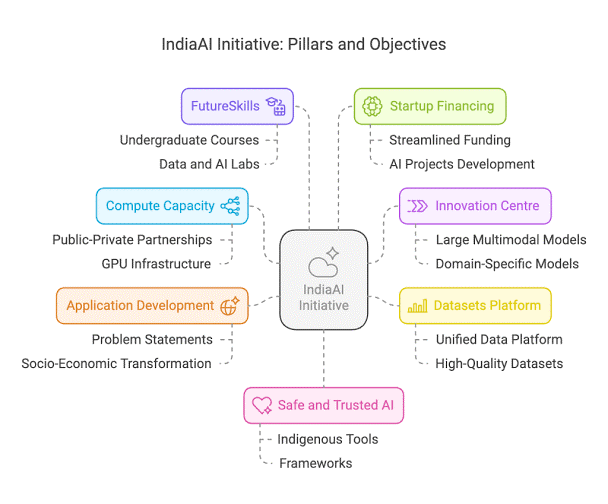
● AI Compute Ecosystem: Establishment of a high-performance computing infrastructure with 10,000+ GPUs to support AI research, startups, and a central AI resource marketplace.
● Innovation Centre: Creation of indigenous foundational AI models and Large Multimodal Models (LMMs) across sectors, with a dedicated budget of ₹2,000 crore.
● Datasets Platform: Launch of a centralised platform for easy access to high-quality non-personal datasets for AI startups, researchers, and developers.
● Application Development Drive: Support for AI solutions focused on governmental and public sector problem areas, enabling socio-economic transformation through scalable applications.
● FutureSkills Program: Enhancement of AI education via UG, PG, and PhD courses, and establishment of AI and Data Labs in tier-2 and tier-3 cities.
● Startup Financing Support: Simplified funding process for deep-tech AI startups, with a total outlay of ₹2,000 crore to back innovation across growth stages.
STRATEGIC AUTONOMY AND NATIONAL SECURITY
● Foreign Dependency: Absence of indigenous AI capabilities may lead to dependence on foreign technologies, risking sovereignty and control.
● Geopolitical Risks: Technological dependencies can be weaponised, as seen in financial and defense sectors globally, making self-reliance critical.
● Military Applications: AI is being integrated into defence and intelligence systems; lacking strategy here could create security vulnerabilities.
● Whole-Government Approach: A coordinated AI strategy involving multiple ministries is essential to protect national interests.
● Sovereign Infrastructure: Focus must be on building resilient domestic capabilities in AI hardware, cloud computing, and data processing.
DATA GOVERNANCE AND INNOVATION ECOSYSTEM
● Data as Resource: Public data platforms are key to AI development; their design will affect innovation and market structures.
● Corporate Control: Without transparent governance, there’s risk of data monopolies reinforcing corporate concentration.
● Democratic Frameworks: The absence of debated, legislated rules around data access and use can erode public trust.
● Inclusive Innovation: Equitable access to data infrastructure is needed to democratize AI innovation beyond tech giants.
● Public Good Orientation: Data ecosystems must prioritize public value over private profit, especially in sectors like health and education.
LABOUR MARKET TRANSFORMATION RISKS
● Job Losses: AI in India is already impacting employment—TCS, Infosys, and Wipro together shed 65,000 jobs in 2024, signalling systemic shifts.
● Displacement Risk: The IMF estimates that 26% of India’s workforce is exposed to AI, with 12% at high risk of displacement.
● Lack of Safeguards: No structured framework exists for employment transition, reskilling, or social protection in the AI era.
● Expert Exclusion: Policy design has largely excluded labour economists and civil society, narrowing the debate to technical feasibility.
● Social Stability: A structured AI labour strategy is needed to ensure economic resilience and inclusive adaptation to automation.
ENVIRONMENTAL COSTS OF AI GROWTH
● Energy Demand: AI technologies are energy-intensive. Data centres could double their electricity usage by 2030, straining resources.
● Urban Water Stress: AI hubs like Bengaluru and Hyderabad face acute groundwater depletion, exacerbating the resource burden.
● Policy Blind Spots: India’s AI strategy lacks focus on the climate and ecological consequences of data centre proliferation.
● Green Technology Need: Investment in sustainable AI infrastructure is critical to balance innovation with environmental responsibility.
● Energy-AI Nexus: There must be integration of AI expansion planning with national energy and water policies to ensure sustainability.
SOCIAL CONTRACT AND DEMOCRATIC LEGITIMACY
● Shifting Skills: AI will redefine which skills are valuable, making education policy crucial for future-readiness.
● Public Deliberation: National strategy must be co-created with civil society, educators, workers, and parliamentarians.
● Bias and Accountability: In sensitive domains like healthcare and policing, AI can perpetuate bias, requiring robust oversight mechanisms.
● Regulatory Vacuum: India lacks a strong legal and ethical AI framework, risking public backlash and reduced trust.
● Inclusive Dialogue: National conversations must drive consensus on how AI impacts citizen rights and economic fairness.
INDIA’S ROLE IN GLOBAL AI GOVERNANCE
● Global South Voice: India seeks to champion human-centric AI for the Global South, but this must reflect in domestic policy.
● International Forums: India’s participation in the Global Partnership on AI (GPAI) adds weight to its global credibility.
● Coherence Needed: Global influence is contingent upon a clear, coherent, and operationalized domestic AI policy.
● Norm Setting: India’s governance choices today will influence international norms, especially for developing nations.
● Soft Power Advantage: A democratically grounded AI model can become India’s soft power lever in tech diplomacy.
BUILDING THE ROAD AHEAD
● Parliamentary Strategy: India must table a Cabinet-approved AI strategy in Parliament for democratic legitimacy.
● Standing Committee: Establishing a Standing Committee on AI and Emerging Technologies can ensure oversight and accountability.
● Labour Impact Study: A detailed national study on AI’s labour market effects, especially in entry-level jobs, is urgently required.
● Public Consultation: An inclusive deliberation model involving industry, labour, and civil society is essential for balanced decision-making.
● Institutional Architecture: Strategic investment in institutions and think tanks dedicated to AI policy will ensure sustained governance innovation.
CONCLUSION
AI presents immense opportunities and challenges for India. But ambition alone is not enough. A clear, inclusive, and democratically grounded national AI strategy must precede mission execution. India’s global leadership in AI governance depends on domestic coherence, strategic foresight, and institutional readiness. Strategy must precede mission to safeguard India’s future.
As we look towards India 2030, the development of robust AI regulations will be crucial. The vision of AI for India must be balanced with the principle of AI for all, ensuring that technological advancements benefit every sector of society. The success of AI in India initiatives will depend on how well we navigate these challenges and opportunities in the coming years. India a nation at the forefront of technological innovation must prioritize a comprehensive strategy to harness the full potential of AI while addressing its societal implications.
SOURCE:TH
UPSC MAINS PRACTICE QUESTION
Q. India aspires to become a global leader in Artificial Intelligence (AI). Critically evaluate the need for a comprehensive national strategy for AI governance. What steps should India take to align innovation with democratic values and strategic autonomy?