







A REVISION OF GDP AND ITS IMPLICATIONS
Why in the News?
- India has released a revised GDP series with 2022–23 as the new base year, replacing the earlier 2011–12 base year series.
- The revision reduces the estimated absolute size of GDP and alters the sectoral composition of production in the economy.
- While the correction in GDP estimates is seen as a positive step toward improving statistical accuracy, similar to how ex post facto reviews improve regulatory frameworks including environmental clearances,
- It remains uncertain whether the revision adequately addresses concerns and methodological red flags raised about the 2011–12 GDP series.
GDP Revision and Base Year Change
- Gross Domestic Product (GDP) is the total value of all final goods and services produced in a country in a year, excluding the value of intermediate inputs.
- It is the most widely used indicator of the size and performance of an economy.
- GDP, or Gross Value Added (GVA), is estimated using extensive data on physical output and prices, requiring multiple statistical methods.
- The estimates are prepared in accordance with the global framework of the United Nations System of National Accounts (UNSNA).
- The latest GDP revision with base year 2022–23 follows the 2025 edition of the UNSNA guidelines.
Periodic Revision of National Accounts
- The base year for National Accounts Statistics (NAS) is typically revised every 5–10 years.
- Such revisions update key macroeconomic indicators including GDP, national savings, consumption, and investment.
- Base year revision captures structural changes in the economy, including shifts in the types of goods and services produced.
- It also accounts for changes in relative prices, which affect the estimation of the real size of the economy (GDP adjusted for inflation).
- The revision process is a large and complex statistical exercise, conducted periodically by the National Statistical Office (NSO) in each country, reflecting the precautionary principle in ensuring data accuracy.
Awaited Revision of NAS
- The revision of National Accounts Statistics (NAS) with 2022–23 as the base year was highly anticipated because it came after an 11-year gap.
- The previous revision, introduced in 2015 with base year 2011–12, had triggered serious concerns among policymakers, economists, and independent analysts about the reliability of GDP estimates.
Concerns with the 2011–12 GDP Series
- In sectors such as manufacturing, the growth rates in the 2011–12 series were significantly higher than earlier estimates and, in some cases, even showed a different trend direction.
- The economic structure depicted in the 2011–12 series differed sharply from earlier estimates.
- For instance, the estimated size of the private corporate sector (PCS) was much larger than previously reported.
- Several experts argued that official GDP growth rates during the last decade were likely overestimated under the 2011–12 series.
- In a review of member countries’ statistical systems, the International Monetary Fund (IMF) assigned India a ‘C’ grade for the quality of its National Accounts Statistics, raising concerns about data credibility.
Significance of the New 2022–23 Base Year Series
- Against this backdrop, the new GDP series with 2022–23 as the base year assumes considerable importance for improving data accuracy and credibility.
- The current discussion focuses on changes in GDP estimates from the production side, while analysis of consumption (expenditure) and price changes is expected separately.
Nature of Comparisons in the New Series
Two key comparisons are made using current price estimates:
- Annual percentage change in GDP between the new 2022–23 series and the older 2011–12 series for the overlapping years 2022–23 and 2023–24.
- Changes in sectoral shares of GDP across major sectors between the two series for the same years.
Key Findings of the Revised GDP Series (Base Year 2022–23)
-
Change in GDP Size and Growth
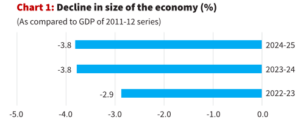
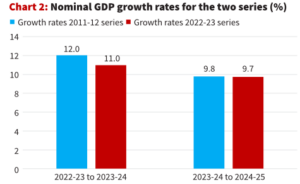
- absolute size of GDP has declined by about 3–4% in the new series compared with the earlier 2011–12 base year series.
- However, annual GDP growth rates remain broadly similar, differing by only ±1 percentage point between the two series.
-
Changes in Production Structure
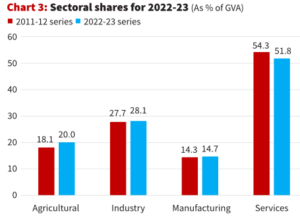
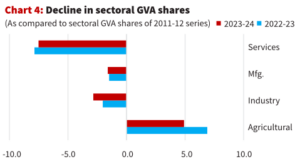
- The share of agriculture and industry (secondary sector) in GDP has increased.
- The share of the services sector has declined slightly in the revised estimates.
-
Manufacturing Sector Trends
- Within industry, the share of manufacturing in GDP has increased marginally from 14.3% to 14.7%.
- Despite this rise in share, the absolute size of the manufacturing sector has fallen by about 1.5–1.6% compared with the previous series.
- This finding is important because manufacturing estimates were a major source of controversy in the earlier GDP revision.
-
Institutional Composition of GDP
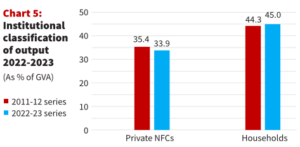
- The share of the non-financial private corporate sector (PCS) in GDP has declined from 35.4% to 33.9% in 2022–23, a fall of 1.5 percentage points.
- The decline is larger in 2023–24 (about 3.4 percentage points), indicating a reduced contribution of the corporate sector in the revised series.
-
Household/Informal Sector
- The household or informal sector’s share in GDP has increased slightly compared with the earlier series.
- The increase is about 0.7 percentage points in 2022–23 and 2.7 percentage points in 2023–24.
- This rise is largely driven by the agriculture sector, while smaller sectors have limited impact on the change.
Interpreting the Changes in the Revised GDP Series
- Unexpected Reduction in GDP Size
○ In principle, rebasing National Accounts Statistics (NAS) should not alter the absolute size of GDP at current prices, since the real economy being measured remains the same.
○ Normally, revisions tend to increase GDP estimates because improved datasets and methodologies capture previously under-reported or new economic activities.
○ Therefore, the 3–4% reduction in GDP size in the new series appears unusual at first glance.
- Possible Correction of Overestimation
○ The reduction may reflect a correction of the widely suspected overestimation of GDP growth in the 2011–12 base year series.
○ If so, the revision can be viewed as a positive step toward improving the accuracy and credibility of economic statistics, much like how retrospective environmental clearances aim to correct regulatory oversights.
- Implications for Economic Targets
○ A smaller corrected GDP base affects perceptions of economic progress.
○ For example, India’s ambition of becoming a $5-trillion economy, announced by Narendra Modi in 2019, could take longer to achieve with the revised estimates.
- Unresolved Concerns
○ Despite the correction in GDP size, it is uncertain whether the revision fully resolves the methodological concerns raised about the 2011–12 series.
○ It is also unclear if the revision adequately addresses the issues highlighted in the statistical review by the International Monetary Fund (IMF).
- Need for Greater Methodological Transparency
○ Some of the changes in growth rates could simply arise from new datasets, revised statistical methods, or updated “rates and ratios” used in estimation.
○ Therefore, detailed methodological documentation from the National Statistical Office (NSO) is necessary to enable a comprehensive evaluation of the reliability of the new GDP series.
- Broader Implications on Regulatory Frameworks
○ Accurate GDP data is crucial for various policy frameworks, including those related to environmental impact assessment and resource allocation for achieving a pollution free environment.
○ The revision affects how economic activities are measured across sectors, including those requiring environmental clearance under the EIA Notification and compliance with the Forest Conservation Act.
○ Statistical transparency in GDP methodology aligns with principles of environmental democracy and environmental jurisprudence, as emphasized in landmark cases like the Vanashakti judgment.
○ Just as the polluter pays principle ensures accountability in environmental matters, accurate economic data ensures accountability in fiscal and developmental policies.
○ The revision also impacts sectors operating in sensitive zones like the Coastal Regulation Zone, where economic activity must be balanced with environmental protection.
○ The ex-post nature of this GDP revision demonstrates the importance of periodic reviews in maintaining data integrity across all regulatory domains.
Source: https://www.thehindu.com/business/Economy/a-revision-of-gdp-and-its-implications/article70730934.ece
Mains Question (250 words):
Critically examine the significance of revising the GDP base year to 2022–23 in India. How does it alter estimates of economic size, sectoral structure, and address concerns raised about the 2011–12 series?