







THE SHIFT OF CRITICAL MINERALS TO INDIA’S STRATEGIC CENTRE
Syllabus:
GS 3:
- Energy and self reliance
- Infrastructure : Energy
Why in the News?
The latest Union Budget 2026 signals a decisive shift by placing critical minerals at the core of India’s industrial, energy, and geopolitical strategy. Backed by the National Critical Mineral Mission (NCMM) and duty rationalisation measures, the focus has moved from policy formulation to execution, highlighting the urgency of securing mineral supply chains in an increasingly volatile global order while ensuring constitutional guarantees under Article 14 and Article 21 for affected communities.
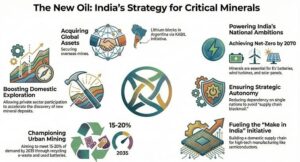
CRITICAL MINERALS AND ENERGY TRANSITION● Clean Energy Backbone: Minerals such as lithium, cobalt, nickel, and rare earths underpin renewable energy and battery technologies. ● Defence Applications: Strategic minerals are essential for aerospace, electronics, and advanced defence manufacturing. ● Resource Nationalism: Rising geopolitical competition has intensified mineral supply chain securitisation. ● Industrial Policy Tool: Mineral security increasingly functions as a core element of modern industrial strategy. ● Climate Linkage: Securing mineral inputs is indispensable for achieving net-zero commitments and decarbonisation pathways. |
FROM POLICY PERIPHERY TO STRATEGIC PRIORITY
- Delayed Recognition: Until 2023, minerals such as lithium were classified as atomic minerals, restricting private exploration and limiting strategic planning.
- Comprehensive Framework: India now maintains an official list of 30 critical minerals, aligning domestic policy with global supply chain realities and international standards.
- NCMM Launch: The ₹16,300 crore National Critical Mineral Mission represents institutional commitment to exploration, processing, and technological capability building.
- Royalty Reforms: Rationalisation of royalty rates and easing of junior miner participation signal regulatory reform to attract private investment.
- Strategic Mainstreaming: Critical minerals have transitioned from niche discussion to a central pillar of India’s industrial and geopolitical doctrine.
GLOBAL SUPPLY CHAIN REALITIES
- Processing Concentration: China controls nearly 90% of global mineral processing capacity for several rare earths and strategic inputs.
- Extraction Lag: Mineral exploration and mining require long gestation periods, often extending over decades before commercial output materialises.
- Processing Bottleneck: Securing raw material access alone is insufficient without domestic refining and purification capabilities.
- Technological Upgradation: Clean energy and defence applications require ultra-high purity processing, demanding advanced metallurgical expertise.
- Strategic Vulnerability: Dependence on concentrated supply chains exposes India’s clean energy transition to geopolitical disruptions.
INDIA’S EXISTING CAPABILITIES
- High Purity Production: Indian industries already produce 99.9% purity copper, graphite, rare earth oxides, tin, and titanium.
- Conventional Orientation: Current output primarily supports traditional industrial applications rather than advanced clean-tech manufacturing.
- Sectoral Leverage: Established strengths in chemicals, pharmaceuticals, and materials engineering offer transferable technical skills.
- Scaling Challenge: Expanding production to globally competitive volumes requires infrastructure, financing, and technological modernisation.
- Value Chain Integration: Moving up the mineral value chain enhances domestic technological sovereignty and industrial resilience.
PRIORITY ONE: DEMAND CREATION
- Capex Incentives: Removal of import duties on capital goods used in processing improves cost competitiveness for emerging refineries.
- Market Certainty: Investors require assured domestic demand for processed minerals to justify large-scale midstream infrastructure investments.
- Clean Tech Linkage: Expansion of electric vehicles, battery manufacturing, solar modules, and wind turbines strengthens downstream demand.
- Backward Integration: Delays in localised supply chain integration create uncertainty for midstream mineral processors.
- Industrial Multiplier: Demand creation generates third-order effects across exploration, refining, logistics, and workforce development ecosystems.
PRIORITY TWO: AI-DRIVEN EXPLORATION
- Exploration Target: The NCMM aims to complete 1,200 exploration projects by FY2031, signalling ambitious scale.
- Tax Support: Exploration expenditure for nine key minerals is now eligible for tax deductions, improving project viability.
- AI Integration: Leveraging Artificial Intelligence tools for prospectivity mapping and geospatial analytics can reduce exploration risk.
- Data Synergy: Integrating the IndiaAI Mission, National Geospatial Policy, and Mission Anveshan enhances data-driven mineral discovery.
- Repository Expansion: Strengthening the National Geoscience Data Repository enables predictive modelling and accelerates resource identification.
PRIORITY THREE: TECHNOLOGICAL SOVEREIGNTY
- Supply Weaponisation: Recent disruptions in rare earth magnet and battery supply chains highlight geopolitical vulnerabilities.
- Rare Earth Corridors: Establishing mineral processing clusters in coastal States leverages infrastructure and export connectivity.
- Import Rationalisation: Reducing duties on monazite sands supports domestic rare earth production.
- Regional Growth: Strategic mineral hubs can generate employment and industrial diversification across coastal regions.
- Strategic Autonomy: Domestic control over processing capabilities strengthens India’s defence and clean energy independence.
SOCIAL JUSTICE AND INCLUSIVE MINERAL DEVELOPMENT
- Constitutional Framework: Mineral extraction must uphold fundamental rights enshrined in Article 14 (equality) and Article 21 (personal liberty and human dignity) for affected communities.
- Gender-Sensitive Approach: Mining sector employment must address gender discrimination and promote gender equality through women’s rights protection and equal treatment in hiring and vocational training programs.
- Women’s Safety: Ensuring women’s safety in mining operations requires robust policies addressing gender-based discrimination and providing women’s health care, reproductive health services, and mental health care facilities.
- Rehabilitation Programs: Displaced communities, including those who become economic prisoners of poverty, require comprehensive rehabilitation programs with vocational training, mental health services, and post-release support for social reintegration.
- Community Welfare: Mining regions must establish mental health services, substance abuse treatment facilities, and suicide prevention programs to address social disruption.
- Access to Justice: Affected populations require legal assistance and access to justice mechanisms, ensuring non-discrimination and protection of constitutional rights throughout mineral development processes.
- Monitoring Mechanisms: Independent monitoring committees should oversee compliance with international standards, ensuring gender justice and human dignity in all mining operations.
INTERNATIONAL PARTNERSHIPS AND DIPLOMACY
- Strategic Alliances: Collaboration with Australia, Japan, the European Union, the UK, and the United States diversifies supply chains while adhering to international standards on labor rights and gender-specific needs.
- Technology Transfer: Encouraging foreign firms to establish processing facilities in India reduces overdependence on single geographies.
- FTA Leverage: The India-EU Free Trade Agreement can facilitate integrated mineral supply chain partnerships.
- Institutional Linkages: Joint research through platforms such as Critical Minerals Supply Chain Observatories enhances innovation.
- Regulatory Certainty: Stable legal frameworks and water-tight contract enforcement are essential to attract global capital.
IMPLEMENTATION CHALLENGES AHEAD
- Inter-Ministerial Coordination: Effective implementation requires coordination across mining, environment, commerce, and energy ministries.
- Environmental Safeguards: Mineral expansion must adhere to sustainable extraction norms to prevent ecological degradation.
- Skill Development: Building technical capacity for advanced refining demands workforce training and research investment.
- Financing Mechanisms: Long-term capital and risk-sharing frameworks are needed to support exploration and processing projects.
- Execution Speed: Policy ambition must translate into rapid and coordinated on-ground action to sustain strategic momentum.
CONCLUSION
India’s repositioning of critical minerals at the strategic centre reflects recognition that mineral security underpins energy transition, defence preparedness, and industrial competitiveness. The challenge now lies in execution — combining demand creation, AI-driven exploration, processing scale-up, and global partnerships to secure technological sovereignty in a turbulent geopolitical era.
SOURCE:TH
MAINS PRACTICE QUESTION
“Critical minerals have emerged as a strategic cornerstone of India’s energy and industrial policy.” Discuss the challenges and policy priorities for securing mineral sovereignty.