







THE PRIVATE FORESTRY PLAN MUST SQUARE WITH THE FOREST RIGHTS ACT
Syllabus:
GS 3:
- Forest Conservation Act and environmental clearances
- Land reforms in India
Why in the News?
The Union government has amended guidelines under the Van (Sanrakshan evam Samvardhan) Adhiniyam, 1980, allowing private entities to lease forest land for plantation activities. Activities earlier treated as non-forestry uses requiring environmental clearance, particularly commercial monoculture plantations, are now reclassified as forestry activities, raising concerns regarding ecological sustainability, compliance with the Forest Rights Act, 2006 (FRA), and potential circumvention of environmental impact assessment requirements.
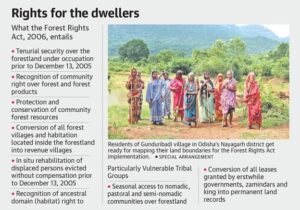
FOREST GOVERNANCE IN INDIA● Constitutional Basis: Forests fall under the Concurrent List, enabling both Union and State legislative competence. ● FRA Objective: Enacted to correct historical injustices faced by forest-dwelling Scheduled Tribes and traditional forest dwellers. ● PESA Linkage: In Scheduled Areas, the Panchayats (Extension to Scheduled Areas) Act, 1996 strengthens community consent requirements. ● Conservation Paradigm: India’s conservation policy, governed by the Forest Conservation Act and environmental jurisprudence, historically oscillated between exclusionary preservation and participatory management. ● Sustainable Model: Modern environmental governance emphasises integration of ecological sustainability with community rights, ensuring a pollution free environment. |
RECLASSIFICATION AND COMMERCIAL INCENTIVES
- Cost Reduction: By redefining plantation activities as forestry, the amendment exempts private actors from paying Net Present Value (NPV), undertaking compensatory afforestation, and obtaining environmental clearances, significantly lowering entry costs.
- Industrial Benefit: Sectors such as paper and pulp industries, which increasingly rely on timber imports, stand to benefit from access to domestic forest land at reduced regulatory cost, bypassing the EIA notification requirements.
- Revenue Orientation: Emphasis on revenue-sharing models indicates prioritisation of commercial returns over ecological restoration or biodiversity conservation.
- Colonial Legacy: Forest working plans, prepared by State forest departments, continue to reflect a timber-centric management philosophy, rooted in colonial extraction models.
- Ecological Risk: Monoculture plantations can alter forest composition, reduce biodiversity, and undermine ecosystem resilience despite formal classification as forestry activities, potentially violating the precautionary principle embedded in environmental law.
RESTORATION CLAIMS VERSUS REALITY
- Funding Availability: The government already possesses substantial allocations for forest restoration, with significant funds often remaining unutilised.
- Innovation Argument: The claim that private actors may introduce socio-ecologically innovative models appears constrained by mandatory adherence to rigid working plans.
- Limited Flexibility: Strict compliance requirements reduce scope for community-driven or ecologically adaptive forest management approaches.
- Policy Contradiction: Framing commercial leasing as ecological restoration creates tension between conservation objectives and industrial incentives.
- Credibility Question: Without systemic reform of management frameworks and proper environmental impact assessment, the restoration justification appears administratively convenient rather than ecologically grounded.
LEGAL INFIRMITY UNDER THE FRA
- Statutory Mandate: The Forest Rights Act, 2006 recognises legal rights of forest-dwelling communities over land, non-timber forest products (NTFP), and forest management, forming a crucial component of environmental democracy.
- Mandatory Compliance: The amended guidelines themselves require adherence to FRA provisions and the Forest Conservation Act before leasing forest land.
- Rights Settlement: FRA compliance requires formal settlement of individual and community forest rights prior to diversion or leasing decisions, preventing ex post facto or retrospective environmental clearances.
- Institutional Authority: Gram Sabhas hold statutory authority to protect, regenerate, and manage forests within traditional boundaries, as reinforced by the Vanashakti judgment.
- Procedural Bypass: Proceeding with leasing without full rights recognition risks violating constitutional protections embedded in decentralised forest governance and established environmental jurisprudence.
GRAM SABHAS AND COMMUNITY GOVERNANCE
- Traditional Boundaries: Estimates suggest over half of India’s forest land lies within traditional community boundaries recognised under FRA.
- Management Plans: Gram Sabhas are empowered to prepare local forest management plans tailored to ecological conditions and livelihood needs.
- Integration Requirement: The law mandates integration of village-level plans into official forest working plans.
- Administrative Resistance: In practice, forest departments frequently ignore or refuse to incorporate Gram Sabha management frameworks.
- Conflict Potential: Leasing decisions without community consent risk escalating disputes, particularly in the central Indian forest belt.
ECOLOGICAL AND SOCIAL CONSEQUENCES
- Livelihood Dependence: Approximately 275–300 million forest-dependent people rely on forests for subsistence, cultural identity, and economic security.
- Sustainability Incentive: Communities dependent on forests bear long-term risks of degradation, encouraging more sustainable decision-making than distant bureaucracies, consistent with the polluter pays principle.
- Biodiversity Protection: Community-managed forests have often demonstrated better biodiversity outcomes than centrally controlled extraction regimes.
- Rights Revocation: Instances of attempts to revoke recognised rights or reject pending claims highlight institutional tension between conservation policy and community entitlements.
- Carbon Economy Risks: Emerging opportunities such as carbon markets may further marginalise communities unless institutional safeguards are strengthened.
- carbon markets may further marginalise communities unless institutional safeguards are strengthened.
CENTRALISED GOVERNANCE VERSUS DECENTRALISED RIGHTS
- Institutional Dominance: Legacy forest departments continue to exercise dominant control over decision-making despite statutory decentralisation mandates.
- Fiscal Access Barriers: Gram Sabhas face obstacles in accessing public funds or participating effectively in NTFP markets.
- Technocratic Bias: Centralised planning frameworks prioritise quantifiable timber outputs over livelihood and cultural considerations.
- Subsidiarity Violation: Ignoring Gram Sabha consent undermines the principle that governance should occur at the lowest competent authority.
- Democratic Deficit: Exclusion of communities weakens participatory democracy envisioned under constitutional decentralisation reforms.
WAY FORWARD: ALIGNING POLICY WITH LAW
- Rights First: Ensure complete settlement of community forest rights before permitting any leasing or commercial engagement.
- Plan Integration: Mandate formal integration of Gram Sabha management plans into official working plans.
- Institutional Reform: Reorient forest departments from extraction-focused regulators to facilitators of community-led sustainable management.
- Transparent Framework: Develop clear protocols for revenue-sharing, ecological safeguards, and grievance redressal mechanisms.
- Participatory Model: Empower communities to decide whether and how to collaborate with private actors, ensuring equitable benefit-sharing.
CONCLUSION
The amendment under the Van (Sanrakshan evam Samvardhan) Adhiniyam, 1980 seeks to stimulate private participation in forestry but risks undermining statutory protections under the Forest Rights Act, 2006. Sustainable forest governance requires alignment of commercial initiatives with legally mandated community rights. Ecological restoration cannot be achieved by sidelining those who depend on forests.
SOURCE: HT
MAINS PRACTICE QUESTION
“The recent private forestry amendment risks weakening the Forest Rights Act framework.” Critically examine the legal and ecological implications.