






PM Modi’s Israel Visit 2026
Syllabus
GS 2: India and its Neighbourhood
Why in the News?
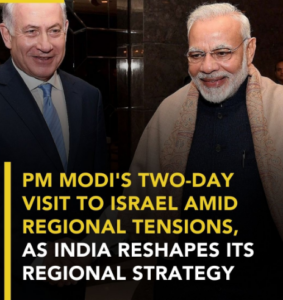
Recently, Prime Minister Narendra Modi announced a two-day visit scheduled for February 25-26, 2026 to Israel amid rising West Asian tensions, deepening strategic, defence, and economic cooperation between the two countries.
Introduction
- West Asia is facing rising military tensions, uncertainty in Gaza, and shifting regional alliances.
- In this fragile situation, Prime Minister Narendra Modi’s February 2026 visit to Israel carries strategic importance.
- The visit reflects deep India-Israel ties in defence, technology, trade, and regional connectivity.
Rising Tensions in West Asia
- The West Asian region is currently witnessing the possibility of a major military conflict.
- There is one of the largest American military buildups in the Persian Gulf in recent times.
- Iran has clearly refused to accept what it calls unreasonable demands from the United States.
- In Gaza, a ceasefire has held since October 2025, but long-term peace remains uncertain.
- Emerging regional divisions are drawing countries like the UAE and Saudi Arabia into opposing blocs.
- These developments are increasing instability and raising global security concerns.
Significance of the Prime Minister’s Visit
- Prime Minister Narendra Modi is scheduled to visit Israel on February 25-26, 2026.
- This will be his second visit to Israel after the historic July 2017 visit.
- The 2017 visit was the first ever by an Indian Prime Minister to Israel.
- The 2026 visit is a standalone visit without engagement with Palestinian Authority leadership.
- This highlights India’s policy of “de-hyphenating” its Israel engagement from the Palestine issue.
- The visit takes place at a time of serious regional uncertainty.
Key Questions Around the Visit
- Observers are asking why this visit is taking place during heightened regional tensions.
- Questions are also being raised about the role India can play in the fragile security environment.
- There is interest in how India and Israel can deepen cooperation against common threats.
- The visit is being closely watched for its long-term strategic implications.
Convergence in Security and Defence Cooperation
Shared Security Challenges
- Both India and Israel are surrounded by hostile or unstable neighbourhoods.
- Both countries have experienced frequent terrorist attacks over the years.
- These shared threats have created natural convergence in defence and security matters.
- Cooperation has evolved from simple arms purchases to joint development projects.
Defence Trade and Strategic Depth
- According to the Stockholm International Peace Research Institute, India has been Israel’s largest defence customer.
- Between 2020 and 2024, India accounted for about 34% of Israel’s total arms exports.
- Defence cooperation has gradually shifted toward technology collaboration and joint production.
- Israel Aerospace Industries and other Israeli firms have supplied India with unmanned aerial vehicles and advanced missile systems.
- Special forces equipment and radar systems have also been part of defence cooperation.
Barak-8 and Vision Documents
- The Barak-8 air and missile defence system represents successful joint development.
- It strengthens India’s air defence and reflects high trust between the two countries.
- During Defence Minister Benjamin Gantz’s June 2022 visit, the India-Israel Vision on Defence Cooperation was announced.
- The Vision document emphasised futuristic defence technologies and deeper collaboration.
- In November 2025, a new agreement expanded cooperation in defence industry and technology sharing.
Operation Sindoor and Mission Sudarshan Chakra
- India’s experience during Operation Sindoor in May 2025 highlighted defence gaps.
- It reinforced the need for a strong air and anti-drone defence system.
- Mission Sudarshan Chakra aims to build an impregnable air and ballistic missile defense shield.
- During the visit, discussions may focus on procurement and co-production of Iron Beam.
- Iron Beam is a 100kW high-energy laser system capable of intercepting drones and rockets.
- The system offers cost-effective and efficient defence against aerial threats.
Private Sector Defence Collaboration
- Reports suggest that Autonomous Guard signed a deal with an Indian defence firm.
- The agreement is valued at approximately $1.9 million.
- It involves supply of advanced surveillance and threat-detection systems.
- These systems specialise in sensor-based observation technologies.
- Such private collaborations deepen industrial partnerships beyond government contracts.
Science, Technology and Innovation Linkages
Agriculture and Centres of Excellence
- India has benefited from Israel’s expertise in agriculture technology and innovation.
- There are more than 35 Centres of Excellence established across Indian states.
- These centres focus on high-quality production of flowers, vegetables, and fruits.
- Crops include mango, citrus, litchi, date palm, and pomegranate.
- Beekeeping and modern farming practices are also supported through these centres.
Water Management Cooperation
- Water scarcity is a serious challenge in many Indian regions.
- Israeli water management technologies have proven valuable in this context.
- MASHAV signed agreements with Haryana in June 2022.
- Another agreement was signed with Rajasthan in December 2024.
- These agreements focus on integrated water resource management and capacity building.
Artificial Intelligence Cooperation
- Artificial Intelligence is emerging as a key driver of modern innovation.
- AI is expected to become an important area of bilateral cooperation.
- Future collaboration may focus on AI-based defence and civilian technologies.
Trade and Economic Engagement
Bilateral Trade Growth
- India is Israel’s second-largest trading partner in Asia.
- Bilateral trade reached $3.75 billion in FY 2024-2025.
- Merchandise trade remains dominated by diamonds, petroleum, and chemicals.
- Trade is expanding into electronics, high-tech products, communications, and medical equipment.
Investment and Free Trade Agreement
- In September 2025, India and Israel signed a Bilateral Investment Agreement.
- The agreement was signed during Finance Minister Bezalel Smotrich’s visit.
- In November 2025, Terms of Reference for a Free Trade Agreement were signed.
- The FTA discussions gained momentum during Commerce Minister Piyush Goyal’s visit.
- The Prime Minister’s visit may further accelerate FTA negotiations.
Human Mobility and Infrastructure
- Israel is interested in facilitating Indian infrastructure companies in road and port projects.
- Discussions may include exemptions and arrangements for such participation.
- Israel may also pursue a human mobility agreement similar to India’s deal with Russia.
- Such arrangements would allow skilled Indian professionals to work in Israel.
India-Middle East-Europe Economic Corridor (IMEC)
- IMEC was announced during the G-20 Summit in Delhi in September 2023.
- It aims to create an intercontinental connectivity corridor linking India to Europe.
- The Gaza conflict temporarily stalled progress on this initiative.
- Recent trade agreements with the EU, Oman, and UAE create renewed urgency.
- IMEC offers an alternative route to Europe beyond the vulnerable Suez Canal.
- Achieving lasting peace in Gaza is essential for IMEC’s success.
Gaza Peace Process and Regional Balance
- Discussion on the Gaza peace process is likely during the visit.
- On February 19, 2026, a Summit of the Board of Peace was presided over by President Donald Trump.
- More than 50 countries participated in this summit.
- Some countries pledged $7 billion in funding for stabilisation efforts.
- Others committed troops to the International Stabilisation Force.
- India attended the summit as an observer without defining its role.
- Given India’s strong ties with Gulf states and Israel, its potential role may be discussed.
Regional Dynamics and Iran
- Regional discussions will likely include developments involving Iran.
- Any conflict involving Iran could affect India’s energy security.
- India hosted the 2nd India-Arab Foreign Ministers’ Meeting in January 2026.
- Prime Minister Modi visited Jordan and Oman in December 2025.
- The UAE President visited India in January 2026.
- These engagements show India’s balanced diplomacy in West Asia.
Proposed ‘Hexagon’ Alliance
- Israeli Prime Minister Benjamin Netanyahu proposed a “hexagon” of alliances.
- The proposal includes India, Arab nations, African nations, Greece, Cyprus, and Asian countries.
- It aims to counter radical Shiite and Sunni axes in the region.
- India may not necessarily view regional dynamics through this lens.
- India’s response to such proposals will be closely observed.
Symbolism and Strategic Importance
- Mr. Modi is expected to address the Knesset (Israel’s Parliament) during the visit.
- Such privilege is usually reserved for U.S. Presidents.
- He is also scheduled to visit a Jerusalem innovation centre.
- The visit reflects strong strategic partnership built over the past decade.
- It goes beyond routine diplomacy and may shape long-term regional strategy.
Conclusion
Prime Minister Modi’s Israel visit occurs amid rising regional tensions and strategic shifts. It strengthens defence, trade, and innovation ties while testing India’s balanced diplomacy in West Asia and shaping future regional engagement.
Source:The Hindu
Mains Practice Question
Discuss the strategic significance of Prime Minister Modi’s 2026 visit to Israel in the context of West Asian security challenges.