







INDIA’S ENERGY SHIFT THROUGH THE GREEN AMMONIA ROUTE
Syllabus:
GS 3:
- Science and technology
- Development and its application in everyday life
Why in the News?
At India Energy Week 2026, Prime Minister Narendra Modi highlighted investment opportunities worth $500 billion, signalling India’s transition from energy security to energy independence. Central to this shift is green ammonia, emerging as a scalable derivative of green hydrogen, with India’s recent SECI auction under the National Green Hydrogen Mission setting global benchmarks in cost-competitive procurement.
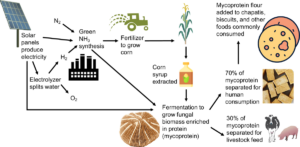
INDIA’S ENERGY TRANSITION FRAMEWORK● National Green Hydrogen Mission: Launched to make India a global hub for green hydrogen production, usage, and export. ● Energy Independence Vision: Moving beyond security to independence reduces structural vulnerabilities in fossil fuel dependence. ● Renewable Scale: India’s rapid expansion of solar and wind capacity provides foundational input for green hydrogen competitiveness. ● Industrial Policy Linkage: Integration of hydrogen strategy with fertiliser, shipping, and heavy industry ensures coherent policy execution. ● Climate Commitments: Clean ammonia adoption contributes directly to lowering emissions intensity under India’s Paris Agreement commitments, advancing the goal of a pollution free environment. |
STRATEGIC IMPORTANCE OF GREEN AMMONIA
- Hydrogen Carrier: Green ammonia serves as an efficient hydrogen carrier, enabling storage, transport, and large-scale deployment of green hydrogen across fertiliser, power, and maritime sectors.
- Industrial Decarbonisation: Its application in fertiliser manufacturing, marine fuels, and clean energy systems directly supports decarbonisation of hard-to-abate sectors central to India’s industrial growth trajectory.
- Energy Diversification: By reducing dependence on natural gas imports, green ammonia strengthens India’s long-term energy sovereignty and reduces exposure to global fuel price volatility.
- Export Potential: As countries such as the European Union and South Korea seek clean ammonia imports, India is positioned to become a competitive global supplier.
- Climate Alignment: Adoption aligns with India’s commitments under the Nationally Determined Contributions (NDCs) and broader net-zero ambitions, reinforcing the precautionary principle in environmental governance.
SECI AUCTION: A GLOBAL BENCHMARK
- Aggregated Demand Model: The Solar Energy Corporation of India (SECI) aggregated demand across 13 fertiliser plants for 724,000 tonnes annually, creating scale-driven cost efficiency.
- Market Participation: The auction attracted 15 bidders, resulting in seven successful awardees, demonstrating strong investor confidence in India’s hydrogen ecosystem.
- Price Discovery: Discovered prices ranged between ₹49.75–₹64.74/kg, nearly 40–50% lower than comparable H2Global tenders in Europe.
- Production Subsidies: Incentives under the SIGHT programme offered declining subsidies over three years, ensuring gradual market competitiveness without permanent fiscal distortion.
- Long-Term Certainty: Ten-year fixed-price offtake agreements provided stable revenue visibility, significantly enhancing project bankability and investor confidence.
COST COMPETITIVENESS AND GAP NARROWING
- Grey Comparison: Grey ammonia in India costs around $515 per tonne, while green ammonia prices under SECI approach global parity with reduced subsidy support.
- Renewable Advantage: India’s low-cost solar and wind power significantly reduces input costs for green hydrogen production, improving ammonia competitiveness.
- Scale Economics: Aggregated procurement reduces transaction risks, optimises logistics, and leverages economies of scale in production and delivery.
- Risk Allocation: Tender refinements addressed concerns regarding payment security and risk-sharing, creating a balanced framework between developers and offtakers.
- Import Substitution: Contracted volumes equate to roughly 30% of ammonia imports, strengthening domestic supply resilience and embodying the polluter pays principle through cleaner production pathways.
LOGISTICS AND DELIVERY INNOVATION
- Coastal Integration: Pre-identified delivery points near coastal fertiliser plants enable efficient maritime transportation, lowering logistics costs while ensuring compliance with coastal regulation zone norms.
- Infrastructure Synergy: Utilisation of existing port and shipping networks supports rapid scale-up without excessive new infrastructure investment, subject to necessary environmental clearances.
- Geopolitical Buffer: Domestic procurement reduces exposure to currency fluctuations and global gas market disruptions, enhancing macroeconomic stability.
- Supply Predictability: Fixed-price contracts ensure long-term cost visibility for fertiliser manufacturers, stabilising agricultural input markets.
- Export Readiness: Coastal integration simultaneously strengthens India’s ability to serve future global clean ammonia markets.
GLOBAL POSITIONING AND STRATEGIC LEADERSHIP
- Policy Innovation: India’s auction design combines contract certainty, targeted incentives, and competitive bidding, offering a replicable global model rooted in environmental democracy and stakeholder participation.
- Renewable Backbone: The synergy between large-scale renewables and hydrogen production positions India advantageously within emerging clean fuel supply chains.
- Market Structuring: India’s early-mover advantage can shape evolving global certification standards and contract structures for green ammonia trade, contributing to international environmental jurisprudence.
- Industrial Competitiveness: Affordable green inputs enhance long-term competitiveness of India’s fertiliser and shipping sectors.
- Diplomatic Leverage: Leadership in clean ammonia strengthens India’s standing in global climate diplomacy and energy governance platforms.
IMPLEMENTATION CHALLENGES AHEAD
- Grid Stability: Developers require harmonised regulations regarding grid access, banking provisions, and renewable integration frameworks.
- Safety Protocols: Expansion necessitates stringent ammonia storage and transport safety standards aligned with global best practices.
- Environmental Compliance: Streamlined environmental clearance processes through the EIA notification framework and timely environmental impact assessment are essential to avoid delays, while preventing ex post facto or retrospective environmental clearances that undermine regulatory credibility.
- Land and Forest Regulations: Large-scale renewable installations must navigate Forest Conservation Act provisions and land acquisition norms without compromising ecological integrity.
- Financial Instruments: Long-tenor blended finance and dedicated risk-mitigation mechanisms are essential for scaling capital-intensive projects.
- Certification Alignment: International recognition of India’s green certification frameworks will determine export market access.
- Technical Capacity: Robust monitoring, hybrid renewable integration, and storage solutions are critical for operational sustainability.
CONCLUSION
India’s green ammonia auctions mark a structural shift in its energy architecture, combining cost competitiveness, policy innovation, and market certainty. While regulatory harmonisation, streamlined environmental clearances, and financial de-risking remain essential, India is uniquely positioned to lead the global clean ammonia market. Sustained coordination between policymakers, developers, and financiers can transform this momentum into durable climate and economic advantage.
SOURCE: TH
MAINS PRACTICE QUESTION
“Green ammonia can serve as a bridge between energy security and climate ambition.” Examine India’s strategy in light of recent policy and auction developments.