






PARLIAMENT’S HISTORIC LAW, AN EXTENDED WAIT FOR WOMEN
Syllabus:
GS 2:
- Amendments and significant provisions
- Structure of Parliament and state legislature
Why in the News?
The Women’s Reservation Act, 2023 was celebrated as a landmark reform promising 33% reservation in the Lok Sabha and State Legislative Assemblies. However, its implementation is constitutionally linked to the first Census conducted after 2026 and a subsequent delimitation exercise, making enforcement before the 2029 general elections legally impossible, thereby prolonging the wait for substantive political representation of women.
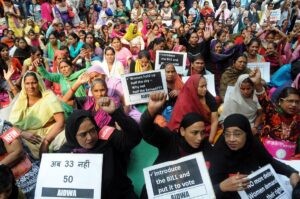
WOMEN’S REPRESENTATION IN INDIA● Historical Evolution: The first Women’s Reservation Bill introduced in 1996 lapsed repeatedly despite broad rhetorical support across political parties. ● Local Governance Success: Reservation in Panchayati Raj Institutions has demonstrated measurable gains in grassroots leadership and gender-sensitive policymaking. ● Global Practice: Several democracies employ legislative quotas or party mandates without linking them to demographic restructuring processes. ● Constitutional Backing: Article 15(3) empowers the State to enact special provisions for women, providing strong constitutional legitimacy for affirmative representation. ● Substantive Equality: Political reservation aligns with the constitutional vision of substantive equality rather than mere formal equality. |
THE CONSTITUTIONAL ROADBLOCK
- Sequential Preconditions: The Act mandates completion of a nationwide Census followed by constitution of a Delimitation Commission under Article 82, making these sequential steps legally indispensable before reservation can commence.
- Time-Intensive Census: The upcoming 2027 Census, once conducted, will require detailed enumeration, verification, compilation, and official publication, a process historically taking 12 to 18 months before legal validity attaches.
- Complex Redrawing: The Delimitation Commission must redraw 543 parliamentary and over 4,000 Assembly constituencies, balancing population, administrative continuity, geographic compactness, and existing SC/ST reservations, alongside new women’s quotas.
- Historical Experience: Previous delimitation exercises have taken three to six years, even without reallocation of seats among States, suggesting that implementation before 2032–33 remains improbable under current timelines.
- Legal Certainty: Unless Parliament passes another constitutional amendment removing the Census-delimitation linkage, the 2029 election cycle cannot legally incorporate women’s reservation provisions.
POLITICAL CALCULUS BEHIND THE DESIGN
- Incumbency Protection: Immediate reservation within the existing 543-seat structure would displace approximately 181 male Members of Parliament, creating political resistance across parties concerned about internal leadership disruption.
- Seat Expansion Strategy: Post-delimitation expansion of the Lok Sabha to possibly 800 or more seats allows reservation without directly replacing incumbents, thereby reducing short-term electoral backlash.
- Deferred Accountability: Linking reservation to expansion postpones difficult political trade-offs while maintaining symbolic commitment to gender inclusion.
- Electoral Pragmatism: The design reflects strategic balancing between political feasibility and constitutional promise rather than an outright commitment to immediate representation.
- Democratic Consequence: While politically convenient, this framework effectively delays actual representation for women, raising questions about the sincerity of legislative intent.
FEDERAL TENSIONS AND DEMOGRAPHIC POLITICS
- North-South Divide: Delimitation based on updated population data may increase representation for higher-growth States, intensifying tensions between demographically expanding northern States and southern States with successful population control.
- Historic Freeze: The freeze on seat reallocation since 1976, extended in 2001, reflects the political sensitivity surrounding population-based representation adjustments.
- Representation Hostage: By tying women’s reservation to delimitation, Parliament has linked gender justice to contentious debates over federal balance and regional equity.
- Consensus Challenge: Given the politically explosive nature of demographic redistribution, delimitation itself may face prolonged negotiation, further delaying women’s reservation.
- Systemic Risk: This entanglement risks converting a gender equality reform into collateral damage of unresolved federal disputes.
DESIGN GAPS AND POLICY AMBIGUITIES
- Upper House Exclusion: The Act excludes the Rajya Sabha and State Legislative Councils, limiting women’s representation only to directly elected lower houses.
- OBC Omission: Despite providing sub-quotas for Scheduled Castes and Scheduled Tribes, the Act omits reservation for Other Backward Class women, despite their significant demographic presence.
- Rotation Uncertainty: The mandated rotation of reserved constituencies after each election lacks operational clarity regarding frequency, boundary adjustments, and continuity of care in political engagement.
- Legal Vulnerability: Absence of clear implementation guidelines increases the likelihood of judicial challenges and political disputes, potentially stalling effective execution.
- Institutional Ambiguity: Without codified rules, political parties may exploit interpretative gaps, undermining the objective of stable and meaningful representation.
IMPACT ON WOMEN’S POLITICAL PARTICIPATION
- Leadership Pipeline Delay: Postponed implementation restricts opportunities for women leaders to build electoral experience at national and State levels.
- Policy Representation Gap: Continued underrepresentation weakens women’s influence over legislation concerning health, education, labour rights, and gender-based violence.
- Generational Cost: Young women aspiring to public office face prolonged structural barriers, discouraging participation in mainstream electoral politics.
- Symbolic Versus Substantive: Celebration of the Act without timely enforcement risks reducing transformative reform into mere symbolic legislation.
- Democratic Legitimacy: A democracy aspiring for inclusive governance cannot sustain prolonged exclusion of half its population from meaningful parliamentary presence.
A CONSTITUTIONAL PATH FORWARD
- Targeted Amendment: Parliament can introduce a limited constitutional amendment permitting reservation within existing constituencies before delimitation concludes.
- Incremental Expansion: An interim expansion of Lok Sabha seats earmarked exclusively for women could avoid displacement of incumbents.
- Temporary Framework: Reservation may operate for two electoral cycles under current boundaries, ensuring timely implementation.
- Federal Safeguards: Freezing State-wise seat reallocation temporarily could prevent demographic disputes from obstructing gender representation.
- Political Commitment: Ultimately, timely enforcement depends not on constitutional impossibility but on the exercise of decisive political will.
CONCLUSION
The Women’s Reservation Act, 2023 represents a historic constitutional promise, yet its linkage to Census and delimitation processes risks postponing effective implementation until 2034 or beyond. Democratic credibility demands that representation not remain hostage to procedural complexity. Parliament must transform symbolic commitment into immediate constitutional reality.
SOURCE: TH
MAINS PRACTICE QUESTION
“The Women’s Reservation Act embodies constitutional intent but procedural delay.” Critically examine the challenges in its implementation and suggest corrective measures.