







CLIMATE MITIGATION, ADAPTATION AND INDIA’S DEVELOPMENT PATH
Syllabus:
GS-2: Groupings & Agreements Involving India and/or Affecting India’s Interests, International Treaties & Agreements
GS-3: Environmental Pollution & Degradation
WHY IN THE NEWS?
India’s Economic Survey 2025–26 emphasized climate adaptation over near-term mitigation, citing fiscal constraints and development priorities. This framing has sparked debate on whether mitigation and adaptation are competing objectives. Given India’s rising emissions, vulnerability to climate impacts, and global commitments, the issue raises fundamental questions about balancing growth, equity, and climate responsibility, particularly in light of recent environmental jurisprudence and policy developments.
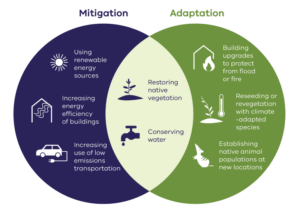
Mitigation–Adaptation Framing Debate
● False Dichotomy: Treating mitigation and adaptation as competing priorities misrepresents climate policy, since unchecked emissions intensify climate impacts and undermine adaptation effectiveness.
● Survey Position: The Economic Survey cautions against diverting scarce fiscal resources towards near-term mitigation, privileging health, agriculture, and poverty reduction.
● Conceptual Gap: This approach underestimates mitigation as a development efficiency tool, not merely an environmental add-on. It also overlooks the role of environmental clearances in ensuring sustainable development.
● Risk Escalation: Failure in mitigation accelerates climate risks, raising long-term adaptation costs beyond fiscal capacity. This aligns with the precautionary principle in environmental law.
● Policy Clarity: Climate action requires integrated strategies, not compartmentalized mitigation-versus-adaptation narratives. This includes considering environmental impact assessments in development planning.
Understanding Climate Action Framework: |
| ● Mitigation |
| ○ Refers to actions aimed at reducing greenhouse gas (GHG) emissions or enhancing carbon sinks such as forests and oceans. |
| ○ Includes measures like renewable energy expansion, energy efficiency, afforestation, and low-carbon technologies. |
| ○ Mitigation addresses the root cause of climate change and is crucial for limiting global temperature rise in line with the Paris Agreement targets. |
| ● Adaptation |
| ○ Involves adjustments in natural, social, and economic systems to minimize damage from climate impacts. |
| ○ Examples include climate-resilient agriculture, flood-resistant infrastructure, coastal protection, and early warning systems. |
| ○ Adaptation is particularly vital for developing countries, which are more vulnerable despite contributing less to global emissions. |
| ● Resilience |
| ○ Denotes the capacity of communities, ecosystems, and economies to absorb shocks and recover from climate stresses. |
| ○ Focuses on preparedness, flexibility, and recovery, rather than just prevention. |
| ○ Enhancing resilience strengthens long-term sustainable development and disaster risk reduction. |
| ● Per-Capita Emissions |
| ○ Measures average emissions per person, highlighting disparities between developed and developing nations. |
| ○ Forms a key basis for equity-based climate negotiations and responsibility sharing. |
| ● Climate Justice |
| ○ Emphasizes fairness in climate action, balancing historical responsibility, current capability, and development needs. |
| ○ Supports principles like Common But Differentiated Responsibilities (CBDR) to ensure inclusive and just climate governance. |
Mitigation As Development Strategy
● Cost Efficiency: Emission reduction is often more cost-effective than ex-post adaptation to intensified climate disasters. This aligns with the polluter pays principle in environmental law.
● Infrastructure Timing: India’s greenfield infrastructure stage offers opportunities to embed low-carbon pathways early, considering environmental clearances and impact assessments.
● Growth Synergies: Clean energy, efficiency, and electrification support productivity and energy security, while adhering to environmental regulations like the Coastal Regulation Zone.
● Technology Learning: Global mitigation experiences provide transferable lessons for scaling decarbonisation rapidly, informed by environmental jurisprudence.
● Strategic Choice: Mitigation aligns with long-term competitiveness, similar to industrialisation-driven growth strategies, while respecting environmental democracy principles.
India’s Emissions And Global Standing
● Rising Emissions: India is the third-largest greenhouse gas emitter and may become second-largest by mid-2030s, highlighting the need for robust environmental impact assessments.
● Economic Scale: With India poised to be among the world’s largest economies, mitigation responsibility inevitably rises, necessitating stronger environmental clearance processes.
● Equity Argument: Low per-capita emissions remain relevant but weaken as income levels and consumption rise, challenging traditional environmental jurisprudence.
● Future Exposure: Non-poor Indian populations may soon exhibit emissions comparable to developed economies, requiring a reevaluation of environmental policies.
● Credibility Stakes: Sustained mitigation is essential for maintaining international climate leadership, supported by progressive environmental legislation like the Forest Conservation Act.
Adaptation Needs And Environmental Stress
● Immediate Risks: India faces severe air pollution, water stress, plastic pollution, and heat extremes requiring urgent adaptation and stricter environmental clearances.
● Vulnerability Mapping: Effective adaptation demands identification of climate risks, exposed populations, and region-specific impacts, informed by environmental impact assessments.
● Resilience Building: Investments in health systems, water security, and urban planning strengthen climate resilience, while adhering to Coastal Regulation Zone guidelines.
● Outcome Orientation: Adaptation should prioritize measurable resilience outcomes, not generic development spending, guided by environmental jurisprudence.
● Reporting Gap: Regular public reporting on adaptation progress enhances accountability and learning, supporting environmental democracy principles.
Poverty, Equity And Climate Policy
● Persistent Poverty: Using lower-middle-income thresholds, nearly one-fourth of India’s population remains poor, emphasizing the need for equitable environmental policies.
● Distributional Lens: Climate strategies must address uneven exposure and adaptive capacity across income groups, considering environmental justice principles.
● Just Transition: Mitigation pathways should safeguard livelihoods and energy access for vulnerable communities, in line with the precautionary principle.
● Selective Comparisons: Comparing per-capita emissions of non-poor Indians with developed-world peers reveals emerging equity challenges in environmental governance.
● Balanced Approach: Equity strengthens, rather than weakens, the case for integrated climate action, supported by comprehensive environmental impact assessments.
Critique Of Selective Global Comparisons
● Context Misuse: Highlighting mitigation slowdowns in Europe ignores differences in infrastructure maturity and consumption patterns, as well as varying environmental clearance processes.
● Learning Bias: Global lessons should be adapted, not selectively invoked to justify lower ambition, considering evolving environmental jurisprudence.
● Dynamic Context: India’s aspirational lifestyles necessitate forward-looking mitigation, not backward-looking comparisons, guided by progressive environmental policies.
● Strategic Framing: Defensive climate narratives risk underplaying long-term systemic risks and undermining environmental democracy.
● Policy Consistency: Climate strategy must align short-term realism with long-term transformation goals, supported by robust environmental impact assessments.
Integrating Mitigation, Adaptation And Resilience
● Systemic Approach: Climate action must embed mitigation, adaptation, and resilience across all sectors of the economy, guided by comprehensive environmental clearances.
● Co-Benefits: Mitigation delivers air-quality, health, and energy-security gains alongside emission reduction, aligning with the polluter pays principle.
● Resilience Synergy: Adaptation strengthens the effectiveness of mitigation investments under changing climate conditions, supported by the Forest Conservation Act.
● Monitoring Commitments: Tracking progress on international commitments ensures policy credibility, enhancing environmental democracy.
● National Context: Strategies must be tailored to India’s development stage while preparing for an altered climate future, considering landmark rulings like the Vanashakti judgment.
STATIC TOPIC: Climate Policy Framework
● Mitigation: Actions to reduce or limit greenhouse gas emissions, guided by environmental impact assessments.
● Adaptation: Measures to reduce vulnerability to climate impacts, considering Coastal Regulation Zone guidelines.
● Resilience: Capacity of systems to absorb shocks and recover, supported by environmental jurisprudence.
● Per-Capita Emissions: Average emissions per person, often used in equity debates and environmental policy discussions.
● Climate Equity: Principle that responsibilities vary by development level and capacity, reflected in environmental clearance processes.
CONCLUSION:
India does not face a trade-off between climate mitigation and adaptation. Both are mutually reinforcing pillars of sustainable development. While adaptation is vital for immediate vulnerabilities, sustained mitigation is indispensable for limiting future risks and safeguarding growth. An integrated, equity-sensitive climate strategy is essential for India’s long-term resilience and global credibility, supported by robust environmental clearance processes, impact assessments, and jurisprudence that upholds the principles of environmental democracy and justice.
Source: Mint
MAINS PRACTICE QUESTION:
“The framing of climate action as a choice between mitigation and adaptation is misleading.” Critically examine this statement in the context of India’s development priorities, emission trajectory, and vulnerability to climate change, considering recent developments in environmental jurisprudence and policy frameworks.