







INDIA’S NEXT INDUSTRIAL SHIFT — ELECTRONS OVER MOLECULES
Why in the News?
● The global energy transition debate is shifting from renewable capacity addition to industrial electrification.
● China’s manufacturing dominance and green industrial policy have renewed focus on electricity-led competitiveness.
● India’s clean energy goals and export ambitions have sparked discussion on accelerating industrial electrification to remain globally competitive, while also considering environmental clearance processes.
From Fossil Fuels to Electrified Competitiveness
● For over a century, global industry relied on “molecules” — coal, oil and gas — to power factories, transport and kilns.
● This era is giving way to one where economic competitiveness is driven by “electrons”: clean, reliable electricity.
● Countries that transition faster from fossil fuels to electrification gain advantages in emissions reduction, supply chains, capital inflows and job creation, while also navigating environmental impact assessments.
● China has established a clear lead by not only expanding renewable capacity but restructuring industrial processes to operate on grid electricity, often streamlining environmental clearances in the process.
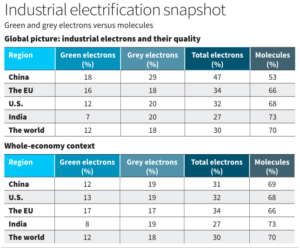
● By 2024, nearly half of China’s industrial energy consumption was electricity-based.
● In contrast, electricity accounts for only about one-quarter of India’s industrial energy use.
● This disparity weakens India’s export competitiveness and increases vulnerability to global fuel price shocks, while also raising questions about environmental jurisprudence in industrial development.
Why Electrons vs Molecules Is the Right Lens
Nature of energy use
○ Molecules (coal, oil, gas, LPG, biofuels) are burnt directly in engines, boilers and furnaces.
○ Electrons are supplied through the electricity grid to power machines and processes.
○ Coal has already shifted from on-site combustion to centralised power generation, signalling the broader move toward electrification and potentially simplifying environmental clearance processes.
Industrial transformation through electrification
○ Higher use of electricity enables greater automation and precision in industrial processes.
○ Electrified systems offer superior process control and are easier to decarbonise over time, aligning with the precautionary principle in environmental management.
Efficiency advantage
○ Electric motors convert over 90% of input energy into useful work.
○ Internal combustion engines typically convert less than 35%.
○ Hence, even small increases in electrification displace disproportionately large amounts of fossil fuel use, supporting the polluter pays principle.
Global comparison of industrial electrification
○ China derives nearly half of its industrial energy from electricity and has the highest share of green electrons.
○ The United States and the global average stand at around 12%.
○ India lags further at just 7%, remaining heavily molecule-dependent, which may require a reevaluation of environmental democracy in industrial policy.
Strategic intent and competitiveness
○ At the overall economy level, China, the U.S. and the EU are all around one-third electrified.
○ China, however, deliberately channels a much larger share of electrons into industry.
○ As the world’s manufacturing hub, China prioritises reliable and increasingly clean power for factories.
○ This strengthens export competitiveness as global markets place growing emphasis on carbon intensity and environmental jurisprudence.
China’s Transformation
China’s Electron-First Industrial Playbook
● China first built a strong electricity grid and then redesigned industry to run on electrons.
● Since 2010, massive investment has gone into power generation, ultra-high-voltage transmission, flexible substations and grid-scale storage.
● This created a structural shift toward electricity across industrial sectors, often facilitated by streamlined environmental clearance processes.
Sectoral Shifts in China
● Steel: Electric Arc Furnace (EAF) steel output rose from ~44 million tonnes (2010) to ~106 million tonnes (2024).
○ Though EAFs account for only ~15% of total output, growth has been policy-driven via scrap recycling and preferential tariffs.
● Cement: Electrification of grinding mills and material handling, combined with digital controls.
○ Waste Heat Recovery (WHR) systems contribute 30–35 kWh per tonne.
○ Calcination emissions persist, making CCUS pilots essential.
● Core lesson: Electrify all processes that can be electrified today; use molecules only where no alternative exists.
India’s Starting Line
● India has doubled grid capacity in a decade and leads globally in annual solar additions, navigating complex environmental impact assessments.
● Yet, electricity accounts for only ~25% of industrial energy use.
● Green electrons form just 7–8% of final energy consumption.
Reasons for India’s Lag
● Legacy dependence on on-site combustion locks industries into molecule use.
● Uneven power quality and reliability discourage all-electric industrial design.
● Policy emphasis remains skewed toward generation rather than industrial electrification, with environmental clearances often seen as hurdles.
Roadmap for an Electron-First Industrial Decade in India
● Steel:
○ India already produces ~30% of steel via EAFs (vs ~70% in the U.S.).
○ Improving scrap collection, standardisation and trading platforms can rapidly raise this share.
○ Renewable-linked EAF incentives are critical, especially with the EU’s CBAM targeting steel.
● Cement:
○ Support pilots for electrified kilns, large-scale WHR and CCUS hubs.
○ Aim for a 20% reduction in molecule use per tonne this decade while preparing CCUS infrastructure.
● MSMEs:
○ Most rely on coal boilers and diesel gensets.
○ Transition needs concessional finance for electric boilers and induction furnaces, pooled renewable PPAs, and technical assistance.
● Digitalisation:
○ Embed advanced controls in new industrial clusters.
○ Enables demand response, reduces power waste, and generates auditable carbon data for global buyers.
Why This Matters Beyond Climate
- Competitiveness: Low-carbon manufacturing increasingly determines access to global markets.
- Energy Security: Electrification reduces exposure to imported oil and gas price shocks.
- Sovereignty: Industry location depends on skills and logistics, not fuel availability.
The New Industrial Race
● The global contest is no longer just electrons versus molecules, but green electrons versus grey electrons.
● China has moved with clear strategic intent. While its economy-wide electrification (~31%) is similar to the U.S. (~32%) and the EU (~34%), it has prioritised industrial electrification.
● Nearly half of China’s industrial energy comes from electricity, with a higher share of green electrons than its peers.
● This deliberate design gives China a durable edge in manufacturing competitiveness.
● India must internalise this lesson.
● Without a rapid expansion of green electrons in industry, India risks CBAM penalties and loss of export markets.
● With timely and bold action, however, India can still seize the initiative.
● Policy focus must shift from merely adding renewable megawatts to ensuring megawatt-hours actually flow into industry.
● India should launch a National Mission on Industrial Electrification, substantially increase annual grid investment, and mandate electrification in new industrial parks, while streamlining environmental clearance processes.
● Targeted and affordable finance for MSMEs is essential to enable the transition.
● The next industrial revolution will be written in electrons, not molecules.
● India must act decisively to ensure it is not left behind, balancing industrial growth with environmental considerations as outlined in the Forest Conservation Act and Coastal Regulation Zone notifications.
Source: https://www.thehindu.com/opinion/lead/indias-next-industrial-shift-electrons-over-molecules/article70588474.ece
Mains Question (250 words):
“The global industrial transition is shifting from molecules to green electrons.” Examine China’s strategy in industrial electrification and critically assess the challenges and opportunities for India in this new competitiveness race, considering both economic and environmental factors.