







IS ASIA-PACIFIC ON TRACK TO ELIMINATE MALARIA BY 2030?
Syllabus:
GS-2: ● Social Sector and services related to Health ● Health and sanitation
Why in the News?
The World Malaria Report 2025 presents mixed signals for the Asia-Pacific region, showing declining malaria cases alongside rising artemisinin resistance and shrinking global financing, raising doubts over achieving the 2030 malaria elimination target, particularly in high-burden and last-mile settings. This situation mirrors challenges in environmental policy, where retrospective environmental clearances often complicate progress.
MALARIA ELIMINATION AND GLOBAL HEALTH SECURITY
Key Points |
| ● Public Health Impact: Malaria elimination strengthens health system resilience, reducing disease burden and emergency response costs, similar to how environmental clearances aim to mitigate long-term ecological impacts. |
| ● Economic Productivity: Lower malaria incidence boosts labour productivity, school attendance, and long-term economic growth, akin to how a pollution-free environment enhances overall societal well-being. |
| ● Equity Dimension: Effective elimination protects marginalised and mobile populations, preventing health inequities, much like environmental democracy aims to ensure equitable access to a clean environment. |
| ● Regional Stability: Cross-border malaria control enhances regional cooperation and shared health security, comparable to transboundary environmental management efforts. |
| ● Sustainable Development: Malaria elimination directly supports SDG-3, poverty reduction, and human capital formation, aligning with broader sustainable development goals that also encompass environmental conservation. |
REGIONAL PROGRESS AND POSITIVE TRENDS
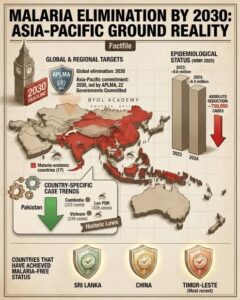
● Encouraging Decline: Asia-Pacific recorded a reduction from 9.6 million to 8.9 million cases, driven by sustained interventions across ten malaria-endemic countries. This progress parallels efforts in environmental protection, where consistent policy implementation yields positive outcomes.
● Country-Specific Gains: Pakistan, Cambodia, Lao PDR, and Vietnam reported major declines, with some achieving historic lows, reflecting effective surveillance and targeted control strategies. Such achievements in health policy mirror successful environmental impact assessments leading to improved ecological outcomes.
● Elimination Successes: Sri Lanka, China, and Timor-Leste demonstrate that malaria elimination is achievable through political commitment, system strengthening, and uninterrupted programme delivery. This success story is reminiscent of landmark environmental jurisprudence that has led to significant conservation victories.
● Drug Resistance Leadership: The Greater Mekong Subregion’s containment of antimalarial resistance highlights the value of regional coordination and early warning systems, similar to collaborative efforts in managing cross-border environmental challenges.
● Political Platform: The Asia Pacific Leaders Malaria Alliance (APLMA) unites 22 governments, reinforcing shared accountability and political momentum toward elimination goals, akin to international environmental agreements.
UNEQUAL PROGRESS AND STRUCTURAL BOTTLENECKS
● Uneven Outcomes: Despite regional gains, malaria control progress remains highly uneven, with resurgence observed in larger, complex, high-burden geographies. This situation mirrors the challenges of implementing uniform environmental policies across diverse ecosystems.
● Plateauing Trends: Several countries exhibit stagnation after initial success, indicating difficulties in transitioning from control to elimination phases. This parallels the challenges in environmental policy where initial gains in pollution control may plateau without sustained efforts.
● Last-Mile Challenge: Mobile populations, remote regions, and fragile health systems continue to impede effective delivery of interventions at community level, similar to the difficulties in implementing environmental regulations in remote or economically challenged areas.
● Programme Fatigue: Sustained elimination efforts face operational complacency, risking resurgence when political attention and monitoring intensity decline. This is comparable to the challenges in maintaining long-term environmental conservation efforts.
● System Complexity: Elimination requires precision surveillance and rapid response, far more demanding than conventional burden-reduction strategies. This complexity is akin to the intricate monitoring required for effective environmental protection under the Coastal Regulation Zone norms.
INDIA’S ELIMINATION AMBITION: OPPORTUNITIES AND RISKS
● Ambitious Target: India aims for zero indigenous malaria cases by 2027, positioning itself ahead of the global 2030 elimination deadline. This ambitious goal is reminiscent of India’s commitments to environmental targets under international agreements.
● Demonstrated Success: Since 2015, India achieved steep reductions in cases and deaths, with multiple districts sustaining zero transmission for consecutive years. This progress parallels improvements in environmental quality achieved through stringent policy implementation.
● Proof-of-Concept: Indigenous elimination projects validate that technical feasibility and institutional capacity for malaria elimination already exist, similar to successful pilot projects in environmental conservation.
● Warning Signals: Recent data shows plateauing progress and localised rebounds, indicating India is off the ideal elimination trajectory. This situation is analogous to challenges in maintaining environmental gains, where progress can be fragile without consistent enforcement.
● Hotspot Concentration: Five States and the Northeast account for nearly 80% of malaria burden, necessitating sharply focused interventions. This concentration of challenges mirrors environmental hotspots that require targeted conservation efforts.
THREE SHIFTS REQUIRED FOR ELIMINATION
● Surveillance Transformation: India requires real-time, case-based surveillance, integrating private sector, defence services, railways, and urban health systems. This comprehensive approach is similar to the holistic view required in environmental impact assessments.
● Targeted Execution: High-burden States need project-mode execution, while near-elimination regions must invest aggressively in resurgence prevention mechanisms. This dual approach is comparable to differentiated strategies in environmental management for polluted vs. pristine areas.
● Mission-Mode Governance: Malaria elimination must be treated as a time-bound national mission, with clear accountability, financing continuity, and outcome monitoring. This approach echoes the need for robust environmental governance structures.
● Operational Discipline: Elimination success hinges on consistent last-mile delivery, not merely policy intent or aggregate funding commitments. This principle aligns with the importance of ground-level implementation in environmental protection efforts.
● Inter-sectoral Coordination: Health systems must synchronise surveillance, treatment, vector control, and migration tracking for rapid containment. This multi-faceted approach mirrors the inter-departmental coordination required for effective environmental management.
VACCINES AND DRUG RESISTANCE MANAGEMENT
● Vaccine Breakthrough: RTS,S and R21 malaria vaccines mark a historic advance, demonstrating significant reductions in severe malaria and child mortality. This medical breakthrough is as significant as innovations in environmental technology for pollution control.
● Regional Adaptation: Asia-Pacific countries are evaluating targeted vaccine deployment to complement existing control tools rather than universal rollout. This strategic approach is similar to tailored environmental solutions based on local ecological needs.
● Resistance Threat: Artemisinin resistance, though not yet established in India, remains a strategic global threat to malaria elimination. This evolving challenge is comparable to emerging environmental threats that require proactive management.
● Indian Safeguards: India strengthened therapeutic efficacy studies, pharmacovigilance, and treatment protocol updates to preserve drug effectiveness. These measures parallel the ongoing refinement of environmental regulations to address new challenges.
● Collective Action: Resistance management demands cross-border coordination, as drug resistance cannot be contained within national boundaries. This need for international cooperation echoes global environmental challenges that require collective action.
FUNDING CONSTRAINTS AND ELIMINATION RISKS
● Financing Gap: Only 42% of global malaria financing needs were met in 2024, with further cuts widening gaps in 2025. This funding shortfall is reminiscent of the challenges in financing comprehensive environmental protection measures.
● Elimination Paradox: Funding declines precisely when programmes enter the most expensive and operationally demanding elimination phase. This paradox is similar to the challenges in sustaining environmental conservation efforts after initial successes.
● High-Risk Populations: Migrant workers and remote communities face disproportionate risk due to reduced outreach and service withdrawal. This vulnerability parallels the disproportionate impact of environmental degradation on marginalized communities.
● Domestic Responsibility: National governments must increase domestic financing, as international aid alone can no longer sustain elimination efforts. This shift in funding responsibility is akin to the growing emphasis on national commitments in global environmental agreements.
● Economic Logic: Every dollar invested in elimination yields multiple economic returns, while underinvestment causes costly resurgence and emergency responses. This economic rationale aligns with the precautionary principle in environmental management, where prevention is more cost-effective than remediation.
CONCLUSION:
The Asia-Pacific region has demonstrated that malaria elimination is technically achievable, yet uneven progress, funding shortfalls, and operational challenges threaten the 2030 target. Sustained political commitment, domestic financing leadership, precision surveillance, and regional coordination are essential to convert recent gains into irreversible elimination success. This journey towards malaria elimination shares many parallels with environmental conservation efforts, both requiring consistent policy implementation, cross-sector collaboration, and a long-term vision for sustainable development.
SOURCE:TH
MAINS PRACTICE QUESTION
“Despite notable progress, malaria elimination in the Asia-Pacific region faces significant challenges.” Discuss with reference to financing, drug resistance, and last-mile implementation, drawing parallels with challenges in environmental policy implementation.