







BUILDING ON RURAL ROADS: PMGSY AT 25
Syllabus:
GS-2: ● Welfare schemes for the vulnerable section of population
Why in the News?
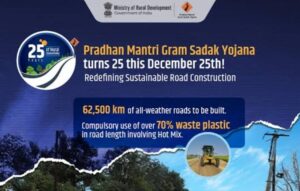
Twenty-five years after the launch of the Pradhan Mantri Gram Sadak Yojana (PMGSY), India’s flagship rural connectivity programme has reached maturity. With most sanctioned roads completed, the policy challenge now lies in maintenance, quality assurance, accountability, and converting infrastructure investments into durable developmental outcomes for rural India. This progress, however, must be balanced with environmental considerations, including the need for environmental clearances and impact assessments for road projects.
RURAL INFRASTRUCTURE AND INCLUSIVE GROWTH
- Growth Multiplier: Rural roads function as economic multipliers, stimulating productivity across agriculture, services, and labour markets.
- Equity Instrument: Connectivity reduces spatial and regional inequality, integrating peripheral areas into national growth trajectories.
- Human Capital Link: Infrastructure access enhances education, health, skill acquisition, and labour mobility outcomes.
- State Capacity Signal: Effective delivery reflects governance quality, coordination, and administrative capability.
- Sustainability Imperative: Long-term impact depends on maintenance, climate resilience, and construction quality, as well as adherence to environmental regulations like the Forest Conservation Act and Coastal Regulation Zone norms.
ORIGINS AND DEVELOPMENTAL RATIONALE
- Structural Isolation: Prior to PMGSY, nearly half of India’s villages lacked all-weather roads, restricting access to markets, schools, healthcare facilities, employment opportunities, and basic administrative services.
- Inclusive Vision: PMGSY conceptualised rural road connectivity as foundational infrastructure, essential for integrating isolated rural populations into national economic, social, and political systems.
- Phased Rollout: The programme followed a population-based prioritisation strategy, with relaxed thresholds for tribal, hilly, and backward regions to ensure equity.
- Fiscal Commitment: With cumulative expenditure nearing ₹3.96 lakh crore, PMGSY represents one of India’s most ambitious and resource-intensive rural infrastructure initiatives.
- Last-Mile Focus: Phase-III reflects a strategic pivot toward upgrading, repairing, and consolidating existing rural roads, rather than merely expanding network length.
ECONOMIC TRANSFORMATION EFFECTS
- Employment Expansion: Empirical studies show PMGSY roads significantly increased non-agricultural employment, enabling rural workers to access construction, services, logistics, and informal manufacturing opportunities.
- Market Integration: Improved connectivity reduced farm-to-market transaction costs, narrowing price dispersion between villages and urban centres while improving farmer bargaining power.
- Enterprise Growth: Road access strengthened rural MSMEs and informal enterprises, facilitating scale expansion, input sourcing, market reach, and productivity improvements.
- Agricultural Modernisation: Connectivity enabled adoption of modern farm inputs, mechanisation, extension services, and timely access to credit and storage facilities.
- Consumption Diversity: Research links PMGSY roads to more diversified household consumption baskets, including improved access to nutritious food items and essential consumer goods.
SOCIAL AND HUMAN DEVELOPMENT GAINS
- Educational Access: All-weather roads increased school enrolment, attendance, and retention, particularly among girls, by reducing travel time and seasonal disruptions.
- Healthcare Reach: Improved road connectivity enhanced maternal health outcomes, emergency medical access, and routine healthcare utilisation, especially in remote villages.
- Women’s Mobility: Roads expanded women’s physical mobility, enabling labour participation, access to education, healthcare services, and social institutions.
- Normative Shifts: Infrastructure access contributed to gradual changes in gender norms, influencing attitudes toward girls’ education, employment, and autonomy.
- Social Integration: Roads strengthened rural–urban linkages, promoting social inclusion, information flows, and participation in broader economic networks.
IMPLEMENTATION AND QUALITY DEFICITS
- Construction Gaps: Independent audits reveal roads listed as completed often remain unfinished or poorly constructed, undermining official performance assessments. This highlights the need for rigorous environmental impact assessments and ex-post facto environmental clearances in some cases.
- Rapid Degradation: Inadequate maintenance leads to premature deterioration, particularly in high-rainfall and flood-prone regions, raising concerns about environmental sustainability.
- Material Weaknesses: Use of substandard construction materials and weak technical supervision continues to compromise long-term road durability, potentially violating the polluter pays principle.
- Political Interference: Allegations of clientelism in tendering and contract allocation weaken competition, transparency, and construction quality, undermining environmental democracy.
- Monitoring Limits: Excessive focus on kilometres built and funds spent obscures actual usability, safety, and seasonal functionality, as well as potential environmental impacts.
SHIFT FROM BUILDING TO SUSTAINING
- Maintenance Priority: PMGSY must transition from a build-and-forget approach toward systematic lifecycle-based road asset management, incorporating environmental jurisprudence principles.
- Dedicated Funding: Ring-fenced and predictable maintenance financing mechanisms are essential to prevent asset erosion and ensure compliance with environmental norms.
- Clear Ownership: Clearly defined institutional responsibility for inspection, repair, and maintenance can improve accountability outcomes and adherence to environmental regulations.
- Digital Oversight: Geo-tagging, GPS monitoring, satellite imagery, and digital dashboards can strengthen transparency and reduce false reporting, including for environmental compliance.
- Community Monitoring: Involving local communities enhances social accountability, early damage detection, and asset longevity, while also promoting environmental stewardship.
RETHINKING METRICS AND GOVERNANCE
- Outcome Orientation: Programme success should be measured through year-round usability, safety, and reliability, not merely construction outputs, while also considering environmental impacts.
- Impact Indicators: Evaluation must assess school access, healthcare reach, market participation, and income mobility, alongside environmental sustainability metrics.
- Independent Audits: Regular third-party technical and financial audits can deter inflated reporting and improve execution standards, including compliance with environmental clearances.
- Data Transparency: Public disclosure platforms strengthen citizen oversight and institutional credibility, fostering environmental democracy.
- Adaptive Governance: Continuous feedback loops enable course correction, learning, and policy refinement, including the integration of environmental considerations like the precautionary principle.
CONCLUSION
PMGSY has transformed rural India by converting isolation into opportunity. Yet, infrastructure gains risk erosion without sustained maintenance, accountability, and outcome-focused governance. The next phase must consolidate achievements, prioritise durability, and ensure that rural roads remain reliable conduits of inclusion, mobility, and long-term development. This evolution should also incorporate environmental considerations, balancing development needs with the imperative of a pollution-free environment and sustainable growth.
SOURCE: HT
MAINS PRACTICE QUESTION
“Rural road connectivity is a catalyst for inclusive growth rather than a mere infrastructure intervention.” Critically examine the achievements and limitations of the Pradhan Mantri Gram Sadak Yojana, considering both developmental impacts and environmental concerns.