







Human Capital for 2047
Syllabus
GS 2: Health
Why in the News?
Recently, policymakers and experts have highlighted that India’s ambition of becoming a developed nation by 2047 lacks a clear and integrated roadmap for early childhood care and development, despite strong evidence linking ECCD with long-term economic growth. This situation is reminiscent of the challenges faced in obtaining environmental clearances for development projects, where the absence of a comprehensive framework can hinder progress.
Introduction
- India’s dream of becoming a Viksit Bharat and a $30 trillion economy by 2047 is ambitious and inspiring.
- However, such transformation cannot rely only on infrastructure or growth numbers.
- It requires sustained investment in human capital, especially during early childhood, when lifelong development and productivity are shaped. This approach is similar to the precautionary principle applied in environmental jurisprudence, where preventive measures are taken to avoid potential harm.
Viksit Bharat and the Missing Human Capital Link
- India aims to become a developed nation and a $30 trillion economy by the year 2047.
- This goal is widely discussed through macroeconomic targets, infrastructure expansion, manufacturing growth, and digital innovation.
- Public discourse often highlights ease of doing business, industrial corridors, startups, and global competitiveness.
- Health and education are also mentioned, but mostly as separate policy sectors.
- A critical missing element is a clear, systematic, and long-term roadmap for early childhood care and development, akin to the need for comprehensive environmental impact assessments in development projects.
- Without strengthening the earliest foundations of human development, economic ambitions rest on fragile ground.
- Human capital is not built at adulthood but shaped from the earliest years of life, much like how environmental conservation efforts must begin early to be effective.
Understanding Early Childhood Care and Development (ECCD)
Why the First 3,000 Days Matter
- Early childhood care and development covers the period from conception to eight years of age.
- The first 1,000 days, from conception to a child’s second birthday, are the most critical phase.
- The World Health Organization and UNICEF recognise this period as a unique window of opportunity.
- The next six years, roughly another 2,000 days, further consolidate development outcomes.
- Together, the first 3,000 days shape brain architecture, physical health, emotional regulation, and social skills.
- Nearly 80 to 85 percent of brain development occurs during the first 1,000 days.
- Neural connections formed during this phase determine lifelong learning capacity and adaptability.
ECCD as an Economic Investment, Not Welfare
- Investment in early childhood is often wrongly viewed as a welfare or social sector expense.
- In reality, ECCD is a strategic economic investment with very high long-term returns, similar to how environmental clearances, though sometimes seen as obstacles, ultimately contribute to sustainable development.
- Children who receive proper nutrition, care, and stimulation perform better in education and skill acquisition.
- Such children are more likely to join the workforce productively and earn higher incomes.
- At the national level, ECCD reduces future spending on healthcare, remedial education, and social protection.
- A healthier and skilled workforce expands the tax base and strengthens fiscal sustainability.
- ECCD investments also reduce inequality caused by poverty, gender, and regional disadvantage.
Global Evidence Supporting ECCD Investments
- Several countries demonstrate the long-term benefits of early childhood investment.
- The United States has documented higher lifetime earnings among children receiving early interventions.
- Nordic countries, particularly Finland, have built strong ECCD systems linked to social mobility.
- South Korea invested heavily in early childhood as part of its human capital strategy.
- These investments delivered results over decades, not immediately.
- ECCD benefits usually appear after 10 to 20 years, when children enter adulthood.
- Once realised, these benefits are durable, intergenerational, and enhance national competitiveness.
India’s Progress in Child Survival and Nutrition
Achievements Over Five Decades
- India has made notable progress in child and newborn survival over the past fifty years.
- The Child Survival and Safe Motherhood initiative began in 1992.
- The Reproductive and Child Health programme followed in 1997.
- These programmes were later consolidated under the National Health Mission.
- They significantly reduced infant and under-five mortality rates.
- Immunisation coverage improved, and severe malnutrition was addressed.
- The Integrated Child Development Services programme began in 1975.
Role of ICDS and POSHAN Initiatives
- ICDS laid the foundation for nutrition and early care among poorer households.
- It was later restructured as Mission Saksham Anganwadi and POSHAN 2.0.
- State governments also introduced innovations and improved delivery systems.
- These efforts were essential in keeping children alive and improving survival outcomes.
- However, survival alone does not guarantee full development.
Limitations of India’s Current ECCD Approach
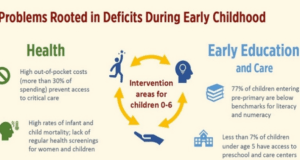
- Most ECCD interventions in India remain fragmented and narrowly focused, similar to how environmental clearances are often handled in a piecemeal manner.
- The primary emphasis has been on survival, not developmental potential.
- Cognitive, emotional, and social development receive limited attention.
- ECCD initiatives are largely targeted at poor households.
- Middle- and higher-income families are mostly excluded from structured support.
- This exclusion is problematic because developmental challenges affect all income groups.
- Urban children increasingly face obesity, inactivity, excessive screen exposure, and emotional difficulties.
- Early childhood development must therefore be universal, not targeted.
Scientific Case for Early Intervention
- Advances in neuroscience and epigenetics strongly support early interventions.
- Health, nutrition, and stress even before conception influence gene expression.
- Parental obesity, substance use, poor nutrition, and chronic stress raise child health risks.
- These factors increase vulnerability to non-communicable diseases and developmental delays.
- Neglect during the first 1,000 days often leads to irreversible damage, much like how ex post facto environmental clearances cannot undo ecological harm.
- Yet, formal interventions usually begin only after 30 to 36 months.
- This creates a major missing window in child development support.
The Digital Age and Parenting Challenges
- Infants and toddlers spend most of their early years within families.
- Interaction with formal systems is limited to immunisation and illness care.
- In the digital age, parents often rely on social media for parenting advice.
- Much online information is commercial, unverified, or poorly informed.
- Structured guidance on early stimulation and responsive caregiving remains scarce.
- Anganwadi’s and preschools, though important, enter too late in a child’s life.
Towards an Integrated ECCD Framework
Key Policy Directions
- India must move beyond feeding programmes and fragmented school health services.
- A comprehensive ECCD framework is required from conception to eight years, similar to how the Forest Conservation Act provides a holistic approach to environmental protection.
- Health, nutrition, early learning, emotional wellbeing, and caregiving must be integrated.
- For a nation aspiring to leadership, early childhood investment is foundational.
Priority Interventions
- Structured premarital and pre-conception counselling should be introduced nationwide.
- This should focus on nutrition, mental health, lifestyle choices, and intergenerational impacts.
- Parents must be empowered with knowledge about early stimulation and caregiving.
- Simple activities like talking, singing, reading, and playing shape brain development.
- Stories can be read to babies as young as four weeks to strengthen neural connections.
- Families should be trained to monitor growth and developmental milestones.
- Early detection of delays is among the most cost-effective interventions.
Reforming Care and Learning Systems
- India must invest more in quality care systems for children aged two to five.
- This phase prevents undernutrition, obesity, and poor emotional regulation.
- Education, health, and nutrition systems must break out of silos.
- Children need learning, not just schooling.
- Nutrition must focus on lifelong health, not only calorie intake.
- Schools should evolve into integrated hubs for learning, health, and nutrition.
Building a Nationwide ECCD Movement
- Preconception health and early childhood must become part of public conversation.
- Teachers need training in child development beyond academic instruction.
- Parents should be engaged as partners in children’s development.
- Non-profits, philanthropies, and CSR initiatives must support ECCD ecosystems.
- Effective coordination is needed among Health, Education, and Women and Child Development Ministries.
- ECCD can be formalised as a national mission or inter-ministerial plan, similar to how the Coastal Regulation Zone notification provides a framework for coastal development.
Conclusion
India’s development future depends on investments made during the earliest years of life. By prioritising integrated early childhood care and development, India can build resilient human capital, reduce inequality, and secure sustainable economic growth across generations. This approach aligns with the polluter pays principle in environmental law, emphasizing that those responsible for a child’s development must invest in it early to prevent future societal costs.
Source
The Hindu
Mains Practice Question
Explain why early childhood care and development is critical for India’s long-term economic growth and social mobility, drawing parallels with the importance of environmental impact assessments in sustainable development.