






India–Germany Partnership: Reinforcing Old Ties for New Challenges
Syllabus:
GS-2: Bilateral Groupings & Agreements ,Effect of Policies & Politics of Countries on India’s Interests
Why in the News ?
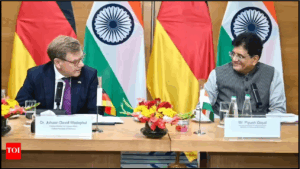
The German Chancellor Friedrich Merz’s first official visit to India marks a significant moment in India–Germany strategic relations, coinciding with 25 years of the Indo-German Strategic Partnership. The visit occurs amid global geopolitical flux, renewed India–EU engagement, and deepening cooperation in trade, technology, defence, and climate action.
Strategic Context: Old Ties, New Global Realities
- India–Germany relationsare anchored in shared commitments to democratic values, multilateralism, and a rules-based international order, offering stability amid global uncertainty.
- The visit takes place during a phase of geopolitical churn, including trade disruptions, security realignments, and stress on global governance institutions.
- Germany and India seek to project an alternative cooperation model, contrasting polarising global blocs with inclusive, sustainable partnerships.
- The relationship has evolved from traditional diplomacy into a comprehensive strategic partnershipspanning trade, technology, climate action, defence, education, and people-to-people ties.
- Merz’s visit also signals continuity and renewal after the silver jubilee (25 years)of the partnership launched in 2000, reinforcing long-term strategic trust.
Acts Involved Indo-German Strategic Partnership :● Indo-German Strategic Partnership: Launched in 2000. ● Intergovernmental Consultations (IGC): Biennial mechanism since 2011. ● Trade Volume: Over $33 billion (2024). ● Services Trade: Approximately $17 billion. ● Make in India Mittelstand Programme: ~€2 billion FDI. ● Green and Sustainable Development Partnership (GSDP): Climate and energy cooperation framework. ● Migration and Mobility Partnership Agreement (MMPA): Facilitates skilled migration and education. ● EU–India Engagement: Ongoing FTA negotiations; EU leadership as Republic Day 2026 Chief Guest. ● Key Sectors: Renewable energy, green hydrogen, AI, defence, manufacturing, education. |
Economic and Trade Pillars of Cooperation :
- Germany is India’s largest trading partner within the EU, with bilateral trade exceeding $33 billion in 2024, reflecting resilient economic ties.
- Trade composition includes machinery, automobiles, chemicals, pharmaceuticals, and a growing services trade valued at $17 billion.
- Germany ranks among the top ten foreign investors in India, contributing capital, technology, and industrial expertise critical for manufacturing diversification.
- Indian firms are expanding their footprint in Germany through acquisitions, R&D centres, and innovation hubs, integrating India more deeply into global value chains.
- Both countries are exploring ways to leverage India’s emergence as a global manufacturing hub, especially for exports to ASEAN and African markets, complemented by German industrial strengths.
Technology, Innovation, and Industrial Collaboration :
- Technology and innovation cooperationhas become a cornerstone of bilateral engagement, supported by research exchanges, industrial partnerships, and institutional frameworks.
- The Make in India Mittelstand Programmehas facilitated technology transfer and SME collaboration, attracting nearly €2 billion in FDI, aiding industrial modernisation.
- Joint efforts aim to nurture innovation ecosystemsthrough start-ups, Global Capability Centres (GCCs), academic collaboration, and applied research.
- Emerging domains such as artificial intelligence, smart cities, digital infrastructure, and Industry 4.0offer new frontiers for collaboration.
- Bengaluru’s inclusion in Merz’s itinerary symbolises the growing technology and innovation nexusbetween the two countries.
Climate Action and Sustainable Development Partnership :
- Environmental sustainability is a shared priority, institutionalised through the Indo-German Green and Sustainable Development Partnership (GSDP).
- Cooperation spans climate action, clean energy, renewable deployment, and sustainable infrastructurealigned with India’s climate commitments.
- Joint initiatives focus on green hydrogen, clean mobility, renewable energy, and urban environmental projectslike metro systems.
- German support has been pivotal in strengthening India’s renewable energy transition, aiding large-scale infrastructure and climate finance.
- The partnership reflects a convergence of interests in achieving net-zero ambitions, resilient urbanisation, and sustainable growth models.
Defence, Security, and Strategic Alignment :
- Defence cooperation, traditionally modest, is gaining traction as part of broader strategic alignment.
- Discussions include potential collaboration in submarine construction, maritime security, and defence manufacturing, though specific contracts remain under negotiation.
- The inclusion of defence issues signals mutual recognition of regional and global security challenges, especially in the Indo-Pacific context.
- Germany’s growing engagement with India’s defence ecosystem complements India’s push for Atmanirbhar Bharat in defence manufacturing.
- Security dialogue underscores trust-building and diversification of partnerships beyond purely economic domains.
People-to-People Ties, Mobility, and Education :
- The Migration and Mobility Partnership Agreement (MMPA)has expanded legal pathways for skilled migration, higher education, and research collaboration.
- The number of Indian students in Germany has grown significantly, addressing skills shortages in German industries while fostering cultural exchange.
- Academic collaboration, vocational training, and professional mobility strengthen human capital linkages.
- People-to-people ties act as a social foundationfor strategic relations, ensuring durability beyond political cycles.
- Educational and research cooperation reinforces mutual understanding and innovation-led growth.
India–Germany Partnership within the Broader EU Framework :
- Indo-German relations are closely embedded within India–EU strategic engagement, which is witnessing renewed momentum.
- The upcoming presence of EU leadership as Chief Guest at India’s Republic Day 2026highlights the deepening India–Europe partnership.
- Enhanced India–Germany trade and investment ties could catalyse progress in long-pending EU–India Free Trade Agreement (FTA) negotiations.
- Germany acts as a bridge between India and Europe, aligning bilateral priorities with broader continental strategies.
- The partnership strengthens Europe’s engagement with the Indo-Pacific while advancing India’s global economic and strategic outreach.
Challenges :
- Global Geopolitical Uncertainty:Trade disruptions, conflicts, and fragmentation challenge long-term economic planning and cooperation.
- Slow Progress in EU–India FTA:Regulatory differences and protectionist tendencies delay broader trade integration.
- Defence Cooperation Constraints:Historical caution and export control regimes limit rapid expansion of defence collaboration.
- Technology Transfer Barriers:Intellectual property concerns and regulatory frameworks can slow deeper industrial integration.
- Climate Finance Gaps:Scaling green projects requires sustained and predictable financing beyond pilot initiatives.
- Skilled Migration Bottlenecks:Language barriers, recognition of qualifications, and administrative hurdles persist.
- Coordination Complexity:Multiple institutional mechanisms sometimes lead to overlaps and slow decision-making.
Way Forward :
- Strategic Dialogue Expansion:Institutionalise regular high-level political engagement beyond IGC frameworks for agility.
- Trade Facilitation:Push sector-specific agreements to complement broader EU–India FTA negotiations.
- Defence Industrial Cooperation:Focus on joint production, co-development, and maritime security collaboration.
- Innovation Ecosystem Deepening:Strengthen joint R&D funding, start-up linkages, and university–industry partnerships.
- Green Finance Mobilisation:Scale up blended finance mechanisms for climate and infrastructure projects.
- Mobility Reforms:Simplify visa regimes, skill recognition, and language training under MMPA.
- Multilateral Coordination:Align positions in global forums on climate, digital governance, and rules-based order.
- Regional Outreach:Jointly leverage India’s manufacturing base and Germany’s technology for ASEAN and Africa.
Conclusion :
In a world marked by instability and fragmentation, the India–Germany strategic partnership offers a stabilising force rooted in shared values, long-term cooperation, and sustainability. Chancellor Merz’s visit reinforces a joint vision for economic resilience, technological progress, and a stronger, inclusive global order.
Source : HT
Mains Practice Question :
“India–Germany relations have evolved into a comprehensive strategic partnership amid global uncertainty.”
Discuss the key pillars of this partnership and evaluate its significance for India’s economic resilience, climate goals, and role in shaping a rules-based international order.