







HIGH-QUALITY EDUCATION NEEDS TRUST BETWEEN STATE AND INSTITUTIONS
Syllabus:
GS-2:
- Issues related to social sectors – Education
- Government Policies and interventions
Why in the News?
India’s higher education landscape is undergoing structural transformation under the National Education Policy (NEP), with regulatory reforms, research funding initiatives, and global engagement reshaping universities. The proposed Viksit Bharat Shiksha Adhishthan Bill, 2025, alongside AI and research investments, has renewed debate on how state–institution trust determines education quality, autonomy, and global competitiveness.
HIGHER EDUCATION IN THE INDIAN CONSTITUTION● Concurrent Subject: Education lies in the Concurrent List, requiring cooperative federalism and alignment between Union policy direction and State-level implementation capacity. ● Autonomy Principle: Constitutional values support institutional autonomy, academic freedom, and diversity, balanced against public accountability and national standards. ● Public Interest: Higher education serves broader goals of social justice, economic development, and democratic citizenship, not merely workforce preparation. ● Regulatory Balance: Excessive centralisation risks undermining federal diversity, while weak regulation compromises quality and equity across institutions. ● Trust Framework: Constitutional governance emphasises trust-based regulation, where institutions innovate responsibly within transparent and predictable rules. |
POLICY-LED TRANSFORMATION IN HIGHER EDUCATION
- Policy Momentum: The National Education Policy has triggered systemic change by promoting flexible degree pathways, multidisciplinary curricula, and outcome-oriented pedagogy, creating momentum for institutional reform and student-centric learning models nationwide.
- State Direction: International experience, including China’s sustained state investment, shows that consistent policy direction combined with funding stability enhances scale, quality, and credibility in higher education ecosystems over time.
- Demographic Imperative: With the world’s largest youth population, India’s higher education outcomes will directly shape economic growth, social mobility, and leadership capacity, making reform urgency both developmental and strategic.
- Curricular Reorientation: Universities are shifting away from narrow specialisations toward holistic education, integrating life skills, apprenticeships, and interdisciplinary exposure to align learning with evolving labour-market realities.
- Public Confidence: Clear policy intent and predictable governance frameworks strengthen public trust in institutions, encouraging students and parents to view Indian universities as credible long-term investments.
RESEARCH ECOSYSTEM AND INNOVATION PUSH
- Institutional Architecture: The creation of the Anusandhan National Research Foundation (ANRF) institutionalises long-term scientific research while encouraging collaboration between universities, industry, and government agencies.
- Dual Funding Track: The ₹1-lakh-crore Research, Development and Innovation (RDI) Scheme complements ANRF by prioritising market-ready innovation, private participation, and translational research outcomes.
- Knowledge Production: Together, ANRF and RDI address India’s historic underinvestment in research by linking basic science, applied research, and commercialisation within a coordinated national framework.
- University Response: Higher education institutions have responded proactively, launching new schools, interdisciplinary centres, and undergraduate research pathways aligned with NEP’s research-led learning vision.
- Innovation Culture: Sustained funding signals reduce risk aversion within institutions, enabling faculty experimentation, doctoral expansion, and industry partnerships, which are essential for global research competitiveness.
INSTITUTIONAL INITIATIVES AND QUALITY GAINS
- Programme Expansion: Leading institutions, including several IIMs, have introduced undergraduate programmes, reflecting a shift toward continuity across education stages rather than isolated elite postgraduate training.
- Student Well-being: Curriculum reforms increasingly incorporate mental health, life skills, and experiential learning, recognising that academic success depends on holistic student development and satisfaction.
- Four-Year Degrees: The rollout of four-year undergraduate programmes, including Honours with Research, strengthens academic depth and global parity while preserving three-year flexibility for diverse learners.
- Global Rankings: India’s presence in QS World University Rankings 2026—with 54 institutions—signals improvement in research output, faculty strength, and international engagement.
- Institutional Capacity: Quality gains reflect investments in governance, faculty recruitment, research infrastructure, and global collaboration, not merely symbolic policy alignment.
GLOBAL MOBILITY AND INTERNATIONALISATION
- Outbound Pressure: Over 25 million Indian students abroad face tightening visa regimes and geopolitical uncertainty, increasing demand for high-quality domestic alternatives.
- Inbound Opportunities: Foreign universities entering India reflect confidence in regulatory reform and market potential, contributing to knowledge exchange and competitive benchmarking.
- Two-Way Globalisation: Indian institutions are also expanding overseas, signalling a shift from student mobility alone toward institutional global presence.
- Quality Imperative: Internationalisation demands strong domestic standards; without credible accreditation and transparency, cross-border expansion risks reputational dilution.
- Strategic Autonomy: Building globally competitive institutions at home reduces dependence on external education systems while strengthening India’s soft power and talent retention.
REGULATORY REFORMS AND SYSTEM CONSOLIDATION
- Fragmentation Challenge: India’s higher education regulation has long suffered from overlapping mandates and institutional silos, constraining multidisciplinary coordination and innovation.
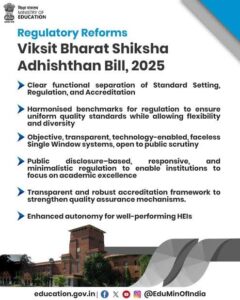
- Proposed Apex Body: The Viksit Bharat Shiksha Adhishthan Bill, 2025 proposes a unified regulatory structure with independent councils for standards, accreditation, and oversight.
- Benchmarking Standards: Consolidation enables consistent quality assurance, public disclosure, and outcome measurement, particularly important with private institutions enrolling two-thirds of students.
- Beyond Silos: Modern economies require interaction between technology, management, sciences, and liberal education, which fragmented regulation previously discouraged.
- Trust Deficit: Regulatory overreach without autonomy risks eroding institutional trust; reform success depends on predictable rules and mutual accountability.
TECHNOLOGY, AI, AND SCIENCE EDUCATION
- AI Integration: Artificial intelligence is reshaping pedagogy, assessment, and administration, demanding context-sensitive adoption rather than uniform technological solutions.
- Indian Advantage: India’s diversity of learners and institutional models positions it to lead inclusive and locally relevant AI applications in education globally.
- Centres of Excellence: The Ministry of Education’s AI Centres in education, health, agriculture, and sustainable cities anchor innovation within national development priorities.
- Science Exposure: Persistent gaps in hands-on science education limit deep-tech talent formation, despite policy emphasis on innovation and start-ups.
- Experiential Learning: Makerspaces, industry linkages, and research-led teaching are essential for cultivating high-calibre scientific and technological human capital.
CONCLUSION
India’s higher education reform has entered a decisive phase where policy clarity, regulatory coherence, and institutional trust must advance together. Expanding enrollment, research, and global engagement will succeed only if the state enables autonomy while enforcing standards. High-quality education ultimately depends on partnership, not control, between government and institutions.
SOURCE:
IE
MAINS PRACTICE QUESTION
“High-quality higher education depends not only on funding and policy reform but also on trust between the State and institutions.” Discuss this statement in the context of the National Education Policy and recent regulatory reforms in India.