
SHANTI BILL AND INDIA’S NUCLEAR TURN
Syllabus:
GS-3: ● Infrastructure : Energy ● Growth and Development
Why in the News?
Parliament has passed the Sustainable Harnessing and Advancement of Nuclear Energy in India (SHANTI) Bill, opening India’s nuclear sector to private participation. The move aims to boost energy security and clean baseload power, but has triggered intense Opposition criticism over liability dilution, safety oversight, transparency, and labour protections.
INDIA’S NUCLEAR LEGAL FRAMEWORK
- Atomic Energy Act, 1962: Established exclusive state control over nuclear materials, facilities, and strategic decision-making.
- Civil Liability Act, 2010: Introduced supplier liability, significantly discouraging foreign participation in India’s civil nuclear sector.
- SHANTI Shift: The new Bill represents a transition from safety-first caution to investment-driven nuclear expansion.
- Global Comparison: Countries like France retain state ownership of nuclear plants despite extensive private supply chains.
- Governance Dilemma: Balancing energy security, public safety, and democratic accountability remains India’s core nuclear policy challenge.
OPENING INDIA’S NUCLEAR SECTOR
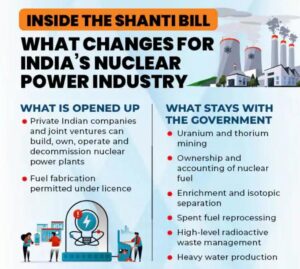
- Structural Shift: The SHANTI Bill marks India’s first decisive move away from a fully state-controlled nuclear sector that has remained unchanged since 1956.
- Private Entry: For the first time, Indian private companies can own, build, and operate nuclear power plants under a regulated public-private partnership model, subject to environmental clearances and compliance with the EIA notification.
- Foreign Participation: While foreign direct investment is not explicitly allowed, foreign suppliers can participate through technology transfers, equipment supply, and joint ventures.
- Ownership Safeguards: Private participation is capped at 49%, ensuring the government retains controlling authority over strategic nuclear operations and decision-making.
- NPCIL Monopoly Ended: The Bill dismantles NPCIL’s exclusive operational monopoly, fundamentally restructuring India’s nuclear power governance and investment landscape.
ROLE AND POWERS OF AERB
- Statutory Authority: The Atomic Energy Regulatory Board is granted statutory status, making it accountable to Parliament rather than functioning solely under executive control.
- Expanded Mandate: AERB oversees nuclear safety, radiation protection, emergency preparedness, and quality assurance across all civilian nuclear installations nationwide.
- Licensing Powers: It issues authorisations covering production, possession, transport, disposal of radioactive material, and establishment, operation, or closure of nuclear facilities. This includes conducting environmental impact assessments for proposed nuclear projects, considering factors like the Forest Conservation Act and Coastal Regulation Zone regulations.
- Private Oversight: With increased private participation, AERB becomes the central institutional pillar ensuring safety compliance and risk mitigation.
- Concentration Concerns: Critics argue that vesting wide regulatory powers in a single authority risks institutional overreach and weakened checks and balances.
LIABILITY REGIME UNDER SHANTI
- Defined Caps: Operator liability is capped at ₹3,000 crore for large plants, ₹1,500 crore for medium plants, and ₹100 crore for Small Modular Reactors.
- State Backstop: The Union government assumes responsibility beyond operator caps through a proposed nuclear liability compensation fund.
- Supplier Immunity: Unlike the 2010 law, the SHANTI Bill completely removes supplier liability, shielding equipment manufacturers and technology providers. This shift away from the polluter pays principle has raised concerns.
- Penalty Ceiling: Criminal penalties for severe safety violations are capped at ₹1 crore, irrespective of the magnitude or long-term impact of damage.
- Investor Certainty: The revised framework prioritises predictable risk allocation and investment confidence over expansive victim compensation mechanisms.
ENERGY SECURITY AND CLIMATE LOGIC
- Baseload Advantage: Nuclear energy provides round-the-clock baseload power, unlike solar and wind, which depend heavily on weather and geographic conditions.
- Coal Dependence: India’s electricity system remains coal-heavy, making nuclear power critical for diversifying the energy mix and reducing emissions intensity.
- Net-Zero Alignment: Expansion of nuclear energy supports India’s net-zero 2070 commitment by delivering reliable, low-carbon electricity at scale, contributing to a pollution-free environment.
- Geopolitical Gains: The Bill may revive stalled civil nuclear agreements with Western partners, reducing excessive dependence on Russian reactors.
- Economic Spillovers: Nuclear expansion boosts advanced manufacturing, skilled employment, research capacity, and long-term technological competitiveness.
INDIA’S NUCLEAR SELF-RELIANCE
- Indigenous Capability: India has mastered Pressurised Heavy Water Reactor technology due to limited domestic uranium availability.
- Closed Fuel Cycle: Domestic expertise exists in spent fuel reprocessing, radioactive waste handling, and material recovery, ensuring strategic autonomy.
- Thorium Strategy: India’s long-term nuclear roadmap is anchored in its vast thorium reserves, unmatched by most nuclear nations.
- Fast Breeder Progress: Operationalisation of fast breeder reactors marks a crucial milestone toward thorium-based nuclear energy deployment.
- Strategic Independence: Despite foreign collaboration, India remains largely self-sufficient in nuclear design, operation, and fuel-cycle management.
OPPOSITION’S CORE OBJECTIONS
- Accountability Dilution: Shifting accident liability from private operators and suppliers to the State undermines the polluter pays principle, critics argue.
- Historical Memory: Comparisons with the Bhopal Gas tragedy fuel fears of corporate evasion of accountability after industrial disasters.
- Inadequate Caps: Liability ceilings ignore inflation, long-term health costs, environmental damage, and livelihood losses from catastrophic nuclear accidents.
- Transparency Rollback: Section 39 overrides the RTI Act, restricting public access to safety data, inspections, and operational details, potentially compromising environmental democracy.
- Labour Exclusion: Section 42 removes nuclear workers from general labour safety laws, triggering opposition from major trade unions.
CONCLUSION:
The SHANTI Bill signals a strategic shift in India’s nuclear energy policy, prioritising investment, energy security, and climate commitments. However, diluted liability, weakened transparency, and labour exclusions risk eroding public trust. Without stronger accountability safeguards and adherence to the precautionary principle, nuclear expansion may provoke social resistance rather than delivering sustainable and legitimate energy security. As India navigates this complex terrain, it must balance economic imperatives with robust environmental jurisprudence to ensure responsible nuclear development, including thorough environmental impact assessments and adherence to environmental clearance processes.
MAINS PRACTICE QUESTION
“The SHANTI Bill marks a paradigm shift in India’s nuclear energy governance.” Critically examine its implications for energy security, safety, liability, and democratic accountability.