
Manipur Crisis: Justice Key For Lasting Peace
Syllabus:
GS Paper – 2: Poverty and Developmental Issues, Communalism, Issues Related to SCs & STs, Issues Related to Minorities, Government Policies & Interventions
GS Paper – 3: North East Insurgency, Pressure Groups
Why in the News?
Prime Minister Narendra Modi’s upcoming visit to Manipur comes amid prolonged ethnic clashes, failed governance, and fragile peace agreements with Kuki-Zo insurgent groups. The editorial stresses that sustainable peace requires justice, trust-building, and equitable development, beyond security-centric solutions, urging attention to governance, local narratives, and community reconciliation in the ongoing Manipur situation. The visit aims to address the complex issues surrounding the Manipur war and find ways to resolve the unrest in Manipur.
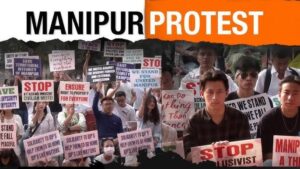
Background of the Manipur Conflict:
- Manipur has endured over two years of ethnic violence primarily between the Meiteis, Kukis, and Nagas.
- The conflict in Manipur ignited after a Manipur High Court decision to include Meiteis in the Scheduled Tribes list, constituting 53% of the state population.
- Subsequent clashes led to mass displacement, killings, and destruction of property, especially targeting the Kuki-Zo community, escalating into what some have termed a Manipur riot.
- The Centre’s response involved Home Minister Amit Shah urging law-and-order restoration but failing to address underlying political grievances.
- The region remained in conflict until President’s Rule was imposed in February 2025, nearly two years after the violence in Manipur began, highlighting the prolonged nature of the situation in Manipur.
Key Insights: Manipur conflict
President’s Rule in Manipur:
- Imposed in February 2025, almost two years after violence began.
- Scheduled Tribes List Inclusion:
- Manipur High Court ruled Meiteis should be included in the ST list in early 2023, sparking unrest.
- Key Insurgent Groups Involved:
- Arambai Tenggol, Meitei Leepun, Kuki National Organisation, United People’s Front.
- Infrastructure Developments Proposed:
- National Highway 02 opening for valley-hill connectivity.
- Important Concepts:
- Free movement as a peacebuilding mechanism.
- Territorial integrity of Manipur as a guiding principle in agreements.
- Justice over security: Foundational for long-term peace.
Political Asymmetry in Manipur’s Governance:
- The 60-member Manipur Legislative Assembly is heavily Meitei-dominated:
- 40 seats were held by Meitei representatives.
- 10 seats by Nagas and 10 by Kukis-Zos.
- This population imbalance has led to governance being valley-centric, ignoring hill districts where Kukis-Zos and Nagas predominantly live.
- The lack of political representation for tribal groups fuels resentment, as Centre’s development funds circulate primarily in the Imphal valley.
- Kuki and Meitei demands for a Separate Autonomous Administration remain unresolved, exacerbating distrust and contributing to ongoing Manipur protests.
Importance of Free Movement for Peacebuilding:
- Free movement of people and goods is essential for restoring normalcy in the Manipur situation.
- Example: In October 2023, relief materials failed to reach Kangpokpi due to unsafe hill roads.
- Alternative routes had to be taken: Dimapur-Kohima-Senapati-Kangpokpi, a long and inefficient process.
- Infrastructure connectivity (e.g., National Highway 02) was part of agreements with insurgent groups to facilitate free movement.
- Still, distrust among communities limits actual implementation, contributing to the ongoing Manipur unrest and hindering efforts to address the insurgency in Manipur.
Security-Centric Agreements: Success or Shortfall?
- The government signed several ceasefire agreements with Kuki National Organisation and United People’s Front.
- These include assurances of territorial integrity of Manipur and political dialogue for long-term peace.
- However, the editorial argues these remain superficial, security-driven pacts without focus on governance, social justice, or development.
- Important questions remain:
- Will these agreements restore normalcy in everyday life?
- Will there be institutional development in hill areas or remain valley-centric?
- The absence of clear institutions in the hills worsens alienation of tribal communities, perpetuating the crisis in Manipur and fueling Manipur clashes.
Need for Justice in Peacebuilding:
- Justice is essential for lasting peace in resolving the Manipur conflict.
- Past violence was fueled by forcible eviction of tribal communities from forests, taking away their livelihood.
- Kuki-Zo communities now live under duress, fearful of returning to their homes.
- The editorial criticizes the labeling of Kuki-Zos as “narco-terrorists” by some Meitei factions, deepening mutual distrust and contributing to the perception that Manipur is burning.
- Without addressing past wrongs and providing restitution, no political agreement can be sustainable.
- Recognition of past grievances, fair compensation, and institutional reforms are essential for reconciliation between Meitei and Kuki communities, including addressing concerns about Meitei militants.
Counter Perspective: “Dear Editor, I Disagree”:
- The counter-view highlights that the High Court’s decision to include Meiteis in the ST list was a legal matter beyond politics.
- The Kuki-Zo resentment intensified due to forced takeover of forests and turning them into state reserves.
- The writer suggests the violence in Manipur arose from deep-rooted historical grievances rather than recent legal decisions alone.
- President’s Rule in February 2025 was too late, seen as a face-saving measure rather than a solution to the Manipur riots.
- The media coverage of atrocities, such as two women being paraded on social media, amplified national outrage about the Manipur situation and highlighted the plight of Manipur victims.
- Ultimately, trust cannot be built unless past wrongs are rectified and narratives of marginalization are acknowledged, including addressing concerns raised by Chief Minister N Biren Singh.
Way Forward:
- Prioritize Justice:
- Conduct fair investigations into ethnic clashes.
- Provide compensation to displaced tribal communities and ensure their right to return home safely.
- Strengthen Governance in Hills:
- Establish elected or nominated hill councils for adequate representation.
- Implement development projects specifically targeting tribal areas, including Churachandpur district.
- Empower Local Institutions:
- Focus on capacity building for local governance bodies in the hills.
- Ensure public service delivery does not remain valley-centric.
- Infrastructure Development:
- Expedite the opening of National Highway 02.
- Improve road safety and transport services in hilly regions.
- Promote Social Integration:
- Launch programs to build trust between Meiteis and Kuki-Zo communities.
- Cultural exchanges, conflict resolution workshops, and joint economic projects.
- Sustained Political Dialogue:
- Engage insurgent groups in political processes, not just ceasefire talks.
- Create time-bound action plans to resolve political grievances.
- Media Sensitivity:
- Avoid sensationalizing ethnic clashes.
- Promote balanced reporting to reduce polarization.
- Early and Proactive President’s Rule:
- In future crises, impose President’s Rule promptly to prevent escalation of violence in Manipur.
- Counter-Insurgency Operations:
- Implement targeted counter-insurgency operations while minimizing civilian impact.
Challenges:
- Deep-rooted Distrust:
- Centuries of ethnic and political marginalization of Kukis and Nagas.
- Labelling insurgent groups as terrorists worsens alienation.
- Lopsided Political Representation:
- Assembly dominated by Meiteis (40/60 seats), while Kukis and Nagas get 10 each.
- Infrastructure Deficit:
- Unsafe hill roads preventing aid delivery or trade.
- Lack of connectivity exacerbates isolation.
- Justice Deficit:
- No credible mechanism for addressing past wrongs.
- Evictions from forests still unresolved.
- Security vs. Development Imbalance:
- Focus remains on ceasefire, not political, social, or economic development.
- No institutional framework to ensure territorial equity.
- Delayed Administrative Action:
- President’s Rule imposed too late, failing to halt violence in Manipur early.
- Media’s Role:
- Sensational reporting fuels polarization and hatred.
- Autonomous District Councils:
- Need for strengthening and empowering autonomous district councils to address local governance issues.
- Refugee Concerns:
- Addressing the influx of Chin refugees and their impact on local demographics and resources.
Conclusion:
Justice is the foundation of sustainable peace in Manipur. Political agreements and security measures alone cannot heal the scars of ethnic clashes. An integrated approach combining equitable development, institutional reforms, historical grievance redressal, and inclusive governance is essential for restoring trust and paving the way for lasting harmony in the Manipur situation. Successful peace negotiations and initiatives like the tribal solidarity march can play crucial roles in bringing communities together and addressing the root causes of the conflict.
Source: TH
Mains Practice Question:
Examine the role of justice and governance in resolving ethnic conflicts, using the Manipur crisis as an example. How can political representation, infrastructural development, and historical grievance redressal help bring long-term peace in conflict-prone regions? Suggest policy measures to address systemic imbalances in multi-ethnic states.