







Indus Waters Treaty Suspension: Correcting Historical Blunders
Syllabus:
GS Paper – 2
India and its Neighbourhood Groupings & Agreements Involving India and/or Affecting India’s Interests
Why in the News?
- India has decided to put the Indus Waters Treaty (IWT) into abeyance after the Pahalgam terror attack, citing Pakistan’s continued support for cross-border militancy.
- This marks a historic shift in India’s approach to the Indus water treaty, moving away from what many consider a historical blunder of 1960, when the treaty was signed between Jawaharlal Nehru and Ayub Khan.
- PM Narendra Modi’s statement that “blood and water cannot flow together” captures the rationale behind this decision, highlighting the link between water sharing and national security concerns.
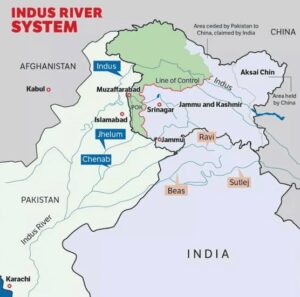
Background of the Indus Waters Treaty (IWT):
- Signed on 19 September 1960 in Karachi between India (Nehru) and Pakistan (Ayub Khan) with World Bank as guarantor.
- Distribution of rivers in the Indus river system:
○ Eastern Rivers (Ravi, Beas, Sutlej) – allocated to India.
○ Western Rivers (Indus, Jhelum, Chenab) – allocated to Pakistan.
- Ratio of sharing: 80% (Pakistan) and 20% (India).
- Transition Period: 10 years for Pakistan to construct link canals (funded by India and World Bank).
- Financials:
○ India paid ₹83.3 crore (₹8,000 crore today).
○ Pakistan received ₹400 crore grants, India got ₹30 crore loan.
- India’s obligation to fund replacement works in Pakistan was seen as a major concession.
Key Facts about IWT:
- Signed: 19 Sept 1960, Karachi.
- Parties: India, Pakistan, World Bank (guarantor).
- Allocation:
○ India → Ravi, Beas, Sutlej (33 MAF).
○ Pakistan → Indus, Jhelum, Chenab (135 MAF).
- Transition period: 10 years.
- Financials: India paid ₹83.3 crore (~₹8,000 crore); Pakistan got ₹400 crore grants.
- Principle: Obligation to honour treaties in good faith.
Constitutional & Legal Aspects
- Article 51(c), Indian Constitution: State shall respect international treaties.
- Vienna Convention on Law of Treaties: Allows termination if other party violates good faith.
Hydro Projects
- India’s potential: 12,000 MW hydropower on western rivers.
- Projects like Kishanganga, Ratle, Salal have faced disputes, often requiring intervention from the Permanent Indus Commission or neutral experts.
Initial Opposition in India:
- Many MPs opposed the treaty, calling it a “capitulation of India’s interests”.
- Harish Chandra Mathur (Congress MP) quoted The Times of India: “India yielded to Pakistan’s wishes at the cost of its own interests.”
- Rajasthan feared loss of irrigation waters.
- Atal Bihari Vajpayee: Warned that Pakistan’s interpretation of joint inspection meant “joint control” of Chenab and Jhelum, undermining sovereignty.
- Nehru dismissed criticism, calling it just “a pailful of water”.
Criticism of the Treaty as a Historical Blunder:
- Unfair Distribution: Pakistan received the majority of waters (~135 MAF) while India retained only ~33 MAF.
- Economic Cost: India had to fund Pakistan’s canal system while struggling to fund its own water infrastructure.
- Strategic Weakness: Treaty limited India’s control over water in J&K and Punjab.
- Diplomatic Naivety: Agreement seen as a symbol of goodwill, but Pakistan continued hostility and wars (1965, 1971, Kargil).
- National Mood: Disappointment across parties; belief that India made excessive concessions without reciprocity in bilateral relations.
India’s Present Shift in Approach:
- Suspension after Pahalgam attack reflects zero-tolerance towards terrorism and cross-border militancy.
- Reassessment of treaty in light of:
○ Population growth.
○ Agricultural needs and food security.
○ Energy transition goals (hydropower potential of western rivers).
- Clear message: Obligation of good faith is central to any treaty; Pakistan’s actions vitiate this principle.
- Demonstrates India’s move towards assertive foreign policy and strategic autonomy in hydropolitics.
Implications of Suspending the IWT:
- Domestic Benefits:
○ Greater access to western rivers for consumptive use.
○ Potential boost in irrigation and hydropower projects.
- Geopolitical Impact:
○ Stronger bargaining power vis-à-vis Pakistan.
○ Signals to global community India’s firm stance against terrorism.
- Diplomatic Risks:
○ Pakistan may escalate water disputes internationally.
○ May invite pressure from World Bank & UN.
- Regional Stability: Could increase geopolitical tensions in South Asia, especially in drought years.
Challenges in Implementation:
- Legal Challenges:
○ IWT is an internationally binding treaty, withdrawal could be contested in the Court of Arbitration.
- World Bank’s Role: International mediation may restrain India’s options.
- Pakistan’s Diplomacy: Likely to raise issue in UN and ICJ.
- Technical Barriers: Large infrastructure needed for India to utilise western rivers fully.
- Environmental Concerns: Alteration in river flow could affect ecosystems and communities.
- Regional Security Risks: Could escalate hostility → increase in cross-border conflict.
- Hydrological Limitations: India cannot divert waters beyond geographical feasibility.
- Domestic Political Resistance: States like J&K, Punjab, Rajasthan have competing water demands.
- China Factor: China’s upstream control on Brahmaputra may complicate India’s water diplomacy.
- Humanitarian Criticism: Suspension may be projected as “water weaponisation.”
Way Forward:
- Diplomatic Strategy:
○ Highlight Pakistan’s terror sponsorship to justify abeyance internationally.
○ Use bilateral and multilateral forums for support.
- Legal Framework:
○ Re-examine treaty provisions under Vienna Convention on Treaties (good faith principle).
○ Push for renegotiation citing changed circumstances and material breach.
- Infrastructure Push:
○ Invest in dams, hydropower, storage projects on western rivers.
○ Fast-track pending projects in J&K.
- Technological Solutions:
○ Improve water efficiency in agriculture.
○ Encourage drip and sprinkler irrigation.
- Federal Coordination:
○ Ensure fair distribution among riparian states.
- Environmental Balance:
○ Maintain minimum ecological flows to avoid humanitarian crisis.
- Alternative Narratives:
○ Frame action as rebalancing rights, not aggression.
- Long-term Policy:
○ Integrate water security into national security concerns.
○ Promote clean energy from hydropower as part of green transition.
○ Enhance flood forecasting and disaster management capabilities.
Strategic Significance:
- Reflects new India’s assertiveness in foreign policy and coercive diplomacy.
- Corrects past concessions that limited India’s growth and upper riparian rights.
- Positions water as both a security and developmental resource.
- Reinforces message: India will not compromise sovereignty and security for misplaced goodwill.
Conclusion:
The suspension of the Indus Waters Treaty marks a historic correction of past blunders, aligning India’s water diplomacy with its security needs. By linking water sharing to Pakistan’s conduct, India sends a clear message that national interest and sovereignty cannot be compromised, especially in the face of cross-border terrorism. This move represents a significant shift in transboundary water management and postcolonial diplomacy, potentially reshaping hydropolitics in the region.
Source: HT
Mains Practice Question:
“The Indus Waters Treaty (1960) has long been seen as a historical blunder that constrained India’s water security. Critically examine the challenges and opportunities of suspending the IWT in the context of cross-border terrorism and India’s strategic interests.”