







India’s Inequality Versus Its Gini Coefficient Ranking
Syllabus:
GS Paper – 2
Welfare schemes for vulnerable sections, Issues relating to poverty and hunger.
WHY IN THE NEWS?
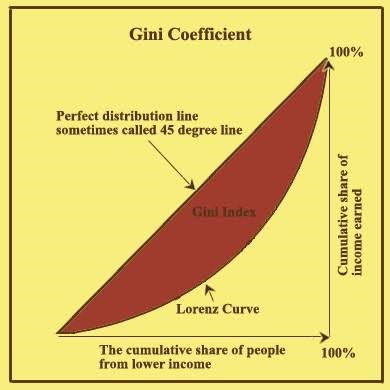
The Gini coefficient, also known as the gini index, a widely used inequality index, recently ranked India as one of the world’s most equal societies, assigning it a score of 25.5. This score, when plotted on a Lorenz curve, suggests near perfect equality. However, the lived realities of persistent income inequality across gender, wealth, digital access, and education in India suggest a different story, exposing flaws in data representation and methodology, and raising questions about transparency in inequality measurement.
Methodological Flaws in Gini Coefficient Ranking
● The Gini coefficient primarily measures consumption inequality, which may not capture deeper income and wealth disparities.
● It overlooks regional, gendered, and digital inequalities, resulting in an incomplete portrayal of societal disparities.
● The informal sector, employing a large share of the population, is underrepresented in official data.
● Wealth and asset inequality, largely invisible in consumption surveys, skews the true picture of income equality.
● Survey data in India misses the top income earners and understates the poorest, distorting the Gini estimate and failing to accurately represent income distribution, including those below the poverty threshold.
Wealth Inequality: Stark and Growing
● A luxury car chauffeur earning ₹3 lakh annually vs. passengers owning cars worth ₹30 lakh illustrates the income disparity and economic inequality.
● In 2022–23, the top 1% captured 22.6% of national income, showing rising concentration of wealth and widening the wealth gap, a phenomenon some refer to as the “billionaire raj”.
● Less than 10% of Indian adults file income tax, pointing to hidden wealth and income outside official records and highlighting issues of tax justice.
● Informal sector employment and high tax exemption thresholds obscure accurate assessment of income distribution.
● Absence of real-time wealth data highlights systemic exclusion and inequality in policy design, contributing to the unequal distribution of resources and raising questions about the need for wealth redistribution and potential wealth tax measures.
● The extreme poverty rate remains a concern, with many living in urban slums, further emphasizing the stark contrast in living conditions.
Gender Inequality: Persistent and Overlooked
● Women make up only 35.9% of the workforce, and hold just 12.7% of leadership positions (2024), highlighting a significant gender pay gap and wage disparity.
● Only 7.5% of startups are led by women, despite India’s booming entrepreneurial ecosystem.
● Social norms deprioritize education and inheritance for girls, entrenching inequality early in life and hindering social justice.
● Unpaid care work, mostly done by women, is not economically valued, impacting financial independence.
● Gendered access to the Internet further excludes women from banking, jobs, and opportunities, exacerbating inequality in India.
● The issue of minimum wage enforcement disproportionately affects women, contributing to ongoing gender-based income inequality.
Digital Divide and Educational Disparity
● Broadband access in India is only 41.8%, widening educational gaps between urban and rural areas and impacting digital literacy. The government’s BharatNet initiative aims to address this, but progress remains slow.
● Only 52.7% of schools have functional computers; Internet is available in just 53.9% of schools, hindering financial inclusion efforts.
● During online schooling (e.g., air pollution closures in Delhi), many children are left behind due to tech unavailability.
● In rural India, only 25% of women use the Internet, versus 49% of men, highlighting gendered digital exclusion.
● The digital divide leads to low-skill employment and intergenerational poverty, particularly among disadvantaged groups, impeding inclusive growth and economic growth.
Intersectional Inequality Across Realms
● Digital inequality compounds gender and class inequality, creating multi-layered exclusion.
● Access to education, jobs, and formal banking is linked to Internet availability, which many lack, affecting overall human development.
● Students without digital access fall behind in skills, leading to limited employment prospects.
● Lack of broadband at home makes virtual learning inaccessible, particularly in rural India, widening the urban-rural divide.
● Inequality in one realm often amplifies inequality in another, resulting in systemic marginalisation and perpetuating the poverty and inequality cycle.
● The disparity in healthcare costs between public healthcare and private healthcare systems further exacerbates these inequalities.
Conclusion:
India’s low Gini score masks the real, structural, and intersectional inequalities that define much of the population’s daily life. The apparent income equality suggested by the Gini coefficient fails to capture the complex reality of inequality in India. Without universal access to education, healthcare, digital tools, and income equity, the claim of being an equal society remains premature. True equality requires bridging disparities, not just statistical satisfaction.
To address these issues, policymakers should focus on implementing robust social security and social protection schemes, enhancing financial inclusion through initiatives like Jan Dhan accounts, and improving direct benefit transfer systems for effective welfare delivery. Additionally, efforts to boost digital literacy, reduce the gender pay gap, and support the informal sector are crucial for achieving inclusive growth and social justice.
Increased public investment in infrastructure, education, and healthcare is essential to tackle these multifaceted challenges. Only by addressing these issues comprehensively can India move towards a more equitable society that reflects the promise of its low Gini coefficient ranking and fosters sustainable economic growth.
Source: TH
Mains Practice Question:
The Gini coefficient recently placed India among the world’s most equal societies. Critically assess this claim in light of the persistent structural inequalities—economic, gender, digital, and educational—that prevail in India. Suggest ways to improve the accuracy and inclusivity of inequality measurement for effective public policy.