







INDIA’S INEQUALITY DEBATE NEEDS CLARITY
Syllabus:
GS-2:Issues Relating to Poverty & Hunger, Issues Related to Children, Issues Related to Women, Government Policies & Interventions
GS-3:Inclusive Growth
WHY IN THE NEWS?
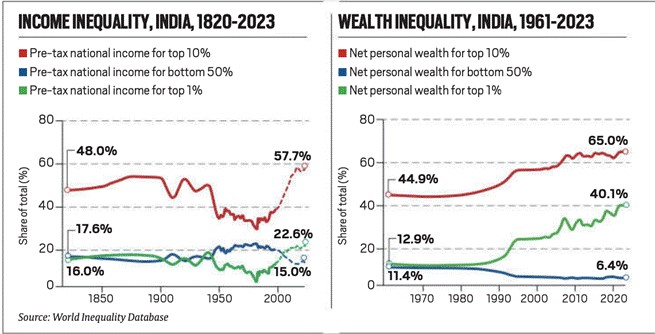
A recent World Bank report claimed India has the world’s lowest consumption inequality, citing a Gini index of 25.5 in 2022-23. Simultaneously, it referenced the World Inequality Database (WID) which shows India’s income inequality measures as the highest globally with a Gini coefficient measure of 62. This contradictory interpretation has sparked confusion and criticism from economists and policymakers alike, highlighting the need for clarity in inequality measures and economic policy discussions.
CONSUMPTION VS. INCOME MEASURES:
- Key Distinction: Consumption inequality refers to how spending varies across households, while income inequality focuses on disparities in earnings and wealth distribution, often measured by the Gini ratio.
- Survey Reliance: In India, official consumption expenditure data is collected, but household income distribution data is absent, making consumption patterns the default indicator for measuring economic inequality and statistical dispersion.
- WID Assumptions: The World Inequality Database (WID) uses synthetic income estimates, not real survey data, often criticized for methodological flaws in assessing income equality measures and disposable income distribution.
- Global Comparisons: Mixing income Gini from WID with consumption Gini from NSSO for global rankings leads to false narratives about India’s position in global inequality indices, especially when compared to high-income countries.
- Misleading Claims: Claims that India is among the most equal societies overlook the incomparable nature of data types and the complexity of measuring economic inequality across different income brackets.
WORLD BANK’S DOUBLE STANDARDS
- Inconsistent Reporting: The World Bank’s Poverty and Equity Brief quoted official consumption data but added WID’s income Gini, causing contradiction in inequality index assessment and confusion about the poverty threshold.
- India-Specific Exception: Among 130 countries, only India’s brief included non-official synthetic estimates, raising questions of selective citation in economic inequality analysis.
- Data Limitations Ignored: While the Bank criticizes official data limitations, it treats WID estimates as unquestionable, despite no empirical basis for income equality measures in India.
- Policy Misguidance: This contradiction could mislead policy framing, especially regarding inequality-targeted programs and sustainable development initiatives.
- Credibility Concerns: The Bank’s acceptance of conflicting estimates undermines its data integrity, a matter of global concern in assessing economic development and poverty reduction efforts.
GOVERNMENT’S ERRONEOUS ENDORSEMENT
- PIB Release: The Indian government endorsed the claim that India is the world’s fourth most equal society, based on flawed comparison of inequality indices, overlooking crucial aspects of social development.
- Party Statements: BJP furthered this by referring to India’s “social equality” ranking, without clarifying the basis of measurement or addressing wealth inequality concerns and their relation to the poverty line.
- Misinterpretation Fallout: The failure to distinguish between consumption and income measures invited valid criticism from economists and policy analysts.
- Credibility Risk: By supporting incomplete narratives, the government risks losing trust on important socio-economic claims related to inequality and poverty reduction.
- Ignored Nuance: The most significant finding—India’s low consumption inequality—was lost amidst political overstatements, overlooking the complexities of economic inequality and social exclusion.
THE WID AND DATA CREDIBILITY
- Synthetic Estimates: WID’s Gini figures for India are based on model-driven assumptions, not survey-based data, which weakens reliability in assessing income inequality across various income brackets.
- Peer Criticism: A number of academic papers, especially in the U.S., have challenged WID’s methodology for generating income inequality data and wealth distribution estimates.
- No Ground Data: India hasn’t conducted an official income survey yet, making WID’s income Gini of 62 speculative and potentially misleading for policy decisions aimed at improving income mobility.
- Six-Point Gap: Historically, income Ginis are 6 points higher than consumption Ginis—the 36-point gap between India’s measures is unprecedented in inequality indices.
- Double Standards: Accepting synthetic income estimates as more reliable than official consumption data reflects methodological bias in assessing economic inequality and understanding real income distribution.
ROLE OF HOUSEHOLD SURVEYS
- Crucial Tool: Household surveys are the best instruments for measuring inequality, acknowledged by governments and economists alike in developing countries and OECD countries for assessing household consumption patterns.
- PIP Platform: The World Bank’s Poverty Inequality Platform (PIP) compiles only official survey data, except in China’s case, for assessing global inequality trends and per capita income variations.
- India’s Absence: India has no income surveys data in PIP, only consumption surveys from NSSO are available, limiting comprehensive inequality analysis.
- Survey Gap: This data vacuum allows external sources like WID to step in, despite methodological limitations in assessing income and wealth inequality.
- Future Surveys: India’s first official household income survey is underway, which will bring clarity to inequality debates and enhance understanding of economic development patterns.
THE PATH AHEAD
- Need Clarity: Policymakers, institutions, and media must clearly state whether their inequality claims are based on income or consumption measures to avoid confusion and improve the quality of life assessment.
- Consistent Metrics: Cross-country comparisons must involve same-type indicators—income to income or consumption to consumption—for accurate assessment of global inequality and multidimensional poverty.
- Transparency Priority: Institutions like the World Bank should disclose data origins and avoid mixing disparate measures of inequality to maintain credibility in welfare economics discussions.
- Public Education: Economists and communicators need to educate the public on the difference between consumption and income inequality and their implications for economic policy in emerging economies.
- Empirical Grounding: India must prioritize empirical income data collection to reduce speculation-based narratives and improve the accuracy of inequality measures.
CONCLUSION:
The inequality debate in India is caught in a data dilemma, with official consumption data being misread or misrepresented, and synthetic income estimates being overemphasized. Clarity and consistency in metrics, improved data collection, and cautious interpretation are essential to ensure that public policy is grounded in statistical truth. Addressing these issues is crucial for sustainable development, poverty reduction, and promoting fairness in economic growth. As India continues to develop, accurate measurement of inequality will be vital for crafting effective policies that promote inclusive growth, human development, and good governance. The path forward requires a comprehensive approach to understanding poverty and inequality, ensuring that both consumption patterns and income distribution are accurately measured and analyzed in the context of emerging economies and global welfare economics.
Source: HT
MAINS PRACTICE QUESTION:
Q. Critically examine the contradictions in the measurement of inequality in India, especially with reference to the use of consumption-based and income-based Gini indices. What are the implications for policy-making? (250 words)