
AGRI INDUSTRY WORRIES OVER US TRADE DEAL
Syllabus:
GS 2: ● Global issues and its impact on India
GS-3: ● Agriculture and allied sector
Why in the News?
India and the United States are finalizing a bilateral agricultural trade deal before the July 9 tariff deadline. Domestic agriculture industries fear trade concessions might adversely impact ethanol and soybean sectors. The potential removal of import restrictions on certain agricultural commodities is causing concern among sugar mills and soybean processors, who anticipate negative market disruptions in the agricultural sector. The looming threat of reciprocal tariffs and changes in trade policy are at the forefront of these concerns, highlighting the delicate balance between international trade and domestic agricultural interests.
FEARS OF SUGAR MILL INDUSTRY
The Indian sugar industry has expressed significant concerns over possible imports of ethanol and GM maize, which might destabilize domestic ethanol-blended petrol programmes and impact the farming community. These concerns are closely tied to issues of food safety and the protection of domestic producers in the agricultural sector.
● Ethanol imports: Indian mills strongly oppose importing ethanol for petrol blending, fearing it will marginalize sugarcane-derived ethanol and threaten their energy market share. The potential for fuel ethanol imports is a particular worry, as it could disrupt the domestic ethanol production ecosystem.
● Feedstock competition: The industry is wary of importing GM maize for fuel ethanol production, potentially displacing traditional molasses and sugarcane juice as primary feedstocks. This could significantly affect feedstock flexibility in the sector and alter established agricultural practices.
● Dependence on imports: Importing ethanol could lead to increased reliance on the US, which dominates global maize and fuel ethanol markets, potentially undermining India’s energy autonomy and affecting ethanol procurement prices. This raises concerns about trade imbalance and long-term agricultural sustainability of domestic ethanol production.
● Threat to by-products: Diversion of maize for ethanol may cause grain shortages for livestock and poultry feed, disturbing India’s delicate food-feed-energy balance. This could have ripple effects on the market for processed cereals and impact overall agricultural sustainability.
● Policy contradiction: Ethanol imports may conflict with India’s Atmanirbhar Bharat policy, which promotes self-sufficiency in energy and agricultural industries. This policy aims at import substitution and boosting agricultural exports, goals that could be undermined by increased dependence on imported ethanol.
SUCCESS OF ETHANOL BLENDING PROGRAMME
India’s ethanol-blended petrol programme is considered a flagship success of the Modi government, contributing towards energy security and reducing carbon emissions while promoting renewable energy. It’s a key component of India’s green energy initiatives and agricultural development strategy.
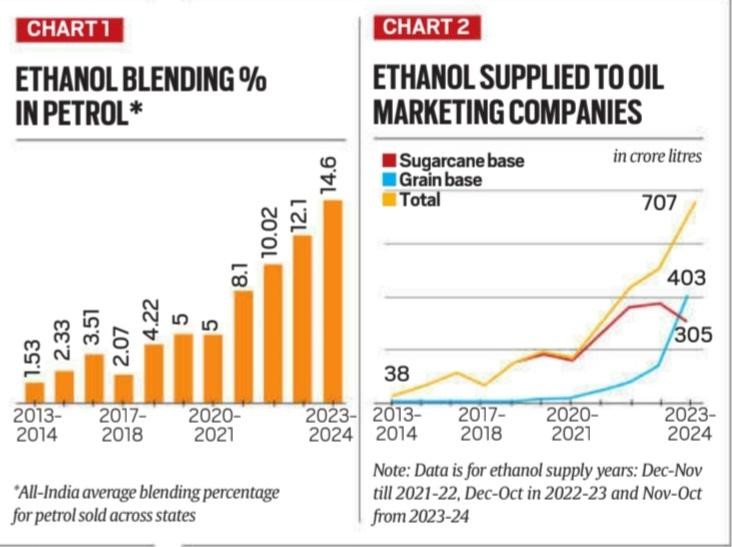
● Growth trajectory: Ethanol blending in petrol has seen remarkable progress, rising from 1.5% in 2013-14 to 14.6% in 2023-24, nearing the ambitious 20% target set for 2025-26.
● Grain-based ethanol: Since 2023-24, grain-based ethanol production has overtaken molasses-based ethanol, indicating a significant shift in India’s biofuel strategy and agricultural focus.
● Feedstock diversification: Currently, 68% of ethanol supplied to OMCs comes from grains such as maize and surplus FCI rice, diversifying the feedstock base and promoting agricultural development across different crop sectors.
● Future plans: The government aims to expand ethanol use into diesel blending and sustainable aviation fuel sectors, boosting clean energy initiatives and supporting the energy transition. This expansion could also involve cogeneration processes, further integrating the agricultural sector with energy production.
● Marginalisation fears: Sugar millers fear sugarcane will be marginalized further if cheap imports are allowed, threatening the viability of their industry and distillery capacity. This could lead to increased price volatility in the sugar market and potentially disrupt established agricultural supply chains.
U.S. INTEREST IN ETHANOL EXPORTS
The United States, the world’s top maize and ethanol exporter, seeks to access India’s growing biofuel market to diversify exports amid geopolitical shifts and trade imbalances. This interest is part of broader trade relationships between the two countries and could significantly impact India’s agricultural sector.
● Export volumes: In 2024, the US exported 724.5 crore litres of ethanol, with India emerging as the third-largest market, importing 70.8 crore litres worth $441.3 million.
● Current import rules: India permits ethanol imports only for industrial uses, not for fuel blending, protecting domestic biofuel industries from external competition and maintaining a trade surplus. These rules act as tariff barriers, shielding domestic agricultural producers.
● NITI Aayog proposal: A NITI Aayog paper proposed allowing GM maize imports solely for ethanol, with DDGS by-products being exported to avoid domestic GM feed use. This proposal aims to balance ethanol production needs with concerns about GM crops in the food supply.
● Cost argument: The paper argues that US corn is cheaper and would help India meet its biofuel targets without disrupting local food markets, potentially benefiting from preferential trade arrangements. However, this argument raises concerns about the long-term impact on domestic maize producers.
● Industry opposition: Indian sugar millers and ethanol producers vehemently oppose this, fearing import dependency and disruption of domestic market dynamics. They argue for maintaining trade concessions that protect local industries and agricultural producers.
CONCERNS OF SOYBEAN INDUSTRY
India’s soybean processors fear the bilateral trade deal may open the market to imported GM soybeans, adversely impacting local farmers and processors in the agricultural sector. This is a major concern for the soybean processing industry and highlights the complex interplay between trade policy and agricultural interests.
● Processing logistics: Most Indian processors are located inland, making imports from ports uneconomical due to high freight costs and logistical challenges. This affects warehousing and distribution efficiency, potentially disadvantaging domestic processors.
● Impact on farmers: The domestic industry supports over 7 million farmers, who may shift away from soybean cultivation if cheap imports flood markets, affecting rural livelihoods. This could lead to a decrease in agricultural exports and disrupt established farming patterns.
● Capacity under threat: Increased imports of oil or seed could force processors to operate below capacity or shut down, causing economic distress. This is particularly concerning for the edible oils sector and could have far-reaching implications for India’s agricultural processing capabilities.
● Market limitations: India’s limited domestic demand for soybean meal makes processing imported soybeans unviable unless new export markets are developed. This highlights the need for a comprehensive strategy that considers both domestic consumption and export potential.
● Rise of multinationals: Global giants like ADM, Cargill, and Louis Dreyfus might dominate processing, displacing local businesses and marginalizing Indian players in the agricultural processing sector.
GOVERNMENT POLICY CONCERNS
The government’s recent decisions and tariff policies are also causing unease within the domestic soybean processing and oilseeds industry, reflecting broader concerns about agricultural policy and trade.
● Tariff cuts: The government slashed import duties on crude soybean, palm, and sunflower oils from 27.5% to 16.5%, squeezing domestic processors’ margins and potentially impacting the minimum support price for farmers.
● Price pressures: Domestic soybean is trading below MSP at ₹4,300-4,350 per quintal, causing distress among farmers and undermining income security. This highlights the need for effective price hedging mechanisms in the agricultural sector.
● Crop shift risk: Farmers may switch to other crops if soybean profitability declines further, impacting crop diversification and agricultural sustainability across regions.
● Industry lobbying: Processors and farmer groups are actively lobbying the government to reconsider tariff policies and import concessions to protect domestic interests in the agricultural sector.
● Negotiation risks: The ongoing India-US trade negotiations might intensify these worries, especially if significant market access is granted to US agro commodities, potentially reshaping India’s agricultural landscape.
CHALLENGES FACING DOMESTIC INDUSTRY
India’s agri-based industries face multiple challenges that could escalate if trade deals lead to import liberalization without adequate protective measures for domestic agricultural producers.
● Global competition: US agro industries benefit from scale, subsidies, and technology, posing stiff competition to India’s relatively small-scale processors in the agricultural sector.
● Policy uncertainty: Frequent changes in tariffs and import policies create an uncertain business environment, deterring long-term investments in agri-processing and potentially hampering sector growth.
● Infrastructure gaps: Poor port infrastructure and logistics hamper Indian industry’s ability to compete effectively against imported products, highlighting the need for comprehensive infrastructure development in the agricultural supply chain.
● GM concerns: Domestic opposition to GM crops remains strong, creating regulatory hurdles and consumer resistance to imported GM products. This adds complexity to trade negotiations and domestic agricultural policy.
● Supply chain disruptions: Imports of ethanol and GM maize could disrupt existing supply chains, affecting food security and feed availability for livestock, underscoring the interconnectedness of various agricultural subsectors.
● Market intelligence: There’s a pressing need for better market intelligence to help domestic industries anticipate and adapt to global market trends, ensuring the competitiveness of India’s agricultural sector.
WAY FORWARD FOR INDIA
India must adopt a balanced approach that safeguards domestic interests while engaging in strategic trade negotiations with global partners like the United States, particularly in the context of agricultural trade.
● Protect domestic markets: Maintain import restrictions on sensitive commodities to shield domestic industries and farmers from unfair competition, ensuring the stability of the agricultural sector.
● Promote innovation: Encourage domestic R&D in non-GM high-yield crops and processing technologies to boost productivity and global competitiveness in agriculture.
● Strengthen supply chains: Develop robust supply chain management for ethanol, oilseeds, and maize to reduce import dependence and enhance agricultural self-sufficiency.
● Farmer-centric policies: Prioritize policies that ensure income security and market stability for farmers, promoting sustainable agricultural growth and water conservation.
● Transparent dialogue: Foster transparent consultations with industry stakeholders during trade negotiations to align economic and national interests in the agricultural sector.
● Circular economy: Implement circular economy principles in the agricultural sector to maximize resource efficiency and reduce waste, promoting sustainability.
● Export facilitation: Develop strategies for export facilitation to help domestic producers access global markets more effectively, boosting India’s agricultural export potential.
CONCLUSION
The upcoming India-US trade deal could significantly reshape India’s agricultural sector. While expanding global ties is necessary, India must carefully assess risks to domestic agri-industries. A calibrated approach balancing national interest, energy security, and agricultural sustainability is key to protecting farmers, processors, and consumers amid evolving global dynamics. Implementing effective risk management strategies and focusing on value addition in the agricultural sector can help create a more resilient and competitive industry. By addressing concerns related to trade concessions, agricultural imports, and market intelligence, India can position itself favorably in international trade while safeguarding its domestic agricultural interests. The path forward requires a delicate balance between embracing global opportunities and protecting the vibrant tapestry of India’s agricultural landscape.
Source: IE
UPSC MAINS PRACTICE QUESTION
“India’s agriculture sector is at a crossroads amid evolving trade negotiations. Critically examine the concerns of domestic agri-industries and suggest a balanced approach for sustainable trade policies.”