







India’s Informal Economy: Better Tracked Than Ever Before
Why It’s in the News
- Debates on GDP over- or under-estimation are losing ground due to India’s improved statistical capabilities in measuring the informal economy and non-observed economy.
- Significant progress has been made in accurately measuring the informal sector, a crucial component of the informal economy, including better tracking of informal wage employment and own account workers.
- The timeliness and regularity of National Sample Survey (NSS) data, particularly employment unemployment surveys, have improved considerably, enhancing our understanding of informal workers and the informal sector.
- Recent surveys indicate robust growth in the informal economy, reinforcing the credibility of current GDP estimates and shedding light on informal sector workers, including street vendors, domestic workers, and even emerging categories like social media influencers.
Deeper Dive into the News
- Indian GDP measurement recently drew media attention after a NITI Aayog observation based on a World Bank projection stated that India is now the world’s fourth-largest economy.
- Some commentators speculated that India’s GDP may be underestimated, citing the large informal economy as being excluded from official measurement.
- However, this allegation is not substantiated and can be dismissed based on current statistical practices and improved national accounts statistics, which incorporate various compilation categories and benchmark estimates.
Clarifying Informal Economy and GDP Measurement
- The term “informal economy” often refers to:
- Informal employment, as defined by the International Labour Organization (ILO)—work without contracts, job security, or fixed wages, often including informal sector workers and contributing family workers.
- Informal sector enterprises, as per the UN’s System of National Accounts (SNA)—household-run establishments that don’t maintain formal accounts or undergo business registration.
- Since 2011–12, India’s GDP calculations have adhered to the SNA framework, which includes value added from the informal sector and accounts for informal workers, informal employers, and formal workers.
- The National Account Statistics 2025, released by the Ministry of Statistics and Programme Implementation (MoSPI), contains Chapter 7 detailing aggregates from the household sector, which largely represents the informal economy and utilizes various administrative data sources.
- This confirms that informal sector contributions are already accounted for in India’s GDP measurement, addressing concerns about the exclusion of the informal economy and improving the capture of the non-observed economy.
Addressing Concerns of Informal Sector Overestimation in GDP
- A second line of criticism argues that India’s GDP might be overestimated, particularly concerning the informal sector and its informal workers, including own account workers and those in informal wage employment.
- This critique has existed since the 2015 GDP series revision, citing events like demonetisation, GST rollout, and later, the COVID-19 pandemic, as major disruptions to the informal economy that may not be adequately captured in official data.
Basis of the Concern:
- Critics claim that despite severe shocks, GDP figures didn’t reflect proportionate declines in the informal sector, raising questions about the accuracy of informal economy measurements and the effectiveness of the residual methodology used.
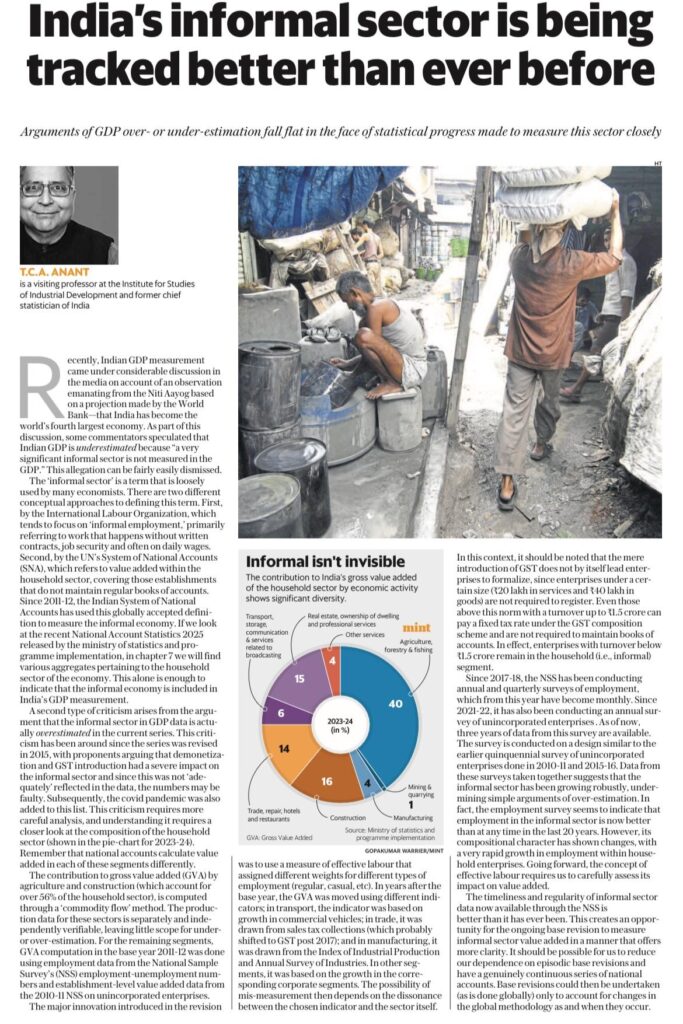
- A closer look at the household sector composition (e.g., pie-chart for 2023–24) is needed to evaluate this claim effectively and understand the role of informal sector enterprises, including those run by informal employers.
Clarification Through Sector-wise GVA Estimation:
- Agriculture and construction, together forming over 56% of the household sector, use the commodity flow method for estimating GVA, which helps capture informal economic activities.
- Their production data is independently verifiable, reducing the scope for major under- or over-estimation of the informal economy.
- For other segments of the informal sector:
- Base Year (2011–12) GVA estimation used:
- NSS employment-unemployment survey data, providing insights into informal workers and the employment relationship in various sectors.
- 2010–11 NSS survey on unincorporated enterprises, capturing data on informal sector enterprises and contributing family workers.
- A new metric of “effective labour input” was applied, assigning weights to different employment types (e.g., regular, casual) to better reflect the informal economy.
- Base Year (2011–12) GVA estimation used:
- Post base year GVA estimation employed varied indicators to track the informal economy:
- Transport: Growth in commercial vehicle registrations.
- Trade: Sales tax collections, later shifted to GST data post-2017, which helped capture some informal economic activities and improve the statistical business register.
- Manufacturing: Index of Industrial Production (IIP) and Annual Survey of Industries (ASI).
- Other segments: Growth in corresponding corporate sector data used as proxy, indirectly reflecting changes in the informal economy.
- Potential mis-measurement, if any, arises from the gap between the proxy indicator used and actual sector performance—not from systematic overestimation of the informal economy or flaws in the labour input method.
GST and the Informal Economy: Key Observations
Introduction of GST alone does not guarantee formalisation:
- Enterprises with turnover below ₹20 lakh (services) or ₹40 lakh (goods) are exempt from registration, remaining part of the informal economy and often lacking business registration.
- Even those with turnover up to ₹1.5 crore can opt for the GST composition scheme, paying a fixed tax without maintaining detailed books, still contributing to the informal economy.
- As a result, enterprises below ₹1.5 crore turnover remain classified as informal (household sector) despite GST coverage, highlighting the persistence of the informal economy and the need for targeted policy design.
Improvements in Data Collection Since 2017–18: NSS Surveys have expanded in scope and frequency, enhancing our understanding of the informal economy:
- Employment surveys: Conducted annually and quarterly since 2017–18, and now monthly as of this year, providing regular insights into informal workers, including street vendors, domestic workers, and social media influencers.
- Annual Survey of Unincorporated Enterprises: Conducted since 2021–22, with three years of data now available, offering valuable information on informal sector enterprises and improving sampling design.
- Survey design mirrors earlier quinquennial surveys (2010–11 and 2015–16), ensuring consistency in measuring the informal economy and providing reliable benchmark estimates.
Insights from Recent NSS Data:
- The combined dataset indicates robust growth in the informal sector, challenging simplistic claims of GDP overestimation and providing a clearer picture of the informal economy, including various types of informal wage employment.
- Employment levels in the informal sector are reportedly better than at any point in the past 20 years, suggesting resilience in the informal economy and the need for improved social security coverage.
- A noticeable compositional shift is underway – Rapid increase in employment within household enterprises, reflecting changes in the structure of the informal economy and the rise of own account workers.
Moving Forward: Opportunities for Statistical Reform
- The concept of “effective labour input” must be evaluated more closely in light of these shifts to better estimate value added in the informal economy and improve the labour input method.
- NSS data is now timelier and more regular than ever before, enabling:
- More accurate and updated measurement of informal sector contributions to the overall economy, including better tracking of informal employers and contributing family workers.
- Reduced reliance on episodic base year revisions for capturing changes in the informal economy.
- Transition toward a continuous national accounting system, with base revisions limited to global methodological updates, improving the tracking of the informal economy and refining compilation categories.
Way Forward:
- Leverage improved NSS data (employment & enterprise surveys) for more accurate and frequent estimation of informal sector value added, enhancing our understanding of the informal economy and improving policy design.
- Shift towards a continuous national accounting system using real-time and regular data, reducing dependence on episodic base year revisions and better capturing the dynamics of the informal economy.
- Limit base revisions only to reflect changes in global statistical standards and methodologies (as followed internationally), ensuring international comparability of informal economy measurements.
- Refine the concept of “effective labour input” by incorporating recent changes in employment composition, especially the rise in household enterprises within the informal economy.
- Enhance integration of GST and other administrative data sources with NSS surveys to better map the overlap between formal and informal sectors, improving the accuracy of informal economy estimates.
- Invest in institutional and technological capacity to ensure timely and granular data collection from the unincorporated sector, a key component of the informal economy, and improve the statistical business register.
- Strengthen awareness among small enterprises about the benefits of formalisation while maintaining support for informal livelihoods, addressing both formal and informal workers’ needs.
- Develop targeted policy interventions and formalization strategies based on improved data to address challenges in the informal economy while supporting income generation and poverty alleviation.
- Enhance labour market information systems to better track labour force participation trends in both formal and informal sectors, including youth employment and gender disparities.
- Explore the use of innovative data sources, such as satellite data and digital payment systems, to complement traditional surveys in measuring the informal economy and improving sampling design.
- Strengthen the regulatory framework and align with international labour standards to improve working conditions and social security coverage for informal workers, including domestic workers and street vendors.
- Implement skill development programs tailored to the needs of informal sector workers, enhancing their productivity and potential for transitioning to formal employment.
Source: India’s informal economy isn’t off the map: It’s being tracked better than ever
Mains Question (250 words):
Discuss the challenges and advancements in measuring India’s informal economy within GDP estimates. How do recent NSSO surveys and GST data contribute to improving national income accounting accuracy?