Why India Needs Nuclear?
Why India Needs Nuclear?
Syllabus
GS 3: Energy
Why in the News?
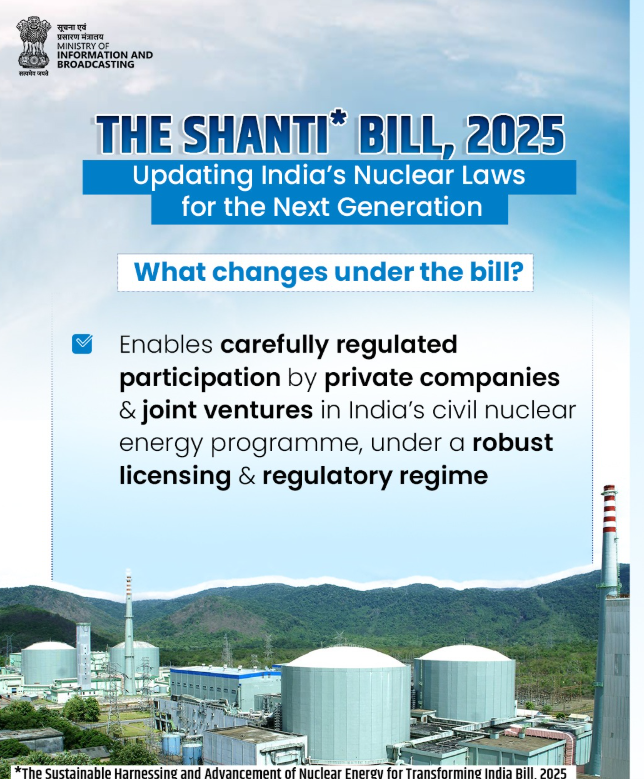
Recently, the SHANTI Bill 2025 was passed by Parliament, marking a major policy shift toward expanding India’s nuclear energy capacity as part of its long-term clean development and energy security strategy. This bill aims to streamline the environmental clearance process for nuclear projects while maintaining rigorous safety standards.
Introduction
- Human development increases with higher and cleaner energy use, and India’s long-term prosperity relies on expanding reliable power sources that can obtain environmental clearances efficiently.
- As the nation aims for high human development and deep decarbonisation, nuclear energy emerges as a key pillar in creating a pollution-free environment.
- Balancing rising demand and climate goals requires stable, large-scale, low-carbon electricity, which nuclear power can provide while adhering to environmental impact assessment guidelines.
Understanding How Development and Energy Consumption Move Together
Human Development Depends on Energy Access
- Human progress improves when people gain access to dependable energy for income growth, education, health services, industry, and homes.
- Earl Cook’s 1971 Scientific American study showed that energy needs expanded with each stage of human evolution from basic food needs in primitive life to complex industrial and digital uses today.
- As societies modernise, electricity becomes essential for homes, businesses, transportation, and technology, necessitating robust environmental clearance processes for power projects.
Digitalisation and New Energy Requirements
- The modern digital era requires massive power for data centres, cloud services, telecom networks and digital payments.
- A fast-growing digital economy like India’s demands continuous and large-scale electricity supply, which must be balanced with environmental considerations.
HDI, Energy Consumption and India’s Future Needs
Why HDI Matters
- The Human Development Index (HDI) is a strong indicator of progress because it includes:
- Income
- Education
- Health
- Countries with an HDI above 0.9 typically consume large amounts of energy per capita, highlighting the need for sustainable energy solutions.
India’s Energy Requirement for Higher HDI
- Research estimates that India must generate around 24,000 TWh of energy annually to reach an HDI of 0.9.
- This includes:
- Electricity
- Energy to produce green hydrogen, which is needed to decarbonise steel, fertilisers, and plastics.
Current Energy Generation and Growth Rate
- India produced 1,950 TWh in 2023–24.
- With a 4.8% CAGR, India can reach 24,000 TWh in 40–50 years.
- But this expansion must align with two goals:
- Decarbonisation of the energy mix
- Growing electrification of industries and transport
Challenges in India’s Existing Energy Mix
Low Share of Electricity in Total Energy Use
- Electricity forms only 22% of India’s total final energy consumption.
- This share must rise sharply to support green industries, mobility, manufacturing and digital infrastructure.
High Dependence on Fossil Fuels
- India’s energy system is still dominated by coal, oil, and natural gas.
- To meet climate goals, the nation must shift toward:
- Hydropower
- Solar energy
- Wind energy
- Nuclear energy
Why Renewable Energy Alone Cannot Meet India’s Needs
Geographic and Land Constraints
- Hydro and wind potential is limited by geography.
- Solar energy requires large land areas, difficult in densely populated regions.
- Even if India uses all available renewable potential, it still cannot meet the 24,000 TWh requirement for a high HDI.
Intermittency and Storage Issues
- Solar and wind are variable energy sources.
- Large storage systems:
- Are very expensive
- Cannot handle seasonal fluctuations
- Are unsuitable for India’s long-term baseload needs
Need for Baseload Power
- A modern economy needs electricity that is:
- Continuous
- Stable
- Non-seasonal
- Available 24/7
- Nuclear power provides this essential baseload, making it indispensable for India’s long-term energy strategy while adhering to the precautionary principle in environmental management.
Why Nuclear Energy is Essential for India’s Decarbonised Future
- Nuclear power is:
- Low-carbon
- Non-intermittent
- Weather-independent
- Cost-effective at scale
- It supports green hydrogen production and industrial decarbonisation.
- Therefore, nuclear energy must be a central pillar in India’s future energy planning, subject to rigorous environmental impact assessments.
India’s Growing Capabilities in Nuclear Technology
Building an Indigenous Nuclear Ecosystem
- India has developed nearly the entire nuclear supply chain, including:
- Fuel fabrication
- Heavy water production
- Pressurised Heavy Water Reactor (PHWR) design
- Waste reprocessing
- Manufacturing of nuclear equipment
- Only uranium is imported due to limited domestic reserves.
Progress in PHWR Deployment
- India operates PHWRs of multiple sizes.
- The largest units 700 MW reactors represent major technological achievement.
- Current status:
- Three 700 MW reactors operational
- One nearing completion
- Two more in advanced construction stages
Strong Nuclear Regulation and Safety
- India formed an independent nuclear regulatory framework in the 1980s.
- The regulator ensures safety, security and environmental compliance.
- BARC manages nuclear waste and reprocessing through advanced indigenous technologies, upholding the polluter pays principle.
Storage, Reliability and the Critical Role of Nuclear Power
Limits of Storage-Based Systems
- Batteries are helpful but cannot manage seasonal energy gaps.
- Long-duration storage remains unavailable and costly.
- Depending only on solar and wind raises electricity prices.
Nuclear Ensures Grid Stability
- Provides constant output
- Supports industries, transportation, digital networks and essential services
- Complements renewable energy by maintaining steady supply
SHANTI Bill, 2025: A Major Reform
Purpose of the SHANTI Bill
- The Sustainable Harnessing and Advancement of Nuclear Energy for Transforming India (SHANTI) Bill, 2025) merges key provisions from:
- Atomic Energy Act, 1962
- Civil Liability for Nuclear Damage Act, 2010
Key Features
- The Atomic Energy Regulatory Board (AERB) continues as the chief regulator.
- Facilities must ensure safety, security and safeguards, with the licensee holding primary responsibility.
- The Bill modernises and simplifies India’s nuclear legal framework, including provisions for ex-post facto environmental clearances in exceptional cases.
Ambitious National Goal
- India targets 100 GW of nuclear capacity by mid-century, a major leap from current levels.
- Achieving this would significantly boost clean, stable, large-scale power availability.
Significance of the Bill
- Nuclear expansion requires clear legislation, safety standards and efficient operations.
- The Bill marks a bold and historic step in India’s journey toward sustainable development and environmental democracy.
Road Ahead: India’s Nuclear Future
Strategic Advantages of Nuclear Power
- Supports energy security
- Enables low-carbon development
- Ensures continuous power supply
- Helps decarbonise heavy industries
- Facilitates green hydrogen production
- Complementing Renewable Energy
- A strong mix of:
- Nuclear + Solar + Wind + Hydro creates a resilient, clean and affordable energy system for India’s future.
Conclusion
India’s development requires large amounts of clean, dependable energy. Renewable energy alone cannot meet future demand, making nuclear expansion essential. With strong policy support and indigenous capability, India can achieve sustained growth and deep decarbonisation together, while adhering to principles of environmental jurisprudence.
Source
The Hindu
Mains Practice Question
Critically examine the features and significance of the SHANTI Bill, 2025 in strengthening India’s nuclear governance structure and environmental safeguards.