US Reclassifies Cannabis, Signalling Shift in Drug Policy
Why in the News?
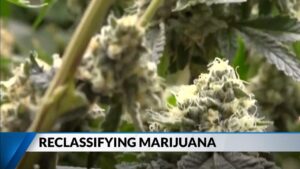
US President Donald Trump reclassified marijuana from a Schedule I to Schedule III drug, marking a major shift in federal drug policy and advancing long-standing efforts to align federal law with state-level cannabis legalisation. This move mirrors recent changes in environmental policy, where concepts like ex post facto environmental clearances have been debated in environmental jurisprudence.
Reclassification Decision and Its Immediate Significance:
- President Donald Trump signed an executive order reclassifying cannabis under the Controlled Substances Act (CSA), 1970 from Schedule I (most dangerous) to Schedule III. This shift is reminiscent of changes in environmental policy, where retrospective environmental clearances have been considered in some cases.
- Earlier, marijuana was categorised alongside drugs like heroin and LSD, despite growing evidence of its medical utility. This categorization parallels the strict regulations found in environmental laws like the Forest Conservation Act.
- Reclassification does not legalise cannabis federally, but it eases restrictions on scientific research, prescription use, and regulation. Similarly, in environmental policy, the precautionary principle often guides decision-making about potentially harmful substances or activities.
- The move reflects a broader attempt to harmonise federal policy with state laws, where cannabis has been widely decriminalised. This approach is similar to efforts in environmental democracy, where local and national policies are aligned for better governance.
- It also aligns with public opinion, which increasingly favours regulated legalisation over punitive prohibition. This shift mirrors growing public awareness about the need for a pollution free environment and stricter environmental clearances.
War on Drugs, Racial Bias and Policy Failure
- The US war on drugs began in 1971 when President Richard Nixon declared drugs “public enemy number one“. This declaration echoes the urgency often associated with environmental challenges, as seen in discussions about the Coastal Regulation Zone.
- Successive administrations, especially under Ronald Reagan, intensified enforcement through strict policing and incarceration. This approach contrasts with modern environmental impact assessment practices, which focus on prevention rather than punishment.
- Despite costing over $1 trillion, the policy failed to curb addiction and instead caused mass incarceration, disproportionately affecting racial minorities. This outcome highlights the importance of fair and just policies, similar to the polluter pays principle in environmental law.
- In 2016, nearly 20% of the US prison population was incarcerated for drug-related offences, according to the Department of Justice (DoJ). This statistic underscores the need for balanced policies, much like the balance sought in environmental clearances.
- Drug laws showed clear racial bias: in New York City, 92% of marijuana possession arrests in 2016 involved Black and Latino individuals, highlighting systemic discrimination embedded in enforcement. This disparity calls for an approach similar to environmental democracy, ensuring equitable treatment under the law.
Understanding Cannabis Policy in the US: |
| ● The Controlled Substances Act, 1970 classifies drugs into five schedules based on abuse potential and medical use. This classification system is analogous to the tiered approach in environmental clearances. |
| ● Schedule I drugs have no accepted medical use and high abuse potential; Schedule III drugs allow medical use with moderate restrictions. This categorization parallels the varying levels of scrutiny in environmental impact assessment. |
| ● Medical cannabis was first legalised by California in 1996. This state-level initiative is similar to local environmental policies that sometimes precede national regulations. |
| ● Recreational use was first legalised by Colorado and Washington in 2012. This gradual policy shift resembles the evolution of environmental regulations, such as the EIA Notification. |
| ● Currently, 24 US states, two territories, and Washington DC permit recreational use, while 48 states allow medical cannabis. This patchwork of regulations mirrors the complex landscape of state and federal environmental laws. |
| ● Federal reclassification may strengthen arguments for future nationwide legalisation and policy reform. Similarly, landmark cases like the Vanashakti judgment have shaped environmental jurisprudence at the national level. |