







Second Nationwide Dolphin Survey Launched Under Project Dolphin
Why in the News?
The Union government has launched the second range-wide dolphin population survey under Project Dolphin to reassess the status of riverine and estuarine dolphins across major Indian river systems, supporting updated population estimates and strengthened aquatic biodiversity conservation planning. This survey is conducted in accordance with the Forest Conservation Act and considers the principles of ex-post facto environmental clearances.
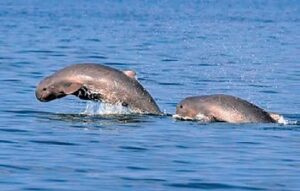
Scope and Phases of the Dolphin Survey:
- The Ministry of Environment, Forest and Climate Change (MoEFCC) has initiated the second nationwide dolphin estimation exercise, beginning from Bijnor in Uttar Pradesh. This survey adheres to strict environmental impact assessment guidelines.
- The survey is being conducted in two distinct phases to ensure comprehensive coverage of India’s major riverine and estuarine ecosystems, taking into account coastal regulation zone considerations.
- Phase One includes the main stem of the Ganga from Bijnor to Ganga Sagar, along with sections of the Indus River system. This phase will also assess the implementation of ex-post facto environmental measures in these regions.
- Phase Two will extend coverage to the Brahmaputra River, Ganga tributaries, the Sundarbans delta, and coastal river systems of Odisha. This phase will incorporate lessons from the Vanashakti judgment regarding environmental protection.
- The large spatial coverage reflects the government’s intent to adopt a landscape-level approach for aquatic species conservation, in line with the precautionary principle of environmental protection.
Objectives and Conservation Significance
- The survey aims to generate updated population estimates of key dolphin species found in Indian waters, while also assessing the effectiveness of retrospective environmental clearances in these habitats.
- Special focus has been placed on assessing the conservation status of the Indus River Dolphin and the Irrawaddy Dolphin, in addition to the Gangetic River Dolphin, considering the polluter pays principle in habitat restoration efforts.
- Apart from population counts, the survey will document habitat conditions, anthropogenic threats, and river health indicators, in accordance with the EIA Notification guidelines.
- The exercise will also record the presence of associated conservation-priority fauna, strengthening ecosystem-based management and supporting environmental democracy in conservation efforts.
- Data generated will feed directly into policy formulation, habitat restoration strategies, and improved implementation of Project Dolphin, ensuring alignment with environmental jurisprudence.
About Project Dolphin and Species Profile: |
| ● Project Dolphin: Launched in 2020, it focuses on the conservation of riverine and marine dolphins through habitat protection, scientific research, and community participation, adhering to principles of environmental jurisprudence. |
- Gangetic River Dolphin: ○ India’s National Aquatic Animal ○ Listed as Endangered by the IUCN ○ Indicator species for river ecosystem health
- Indus River Dolphin: Found in parts of the Indus basin, facing threats from water diversion and habitat fragmentation. Conservation efforts consider ex-post facto environmental measures.
- Irrawaddy Dolphin: Occurs in estuarine and coastal waters, sensitive to pollution and fishing activities. Protection strategies align with coastal regulation zone guidelines.
- Ecological Importance: Dolphins act as apex predators, helping maintain trophic balance and signalling the overall health of freshwater ecosystems. Their conservation is crucial for maintaining a pollution-free environment in river systems. |