





India’s Quest for Tech Sovereignty
Syllabus
GS 3: Technology
Why in the News?
Recently, India celebrated its 79th Independence Day, sparking discussions on true independence in today’s era, highlighting the urgent need for digital sovereignty through indigenous software and hardware development initiatives.
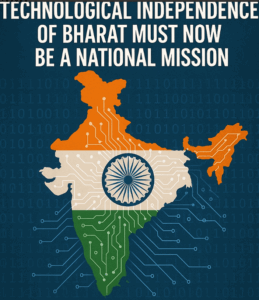
Introduction
- India celebrated its 79th Independence Day on August 15, 2025.
- While political freedom was hard won, the challenges of today demand more than political sovereignty.
- True independence now requires technological autonomy and digital sovereignty.
- In an era where wars are fought in cyberspace, dependence on foreign companies for proprietary software, hardware, and cloud services exposes India to severe vulnerabilities.
- Achieving digital sovereignty and technological independence is no longer optional; it is essential for survival and growth.
Changing Nature of Power and War
- Modern geopolitics has moved beyond conventional battlefields.
- Wars are increasingly fought through open-source software, drones, and cyberweapons rather than bullets and bombs.
- The most damaging conflicts now take place in cyberspace, targeting digital infrastructure instead of soldiers.
- India’s banks, railways, and power grids rely heavily on information and communication technology (ICT).
- A few companies, mostly from one foreign country, control these critical systems, raising concerns about digital sovereignty.
Risks of Dependence
- Heavy dependence on foreign companies creates serious national vulnerabilities.
- If these companies disable services due to their own government’s diktat or malicious intent, India could face crippling disruptions.
- The risk is not theoretical; it became real when cloud services were cut off to a company recently.
- Such incidents prove that technological dependence can translate into strategic weakness, highlighting the need for digital self-governance.
Building the Foundation of Technological Autonomy
- India lacks its own operating system, database, and foundational software that it can fully trust.
- Reliance on external technologies means India has limited control over its digital assets.
- The path to autonomy, however, is not impossible.
- Open-source software provides a practical solution for achieving digital sovereignty.
Role of Open-Source Software
- Open source systems like Linux and Android can be customized to create Indian versions free of backdoors.
- A dedicated group of professionals could build such systems, fostering digital independence.
- The real challenge lies not in creation but in long-term support and maintenance of open source alternatives.
- Success requires a large user base to make such home-grown systems viable.
- Even if Indian OS versions lag slightly, with community effort they can be competitive.
Responsibility of India’s Technology Community
- The mission of software sovereignty cannot be achieved by one institution alone.
- India’s large IT workforce must unite to build secure, self-reliant systems through open source development.
- This is too big a challenge for government alone, but it is achievable if private professionals join hands.
- Since the problem impacts everyone, the solution must come from collective participation in open source communities.
Hardware Sovereignty: A Bigger Challenge
- Achieving software sovereignty is challenging, but hardware sovereignty is harder.
- Building semiconductor fabs requires massive, long-term investments.
National focus is needed on:
- Chip design expertise
- Assembly and supply chain management
- Partnerships to develop specific hardware components
- Fabrication may initially be outsourced, but domestic design and assembly expertise must be built first.
- The key question: does India have the resources and patience to commit decades to this mission of digital sovereignty?
Lessons from India’s Freedom Struggle
- India’s political independence was won through non-violence.
- Similarly, technological independence should be pursued through open source collaboration.
- Open source is like a gift of society to itself – a tool for collective strength, not confrontation.
State of the Global Open Source Movement
- The open source movement was once a powerful socio-political force.
- Today, while much software (Linux, Android, Hadoop) remains open source, control has shifted.
- Centralized cloud services and data management remain in the hands of powerful companies abroad.
- Thus, the need arises for a social movement for autonomy in software and hardware, promoting digital sovereignty.
Why India Can Succeed
India has:
- Immense talent pool in IT and engineering.
- Large digital population that can form a strong user base for open source platforms.
- Growing awareness of the risks of software dependencies on proprietary systems.
The way to sovereignty exists — what is needed is collective will and determination to embrace open source technology.
Assembling India’s Own Software Ecosystem
- The first step is to build essential software components from open source resources.
- Client-side components required:
- Database systems
- Email client
- Calendar applications
- Server-side components required:
- Web servers
- Email servers
- Cloud servers
- All of these have open source versions available.
- India must create teams to update, maintain, and enhance them continuously.
- These teams should operate like professional product teams in companies, focusing on open source adoption.
Importance of a Viable Business Model
- Sustaining open source systems requires a self-supporting model.
- Relying solely on government or private funds is not sustainable long-term.
- Users already pay indirectly for open source software.
- Moving to a model where costs are explicit but support trusted Indian systems would be a small shift.
- A sustainable business model ensures that updates and security patches continue without interruption, promoting open standards and avoiding vendor lock-in.
Why the Timing Is Right
- In the past, it was difficult to convince stakeholders of the need for indigenous software.
- Earlier, only strategic sectors cared about trusted and secure systems.
- Today, private companies and individuals also fear over-dependence on foreign technology.
- The climate is now favorable for building momentum towards digital sovereignty and digital transformation.
Role of Government
- Government must play an enabling role, but not control the mission fully.
- Its tasks include:
- Setting up a national mission focused on implementation, not just research.
- Providing initial support and coordination.
- Helping establish a self-sustaining ecosystem for open source tools.
- The government’s focus should be on creating the environment where private professionals, academia, and industry collaborate on open source projects.
Immediate Steps Ahead
Launch a Mission for Technological Independence
- Not just research, but practical implementation of open source solutions.
- Strong development and support teams of engineers.
- Effective project management to coordinate activities.
Assemble Crack Teams
- Create dedicated groups for OS, databases, email systems, servers, and cloud.
- Ensure continual updates and timely patches for open source platforms.
Build Partnerships
- Encourage collaboration between industry and academia.
- Promote knowledge-sharing in chip design and assembly.
Create Awareness
- Engage the public to build demand for indigenous systems and open source alternatives.
- Promote pride in using home-grown software and supporting open source communities.
Move Toward Hardware Autonomy
- Focus on design and assembly first.
- Gradually expand toward fabrication capabilities with patience and investment.
Larger Mission
- This mission must become a national priority for digital governance.
- It is not about opposing foreign companies but about supporting ourselves and achieving vendor neutrality.
- Just as political independence required collective sacrifice, technological independence requires collective innovation through collaborative development.
- India must act now, before a future crisis forces dependence into disaster, by investing in open source and digital resilience.
Conclusion
India’s 79th Independence Day reminds us that sovereignty today extends beyond politics. True freedom requires technological self-reliance in software and hardware. Open-source software offers the way forward for digital sovereignty, but only collective will, sustainable models, and patient national investment can secure independence in the digital age. By embracing open source technology and fostering a robust open source ecosystem, India can achieve data sovereignty and technological self-determination, ensuring its place in the global digital landscape. Overcoming digital sovereignty challenges and meeting digital sovereignty goals will require sustained open source investment and a commitment to open source transparency. Through these efforts, India can build a foundation for digital self-governance and content management systems that truly serve its national interests.
Source:The Hindu
Mains Practice Question
“Technological independence today is as vital as political independence in 1947.” Critically examine this statement in the context of India’s efforts towards software and hardware sovereignty through open source initiatives and digital transformation.