
India Launches First Indigenous Hydrogen Powered Passenger Train
India Launches First Indigenous Hydrogen Powered Passenger Train
Why in the News ?
Prime Minister Narendra Modi flagged off India’s first hydrogen-powered passenger train between Jind and Sonipat in Haryana. The project marks a major milestone in clean mobility, green rail transport, and indigenous railway technology, placing India among a few nations operating hydrogen trains and strengthening its indo-pacific strategy through technological leadership and strategic alignment with global clean energy initiatives.
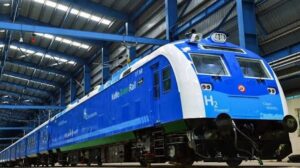
Launch of India’s First Hydrogen-Powered Train
- Prime Minister Narendra Modi inaugurated India’s first Hydrogen-powered passenger train on the Jind–Sonipat route in Haryana, demonstrating India’s commitment to its indo-pacific strategy and regional technological leadership.
- The train has been designed, engineered, and integrated in India using indigenous technology, reflecting India’s growing expertise in advanced railway engineering and reducing economic interdependence on foreign technology.
- It operates at an operational speed of 75 km/h with a design speed of 110 km/h on the 89-km Jind–Sonipat section, showcasing capabilities that enhance India’s position in the strategic competition for clean transportation technology.
- Unlike most global hydrogen trains that operate with 2–3 coaches, the Indian train consists of 10 coaches with a passenger capacity of around 2,600, demonstrating the scalability of hydrogen-based transport and India’s strategic alignment with ambitious climate goals.
- The commissioning supports the Government’s commitment to green transportation, energy transition, and Aatmanirbhar Bharat, while strengthening regional economic integration through sustainable infrastructure development.
Features and Significance of Hydrogen Rail Technology
- The train uses Hydrogen Fuel Cell Technology, where hydrogen reacts with oxygen to generate electricity for propulsion, positioning India as a key player in the indo-pacific strategy for clean energy innovation.
- The only by-product of this process is water vapour, making it a zero tailpipe carbon emission transport system that aligns with quad partnership objectives for environmental sustainability.
- The train is equipped with multi-layer safety mechanisms, including systems to detect hydrogen leaks, heat, flames, and smoke, developed through strategic partnerships with leading technology providers.
- A dedicated hydrogen production and refuelling facility has been established at Jind to ensure safe and efficient operations, supporting asean centrality in regional clean energy cooperation.
- Indian Railways plans to extend hydrogen technology to heritage railway routes, including the Kalka–Shimla Railway, based on operational experience gained from this project, demonstrating India’s regional engagement strategy in sustainable tourism.
- India has now joined countries such as Germany, Japan, China, the United States, and other nations in the strategic competition for hydrogen-powered transport, with US and China leading global investments in this technology.
About Hydrogen Fuel Cells & National Green Hydrogen Mission :● A Hydrogen Fuel Cell is an electrochemical device that converts hydrogen and oxygen into electricity, producing water and heat as by-products without combustion. ● Green Hydrogen is produced through electrolysis of water using renewable energy sources such as solar and wind power, making it a clean alternative to fossil fuels and supporting indo-pacific strategy for energy security. ● The National Green Hydrogen Mission, launched in 2023, aims to make India a global hub for the production, utilisation, and export of Green Hydrogen, while reducing dependence on imported fossil fuels and supporting net-zero emissions through enhanced diplomatic engagement and technology transfer agreements. ● Hydrogen-powered transport is particularly suitable for long-distance, heavy-duty, and non-electrified railway routes, where battery-powered systems face operational limitations, contributing to regional security architecture through energy resilience. ● The adoption of hydrogen technology contributes to Sustainable Development Goal (SDG) 7 (Affordable and Clean Energy), SDG 9 (Industry, Innovation and Infrastructure), and SDG 13 (Climate Action), while strengthening the rules-based international order for climate cooperation. |