
Govt Plans Equivalence in OBC Creamy Layer Norms
Why in the News ?
The Government is working on a proposal to ensure uniformity in creamy layer criteria for OBCs across central/state jobs, PSUs, and universities. This aims to remove anomalies and correct inequities in quota benefits, after consultations with NITI Aayog and NCBC.
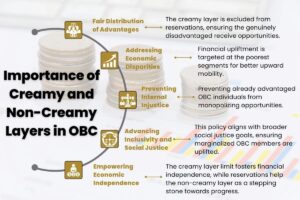
Current Proposal for Equivalence:
- Objective: Establish equivalence across posts in central/state organisations, PSUs, universities, and statutory bodies to uniformly apply creamy layer norms.
- University Teachers: Children of teachers from Assistant Professor level onwards (Level 10, Group A equivalent) may be placed in creamy layer.
- Non-Teaching Staff: To be categorised based on their group/level/pay scale.
- State PSUs: All executive-level positions to be treated as creamy layer, similar to central PSUs (since 2017).
- Exception: Executives with annual income within ₹8 lakh ceiling (for private sector) will not be classified as creamy layer.
- Government-aided institutions: To follow equivalence with central/state posts regarding service conditions and pay.
Issues, Anomalies & Implications
- Problem: Non-uniform rules across sectors led to anomalies (e.g., university teachers’ children got OBC quota, but similarly ranked aided-institution employees’ children did not).
- UPSC Case: Between 2015–2023 CSE batches, DoPT rejected caste certificates of 100+ candidates due to unclear equivalence rules.
- 2004 Clarification: Tried to bring consistency but was not widely implemented.
- Example: Children of fuel station worker in state PSU declared creamy layer on income basis, creating unfairness.
- Proposal Impact: Will benefit lower-level government employees’ children with salaries above ₹8 lakh, correcting current distortions.
- Private Sector: Equivalence difficult; creamy layer determined only via income/wealth test.
- Future Step: Home Ministry & NCBC recommend retrospective implementation so rejected candidates also benefit.
Creamy Layer Concept:● Origin: Derived from Indra Sawhney vs Union of India (1992), where SC upheld Mandal Commission recommendations but excluded “affluent” OBCs. ● Definition: Affluent members among OBCs (creamy layer) are excluded from reservation benefits. ● 1993 DoPT Circular: Listed sons/daughters of high constitutional functionaries, senior govt/PSU/armed forces officers, professionals, wealthy property owners, and those above income/wealth test. ● Income Ceiling: Initially ₹1 lakh (1993); revised in 2004, 2008, 2013, 2017 → currently ₹8 lakh per annum. ● Exemptions: Income from salary and agricultural land is excluded from calculation. ● Group A/Class I Rule: Children of direct recruits or early promoted Group A officers automatically in creamy layer. |